TL;DR
- Customer experience has no natural owner in a B2B organization. By default it fragments: sales owns acquisition, marketing owns messaging, customer success owns retention, and nobody owns the seams between them.
- 90% of B2B leaders call customer experience crucial to their business, yet 72% say they have no real control over the direction of their organization's CX programme (Accenture, cited in CustomerGauge, 2026). That gap is a governance failure, not a budget one.
- Forrester expects budget pressure to pull 15% of CX teams into a death spiral of metric production during 2026. The teams that go are rarely the ones with bad data. They are the ones with no decision rights.
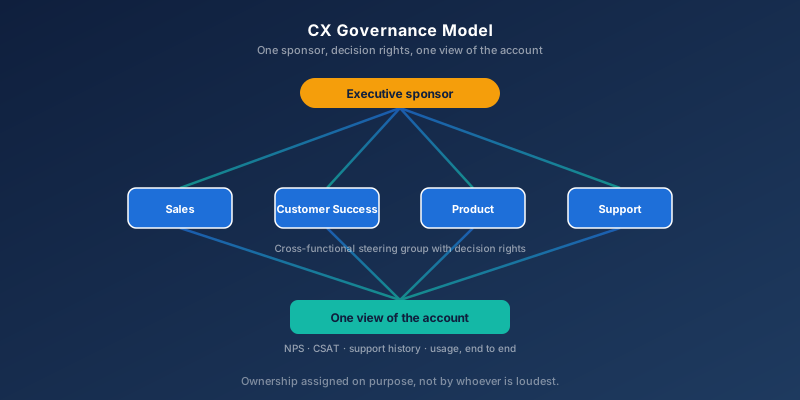
- A minimal governance model needs three things: a named executive sponsor, a small cross-functional group with actual decision rights, and one place where account signals live end to end.
- The newest ownership gap is not between two departments. It is over what an AI agent is allowed to say to a customer: 44% of companies have a measurement framework in place for generative AI, and only 31% for agentic AI (Adobe, 2026 AI and Digital Trends).
Contents8 sections
Who Owns Customer Experience in a B2B Company?
Nobody, by default. That is the uncomfortable answer, and it is also the most common state of affairs in mid-market B2B. Sales owns the deal until signature. Marketing owns the message. Customer success owns the relationship after go-live, until it doesn't, usually when a renewal risk needs an escalation nobody quite knows how to route. Customer experience, as a coherent whole, belongs to none of them, because each function is measured on its own slice of the journey and rewarded for optimizing that slice, not the seams between them.
This is not a staffing problem you fix by hiring a Chief Customer Officer. It is a decision-rights problem. Ownership has to be assigned on purpose, with a name attached, or it reverts to whichever team has the loudest voice in the room when an account is on fire.
The B2B CX Gap: Why "Everyone Cares" Is Not the Same as "Someone Owns It"
Ask any B2B leadership team whether customer experience matters, and the answer is yes, unanimously. Accenture's research on B2B leaders found that 90% consider customer experience crucial to their company's business priorities. The same research found something far less comfortable directly alongside it: 72% of those same leaders say they have no real control over the direction of their organization's customer experience programme (Accenture, cited in CustomerGauge, 2026). CustomerGauge calls this the B2B CX Gap, and it is the right name for it. Belief in CX and authority over CX are two different things, and most companies only have the first one.
Here is the contrarian part: this gap is rarely caused by a shortage of tools or budget. It is caused by an organization deciding, without ever explicitly deciding, that CX would be everyone's job and therefore nobody's job in particular. It also shows up in the definition itself: without an owner, no two departments agree on what a good customer experience is supposed to look like for the same account. A company that spends heavily on a feedback platform while leaving governance undefined has bought a very expensive way to measure a problem it has not assigned anyone to fix.
2026 has given that argument a harder edge. Forrester's Predictions 2026 for customer experience expects budget pressure to lure 15% of CX teams into a death spiral by feeding metrics obsession: a questioned team responds by producing more numbers, which makes it look more like a reporting function, which makes it easier to cut. Forrester's analysts describe companies renaming, restructuring and quietly dissolving CX teams outright, and predict a two-thirds drop in the use of journey mapping as a practice.
Read that as a governance finding rather than a survival warning. A team that only reports numbers can be replaced by a dashboard, and increasingly is. A team that decides what happens to an account when the numbers move cannot. The difference is not competence or tooling. It is whether anyone ever wrote down that this group gets to decide. If the honest answer to "what did your CX function decide last quarter" is a list of reports, the governance work has not been done, and no amount of additional measurement will do it for you. That is also the shortest route to defending the budget: the business case linking customer satisfaction and revenue is built out of decisions and their consequences, not out of response rates.
Where Should CX Report? Four Common Homes and Their Trade-offs
Forrester's Judy Weader, after surveying CX leaders across companies about where the function should sit, gives an answer that frustrates anyone hoping for a formula: it depends on the kind of company, the internal politics, and where the CEO's attention naturally goes. The same survey found that CX teams most commonly live inside customer support/service or IT, while only 7% report into marketing and 8% into customer success, and that the CX leader most often reports directly to the CEO.
That distribution reflects B2C-heavy survey data more than B2B specifically, but the underlying lesson transfers directly: there is no default-correct department, and B2B companies that copy whichever structure a competitor uses tend to inherit that competitor's blind spots along with it. What matters is matching the home to what the company actually needs governed.
| Where CX sits | What it is good at | What it tends to miss | Best fit when |
|---|---|---|---|
| Sales | Fast feedback on deal-stage friction, tight loop to revenue | Retention and post-sale experience get deprioritized once the contract is signed | Long, complex sales cycles where the buying experience itself is the differentiator |
| Marketing | Brand-level consistency, top-of-funnel measurement | Rarely has authority over product or support decisions that actually fix root causes | Companies where CX is still mostly a research and positioning function |
| Customer Success | Closest to the account, owns the renewal conversation, natural home for account-based CX | Can under-invest in acquisition-stage experience and struggles to influence product roadmap | Subscription and services businesses where retention is the primary growth lever |
| Dedicated CX / Customer Office | Cross-functional authority by design, single point of accountability | Needs real executive backing or it becomes a reporting function with no teeth | Companies with more than a handful of departments touching the same accounts |
For most mid-market B2B companies with under a few hundred active accounts, Customer Success is the pragmatic default home, precisely because it already owns the account relationship that account-based CX depends on. A dedicated Customer Office only earns its cost once the company is large enough that CS, sales, product and support genuinely cannot agree without a referee.
The table above answers where the function sits. A second question decides how much it can actually do: whether governance is centralized, federated or embedded. Centralized means one CX owner sets strategy, metrics and priorities for everyone. Federated means a small centre defines the standard, question wording, scale, cadence and what counts as a Detractor, while each business unit runs its own programme against it. Embedded means each unit owns CX outright and the centre only aggregates. For mid-market B2B, federated is usually the honest answer, and the split is worth writing down rather than letting it emerge: the centre owns comparability, the unit owns action. Groups running several business units or countries hit this first, and Voice of Customer across business units covers where that line belongs.
What a Minimal CX Operating Model Actually Looks Like
Skip the org chart debate for a moment. A CX operating model that actually functions needs three components, not a department:
- A named executive sponsor. Not a committee, one person, ideally someone who sits in the room where product and commercial trade-offs get made. Their job is not to run the CX programme day to day. It is to break ties when departments disagree and to protect the programme's budget when it competes with something flashier, which is a great deal easier when the programme can show its return; customer satisfaction and revenue is how you prove that to the rest of the leadership team.
- A small cross-functional steering group with actual decision rights. Representatives from sales, customer success, product and support, meeting on a fixed cadence, with the explicit authority to decide what gets fixed first. A group that only reviews dashboards is not governance. It is a meeting. Service metrics are where this bites first: CSAT, CES and First Contact Resolution get reported everywhere and owned nowhere, which is why delivering great customer service depends on someone having named accountability for those numbers slipping.
- One place where account signals live end to end. NPS, CSAT, support history, and usage data for a given account need to be visible in the same view, not scattered across four tools nobody cross-references. This is the same infrastructure a customer health score is built on, and if you already have one, governance is largely a matter of deciding who is accountable for acting on what it shows.
Nordika A/S, a fictional mid-market logistics company with around 60 named accounts, illustrates the failure mode well: its NPS surveys, support tickets and account plans lived in three different systems, owned by three different managers, none of whom reported to the same person below the CEO. Every Detractor recovery took a week longer than it should have, not because nobody cared, but because nobody had been given the authority to just decide.
Who Owns the Customer Experience an AI Agent Delivers?
There is a newer version of the ownership question, and most B2B companies have not answered it. An AI agent that resolves a support ticket, chases a stalled onboarding step or answers a pricing question is delivering customer experience. It does so at a volume no human team reviews line by line, and in most companies it belongs to nobody in particular. Support deployed it. IT integrated it. Product owns the roadmap it sits on. Nobody has signed off on what it is allowed to promise a customer worth six figures a year.
The data says the gap is real rather than theoretical. Adobe's 2026 AI and Digital Trends research, based on 3,000 executives and CX practitioners plus 4,000 consumers, found that 44% of companies have a measurement framework in place for generative AI, but only 31% have one for agentic AI. Roughly a third say executives and practitioners are misaligned on AI strategy, 47% describe the alignment as only partial, and 61% put that down to executives not understanding what the technology actually does. Adoption is not the missing piece: 16% already have agentic AI embedded in customer support. Accountability is.
The regulatory calendar will not settle it either, which is the part Nordic leadership teams tend to have backwards. The EU's Digital Omnibus on AI entered into force on 27 July 2026 and moved the AI Act's high-risk obligations for stand-alone Annex III systems from 2 August 2026 out to 2 December 2027. What it did not move is Article 50: the transparency duties, including telling a person they are dealing with an AI system, applied from 2 August 2026 as originally scheduled. So the disclosure obligation is live now, the heavier conformity work sits sixteen months further out, and everything in between is yours to assign. A deferred deadline is not a governance decision. Our guide to GDPR and customer feedback in B2B covers the data side of the same question, and AI agents for customer satisfaction covers what these agents are actually good at.
Four decisions are worth naming in writing before the next agent goes live:
| Decision | Who should own it | What breaks without an owner |
|---|---|---|
| What the agent may commit to: credits, dates, scope, price | Customer success, with sales sign-off on commercial limits | Agents promise things the delivery organization never agreed to, and the account owner hears it from the customer |
| When the agent must escalate to a named human | The account owner for that account | A high-value account gets an automated answer at the exact moment it needed a person, which is how a Detractor is made |
| Whether the agent's conversations feed the feedback programme | Whoever owns CX measurement | The richest source of verbatim signal in the company stays in a support tool nobody analyses |
| Who answers for a wrong or non-compliant answer | The named executive sponsor | The question gets settled during the incident, in front of the customer |
The pattern is the same as the human one. Ownership that has not been assigned on purpose defaults to whoever is standing closest when it goes wrong. It is also why buying analysis rarely fixes it: adding AI text analytics to your customer feedback on top of an unowned process produces faster, better-organized neglect, not action.
- Generative AI44%
- Agentic AI31%
The Governance Question That Actually Matters
Here is the scenario that exposes whether a company has real CX governance or just a CX dashboard: an account scores as a Detractor two weeks before its renewal conversation, and the sales team wants to push an upsell anyway because the pipeline number needs it this quarter.
Without governance, this gets resolved by whoever has more organizational leverage that week, which is a coin flip dressed up as a decision. With governance, there is a predetermined answer: a documented detractor recovery process takes precedence over an upsell push, the account owner has explicit authority to pause commercial asks until the relationship is stabilized, and everyone up the chain already agreed to this before the account in question ever went red. The rule existing in writing, before the crisis, is the entire point.
The same logic applies to acting on key driver analysis findings. A driver analysis that identifies onboarding speed as the top lever on NPS is worthless if no one has the standing authority to reprioritize an onboarding engineering ticket over a feature request from sales. Analysis without decision rights is an expensive way to confirm what everyone already suspected.
How CX Maturity Changes Who Should Own It
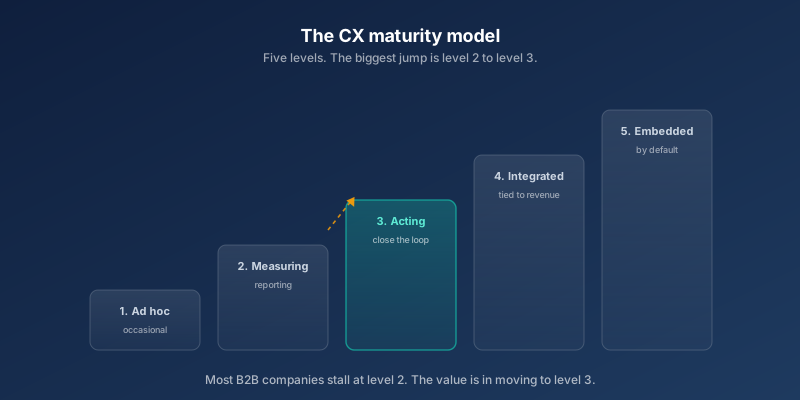
Governance needs are not static. A company at the early stages of the CX maturity model needs a strong, visible, single-throated owner, because without one, a young programme dies from lack of a champion the first time budget gets tight. A company further along the maturity curve, where feedback loops are embedded into normal account management rather than run as a separate initiative, can tolerate more distributed ownership, because the muscle memory of acting on signals is already there.
The mistake we see most often is a company borrowing the governance model of a much more mature organization: a distributed, consensus-driven structure with no single accountable owner, applied to a programme that is only eighteen months old and still needs someone to fight for it in every budget cycle.
Where SurveyGauge Fits
We do not just hand a mid-market B2B company a survey tool and wish them luck on the governance question. Deciding who owns what, and what happens when two departments disagree about an account, is advisory work, and it is the part of a CX programme most vendors quietly skip because it does not show up in a product demo. That is the difference between a tool and a partner.
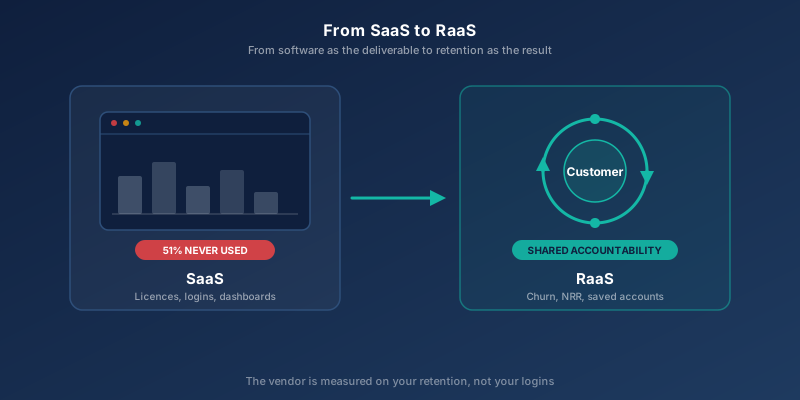
It is also why we describe what we sell as retention as a service rather than a licence. When the vendor's own success is measured on your churn number, the vendor has a reason to care who is allowed to decide, not just whether the survey went out on time.
SurveyGauge helps Nordic B2B companies build the operating model around the data, not just collect the data. Get a Free Demo or see pricing.
Frequently asked questions
Who should own customer experience in a B2B company?
There is no universally correct department. For most mid-market B2B companies, Customer Success is the pragmatic default because it already owns the account relationship, but ownership only becomes real once a named executive sponsor and a cross-functional group with actual decision rights exist alongside it.
What department should CX report to?
It depends on company size, sales motion and internal politics more than any formula. Research on CX teams across industries found the function most often sits in customer support/service or IT, with only 7% reporting into marketing and 8% into customer success, and the CX leader typically reporting directly to the CEO regardless of which department houses the team.
What is a CX operating model?
A CX operating model is the combination of a named executive sponsor, a cross-functional steering group with real authority to prioritize fixes, and a single system where account-level feedback and usage signals are visible together. It is the structure that turns feedback data into decisions, rather than a department on an org chart.
What is CX governance?
CX governance is the set of rules, roles and decision rights that determine who acts on customer feedback, in what order, and who has final say when departments disagree about an account. It is separate from CX measurement: a company can have excellent NPS data and zero governance, which is exactly the B2B CX Gap that Accenture's research describes.
Who owns the customer experience an AI agent delivers?
In most companies, nobody, which is the problem. An AI agent answering a customer is delivering customer experience, so the same decision rights apply: what it may commit to, when it must escalate to a named human, and who answers for a wrong answer. Adobe's 2026 research found only 31% of companies have a measurement framework in place for agentic AI, against 44% for generative AI, so the accountability gap is wider than the adoption gap.
Do we need a dedicated CX team, or can ownership be distributed across departments?
Distributed ownership works once a company has enough maturity that acting on feedback is a normal part of how sales, customer success and product already operate. Early in a programme's life, distributed ownership without a single accountable sponsor usually means nobody defends the budget when it is questioned, and the programme quietly dies.
Who should decide when sales and customer success disagree about an account?
The cross-functional steering group, guided by a rule agreed before the disagreement happens, not negotiated in the moment. A documented process, such as pausing commercial asks on a Detractor account until recovery steps are complete, removes the need to relitigate the same argument every time it comes up.

Written by
SurveyGauge Team
The advisors and developers behind SurveyGauge. We run customer satisfaction programmes for B2B companies, from 20 key accounts to global banks.