
What Is a Good Customer Experience? The Key Drivers in B2B [2026]
What is a good customer experience in B2B? A concrete definition, the six drivers that determine it, why buying committees make "good" relative, and a model for building and measuring it systematically.
![What Is a Good Customer Experience? The Key Drivers in B2B [2026]](/img/knowledge/good-cx.svg)
- A good customer experience is one where the customer consistently gets their need met with minimal friction and a sense of being understood, across the entire relationship.
- It is best defined through the six pillars: personalisation, integrity, expectations, resolution, time and effort, and empathy.
- In B2B the experience is not one meeting but the sum of many touchpoints over a long relationship. A single weak pillar can define the overall impression.
- A good experience is not the average of your touchpoints. It is the worst one, because that is the one the buying committee remembers and retells at renewal.
- You build a good experience by mapping the customer journey, listening systematically through Voice of Customer, and acting on what you hear.
Contents7 sections
What is a good customer experience?
A good customer experience is one where the customer consistently gets their need met with minimal friction and a sense of being understood, across the entire relationship rather than at a single moment. It is reliable, low-friction and personal. In B2B it is not one impressive moment but the sum of many touchpoints over a long relationship: first contact, onboarding, support and renewal.
Put simply, a good experience is rarely a "wow". It is the absence of friction combined with a consistent feeling of being in good hands.
Customer experience is not the same as satisfaction
It is worth separating the two terms, because they are often conflated. The customer experience (CX) is what the customer actually encounters. Customer satisfaction is the measurement of how well that experience met expectations. Read more about what customer satisfaction is if you want to go deeper on the measurement side.
In other words, the experience is the thing, and satisfaction is the thermometer. You can have high satisfaction with your support and still lose the customer if onboarding was a disaster. Optimising a single touchpoint is no use if the whole falls short.
The six pillars: a framework for a good experience
The abstract idea of a "good customer experience" becomes concrete once you break it into drivers. A well-tested framework is the six pillars of customer experience:
- Personalisation: Is the customer treated as a known partner rather than a case number?
- Integrity: Can the customer trust you? Do you deliver on your promises, every time?
- Expectations: Do you set clear expectations, and do you meet them?
- Resolution: When something goes wrong, is it made right, and fast?
- Time and effort: How easy is it to work with you? Every extra hurdle counts.
- Empathy: Does the customer feel understood, on a human level too?
The point of the framework is that it makes the experience measurable and actionable. Instead of asking "do we have a good experience?", you can ask "which pillar is our weakest, and what is it costing us?". Knowing which pillar to fix is one thing; deciding who in the organization owns fixing it is a separate question, and often the harder one, which is where CX governance comes in.
Why B2B is different
A good customer experience in B2B differs from B2C in four decisive ways.
It is collective. With a B2B customer, several people are involved: the decision-maker, the day-to-day user, finance. The experience has to be good for all of them, and they carry different weight.
It is long-lived. The relationship spans years, not minutes. Consistency over time matters more than a single good meeting. Reliability beats surprise.
It is high-stakes. Contract values are large and switching costs high. That makes both good and bad experiences more costly in consequence. A poor experience can cost you an account ten times the size of a typical B2C customer.
It is asymmetric. Over a relationship spanning years, an account's own account of "how we experience you" is rarely the average of every touchpoint. It is the worst one, retold to the buying committee at renewal time. A supplier can have 94% of accounts reporting satisfaction and still lose two of its most important ones over a single mishandled incident, exactly the pattern behind why satisfied customers still walk.
Does "good" mean the same thing to everyone in the buying group?
Usually not, and that mismatch is where a lot of B2B CX programmes quietly go wrong. A typical B2B buying committee has six to ten stakeholders (Gartner), and the people who chose you are rarely the same people who use you every day. The economic buyer who signed the contract judges the experience by outcomes: did the numbers move, did the project land on time. The day-to-day user judges it by friction: how many times this month did they have to explain the same problem again.
A supplier can score well with the champion who negotiated the deal and quietly lose the ten people who are actually logged in every week. Measuring only the signer's opinion means measuring the wrong half of the relationship, and it is exactly the blind spot account-based CX exists to close: weight feedback by who actually uses the product and how much the account is worth, not just by who signed for it.
| Stakeholder | What a good experience looks like to them | What a warning sign looks like |
|---|---|---|
| Economic buyer | Contracted value shows up, renewal is a formality | Surprises at renewal, no clear line to ROI |
| Day-to-day user | Low friction, fast resolution, feels heard | Repeating the same issue, no visible follow-up |
| Executive sponsor | A story to tell their own leadership | Silence between QBRs, no proof points to report upward |
Examples: what does it look like in practice?
To make it concrete, here is what the pillars look like day to day at a fictional B2B supplier, Nordika A/S:
- Reliability: Deliveries arrive on the agreed date, and when something slips, the customer is told up front, not after the fact.
- Low effort: The customer does not have to repeat their case for the third time. Context follows them, no matter who they talk to.
- Resolution: A fault is seen through by a named person who comes back with a solution and an explanation.
- Empathy: The point of contact knows the customer's business well enough to understand why a given fault hurts right now.
It is rarely about grand gestures. It is the small things, done right, every time.
How to build and measure a good customer experience
A good experience does not happen by accident. It is designed, measured and improved systematically. How systematically you do this is exactly what a CX maturity model measures, from occasional surveys to feedback that shapes daily decisions.
- Map the customer journey. Use customer journey mapping to find the touchpoints that matter most, and the ones where friction is highest.
- Listen systematically. Establish a Voice of Customer program that gathers feedback from surveys, support and conversations in one place.
- Measure what matters. Combine relationship-level NPS with CSAT and CES on the most important touchpoints. Layer in a customer health score to catch account-level risk before it becomes churn, and a key driver analysis to see which pillar actually moves the needle.
- Prioritise and act. Find the recurring themes, prioritise the improvements that affect the most customers, and close the loop so customers see their input leading to change.
In other words, a good customer experience is not an ambition on a slide. It is the result of listening, prioritising and acting, again and again.
Frequently Asked Questions
Ready to know what your customers actually think?
SurveyGauge helps Nordic B2B companies move from gut feeling to data-driven CX decisions.
SurveyGauge Team
Customer Experience Experts
SurveyGauge-teamet hjælper virksomheder med at måle og forbedre kundetilfredshed via professionelle surveys, analyser og rådgivning.
You might also be interested in
View all articles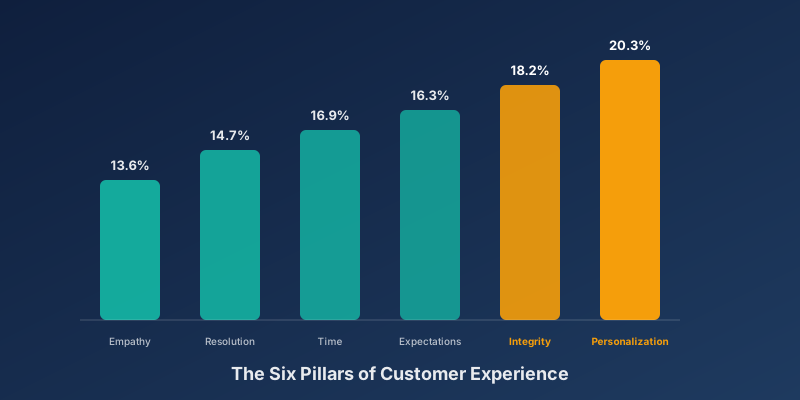
The 6 Pillars of Customer Experience: What Drives Loyalty and NPS
KPMG's Customer Experience Excellence report identifies six universal drivers behind NPS and loyalty, weighted from 80,594 interviews. Integrity and Personalization combined drive 39% of loyalty, and B2B buying committees make Personalization structurally harder than in B2C.
![What Is Customer Satisfaction? The Complete B2B Guide [2026]](/img/knowledge/customer-satisfaction.svg)
What Is Customer Satisfaction? The Complete B2B Guide [2026]
Every company says they care about customer satisfaction. Yet few can define it, measure it properly, or connect it to revenue. Here is how to do all three.
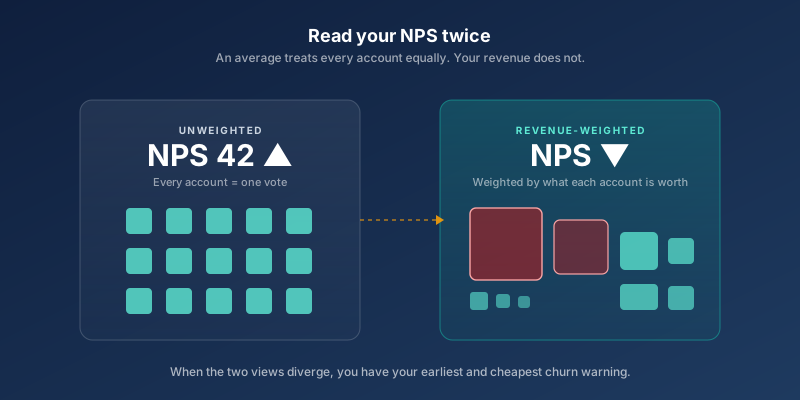
Account-Based CX: Run Your Feedback Programme on the Accounts That Pay the Bills
In most B2B companies a small share of accounts carries most of the revenue, yet every account gets the same survey and the same weight in the score. Account-based CX fixes that mismatch: weight feedback by account value, survey the whole buying group, and tier your follow-up.
![Voice of Customer (VoC): The Complete B2B Guide [2026]](/img/knowledge/voc.svg)
Voice of Customer (VoC): The Complete B2B Guide [2026]
Most VoC programmes do not die from bad technology. They die from the action nobody owns. Here is how to build one that connects feedback to account value and revenue, not just a dashboard.
![What Is Customer Journey Mapping? The Complete Guide [2026]](/img/knowledge/customer-journey.svg)
What Is Customer Journey Mapping? The Complete Guide [2026]
Customer journey mapping turns scattered customer data into one clear view of the end-to-end experience. Here is a persona-first guide to building one in 2026, and why most maps never change anything.