TL;DR
- A **Customer Health Score** aggregates usage, engagement, sentiment and payment into a single number that tells you whether an account is healthy, at risk, or on its way out.
- Leading indicators like **login frequency and feature adoption** predict churn better than lagging indicators like NPS and renewal rate. You need both, but start with the leading ones.
- The goal is **60-90 days of lead time**. That is the window where Customer Success can still save the account before the decision has been made.
- A score without a workflow that reacts to red flags is just a dashboard. Coupling it to [close the loop](/knowledge/blog/close-the-loop) is what makes the difference.
Contents10 sections
Why Existing Metrics Are Not Enough
You can tell when a customer is slipping away. Logins have dropped. Support tickets have a sharper tone. The power user has stopped replying to your emails. But the first official signal you get is a cancellation in your CRM, 60 days later.
The problem is that most organisations measure customer health using lagging indicators, NPS, renewal rate, support CSAT. By the time those move, the decision has usually already been made.
Customer Health Score is the answer to that problem. It combines leading and lagging indicators into a single number that tells you whether an account is in good shape, at risk, or on its way out. The goal is 60-90 days of lead time, the window where you can still act.
What Is a Customer Health Score?
A Customer Health Score is a composite number (typically 0-100 or a colour like green/yellow/red) that aggregates several data signals about the customer's relationship with you. In isolation it means nothing. It is only useful as a trigger for action. Because it lives at account level by design, it is a natural part of account-based CX: running your whole feedback programme around the account rather than the individual respondent. The account-level understanding it builds is also the raw material for genuine personalization, which KPMG's benchmark puts ahead of every other driver of loyalty.
Three levels:
- Green (healthy): The customer is using the product, NPS is positive, support is quiet. Focus on upsell and referrals.
- Yellow (at risk): Unusual patterns, declining usage, more tickets, neutral NPS. Proactive outreach from Customer Success.
- Red (critical): The score indicates high churn probability. Escalated to account management and possibly leadership.
These are triggers, not reports. A red customer should fire a workflow the same day, not end up in a quarterly dashboard.
Leading vs. Lagging Indicators
The biggest mistake in most Health Score models is overweighting lagging indicators. You end up with a model that predicts what you already know.
| Type | Examples | Strength | Weakness |
|---|---|---|---|
| Leading | Login frequency, feature adoption, admin activity | Predicts churn 60-90 days ahead | Requires product data, context-dependent |
| Lagging | NPS, renewal rate, CSAT | Easy to collect, industry benchmarks exist | Only moves after the decision has been made |
A good model blends both, weighted toward leading indicators for prediction. Research from Gainsight, ChurnZero and others consistently shows that usage behaviour is the single strongest predictor of B2B SaaS churn.
The Five Dimensions of a Typical Health Score
Most models cover five dimensions. You do not need all five from day one, but you should have at least three.
- Health Score
- Product usage30-40% weight
- Sentiment20-25% weight
- Engagement15-20% weight
- Support10-15% weight
- Commercials10-15% weight
1. Product usage (weight: 30-40%)
The strongest predictor. What do you track?
- Login frequency: Daily/weekly active users per account
- Feature adoption: How broad is usage across the product's core features?
- Depth: Time in product, number of actions per session
- Admin activity: Is the customer creating new users? Configuring? That is the engagement signal.
Warning signs: -30% MoM drop in DAU, admin-level inactivity for 14+ days, no new users created in a quarter.
2. Engagement (weight: 15-20%)
Interaction with you outside the product.
- Email open/click rates: If these fall, mindshare falls
- Event attendance: Webinars, training modules
- Community activity: Where relevant
- Survey response rate: Silent customers are often a bad sign
The earliest engagement signal you get is from onboarding itself. A B2B onboarding survey that measures effort and first value gives you a health signal weeks before login data or NPS would show the same account slipping.
3. Sentiment (weight: 20-25%)
What is the customer saying?
- NPS and transactional CSAT: See what is NPS and what is CSAT
- Sentiment in open text responses: see analyzing open-ended responses
- Tone in emails and support conversations
- QBR attendance and feedback: In the enterprise segment
4. Support (weight: 10-15%)
Not just volume, but patterns.
- Number of open critical tickets
- Average resolution time for the customer's tickets
- Tickets per month trend: A 50%+ increase over three months is a flag
- Escalations to management
5. Commercials and contract (weight: 10-15%)
- Payment history: Delays, failed charges
- Contract length: Shorter terms = higher flight risk
- Seat utilisation: Is the customer paying for licences that are not used?
- Historical upsell/downgrade
How to Build Your First Health Score in 6 Steps
1. Define what "healthy" means for your product
Get Customer Success in a room for two hours. Ask them to describe their 10 healthiest and 10 least healthy customers. What are the common traits? That becomes the backbone of your signals.
2. Pick 3-5 starter signals
Begin with the smallest set that makes sense. For B2B SaaS that is typically: MAU per account, feature adoption, NPS, open support tickets, paid on time. Your customer journey map is a good source of candidates: the stages where customers stall are the signals worth scoring first.
Add complexity later once the basic model runs.
3. Define scoring per signal
Each signal is scored 0-100. Example for login frequency:
0-30:  no logins in the last 14 days
31-60: 1-3 logins in the last 14 days
61-85: 4-10 logins in the last 14 days
86-100: 11+ logins in the last 14 days
Adjust the thresholds to your product. A B2B integration used once a month should not be judged like a daily-use SaaS.
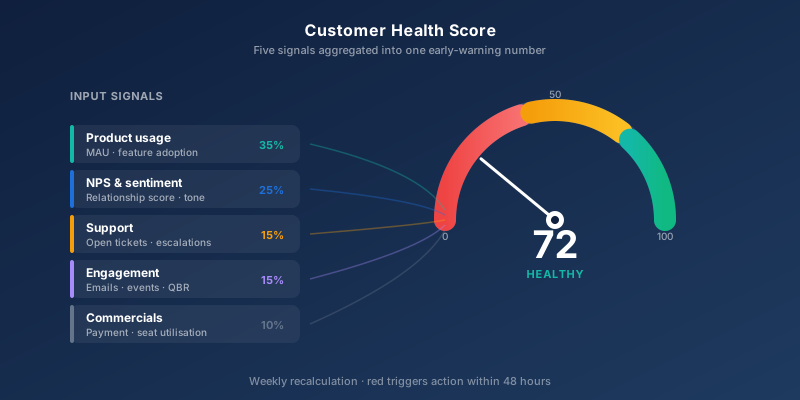
4. Choose weights: start heuristic
Begin with heuristic weights based on CS team experience:
- Usage: 35%
- NPS/Sentiment: 25%
- Support: 15%
- Engagement: 15%
- Commercials: 10%
These are starting points, not truths. Adjust after 6 months once you have data.
5. Set thresholds for green/yellow/red
Rule of thumb for B2B SaaS:
| Colour | Score | Action |
|---|---|---|
| Green | 70-100 | Standard contact, explore upsell |
| Yellow | 50-69 | Proactive outreach within 7 days |
| Red | 0-49 | Escalated CS effort, plan within 48 hours |
Thresholds have to be calibrated to your actual dataset. A score of 60 can be "yellow" at your company and "red" elsewhere.
6. Build the workflow that reacts
The score is meaningless if nothing happens when it turns red. Concretely:
- Green customer drops to yellow: Automatic notification to the CSM, task created in the CRM, outreach within 7 days.
- Yellow customer drops to red: Escalated to Head of CS, executive sponsor contacted, structured close-the-loop conversation within 48 hours. For the detailed recovery process, see Detractor Recovery.
- Red customer does not stabilise within 30 days: Win-back plan or deliberate offboarding. For the full playbook on what to do from here, see these seven churn-reduction strategies.
When the score drops and the trigger fires, see the full closing-the-loop playbook for the 48-hour SLA, the segment workflows, and the escalation rules behind that conversation. Some of this reacting can now run itself: see AI agents for customer satisfaction for how an agent can read the red flag, pull the account's context and open the CSM's task in the same minute the score drops, instead of waiting for the weekly review.
A Real-World Example
A B2B SaaS company we worked with had 14% annual churn. They had no visibility into which customers were at risk before the cancellation hit. We built a simple Health Score with five signals:
| Signal | Weight | Measurement |
|---|---|---|
| MAU per account | 35% | % of seats active in the last 30 days |
| Feature adoption | 15% | Number of core features used in the last 90 days |
| NPS | 25% | Most recent relationship score |
| Open critical tickets | 15% | Tickets with P1/P2 > 7 days old |
| Paid on time | 10% | % of the last 6 invoices paid without a reminder |
After three months of calibration the model caught 74% of the customers who churned in the following 6 months, with 60-90 days of lead time. The CS team reached out proactively to every red customer. After 12 months, churn had fallen to 9%.
Not because of the score. Because of the workflow the score triggered.
- Annual churn-5%Before14%After 12 months9%
Why Most Health Scores Fail to Predict Churn
The example above is not the norm. According to ChurnZero's 2025 Customer Revenue Leadership Study, a survey of 793 senior post-sales and customer growth leaders run in partnership with 6sense, Customer Success MeetUp, Pavilion and Success Venture Partners, 73% said their health score does not reliably predict churn.
The study's own explanation is not "not enough data." It is closer to the opposite. The missing input is qualitative: the customer's own account of how things are going, the kind of signal a spreadsheet full of login counts cannot capture. A model built mainly on product telemetry answers "is this account using the product less," when the real question is "does this account still see the value it is paying for." Those two questions diverge more often than most CS teams assume.
This is exactly why Sentiment carries a real weight (20-25%) in the five-dimension model above, not a token 5%. Teams that strip it down to "usage plus renewal date," because sentiment data is messier to collect than a login count, are rebuilding the majority-fail model the study describes. The real-world example above put NPS at 25% of the score on purpose. It is the direction, not the coincidence, that explains why the model caught 74% of churners with 60-90 days of lead time.
CustomerGauge's answer to the same problem, launched in June 2026, is to stop treating sentiment as something only survey respondents can supply. Its Signal Intelligence Agents derive NPS, CSAT and CES scores directly from operational data, call transcripts, emails, support tickets, QBR notes, the same shift already underway in AI text analytics for customer feedback, so an account gets a sentiment score whether or not it ever opens a survey link. The company states the problem bluntly: average B2B survey response rates sit between 2% and 20%, which means an account's largest, most strategically important customers are often exactly the ones a survey-only sentiment score never reaches. When the survey-based score and the operationally derived score disagree, that gap is itself the signal, and it tends to surface risk before either number does alone.
You do not need Signal Intelligence, or any specific vendor, to apply the underlying lesson. If sentiment in your health score depends entirely on customers who choose to answer a survey, you have built the kind of score that fails 73% of the time. Widen the sentiment input, support tickets, QBR notes, even a CSM's own call summary, before you add another usage metric.
Common Pitfalls
Too many signals from the start. 20 signals sounds precise. It becomes practically impossible to explain why a customer is red. Start with 3-5.
Only lagging indicators. If your model is primarily built on NPS and renewal rate, it will only detect churn when it is too late. Use leading indicators as your primary signals. One of the earliest sits outside the account entirely: eNPS on the team serving it usually moves a quarter or two before the account's own score does.
Treating survey silence as missing data. An account that has stopped answering your surveys is not a gap in the spreadsheet, it is a signal. CustomerGauge calls the pattern loss of signal, and it often precedes churn by longer than a low score does. Average B2B response rates run 2-20%, so if sentiment only enters your score through the survey, most of your accounts are contributing nothing to that dimension at all. Score non-response explicitly rather than excluding it, and read how to improve your survey response rate for why a quiet account is usually a deliberate one.
No segmentation. Enterprise customers have completely different usage patterns than SMB. Build separate models for your main segments, or adjust the thresholds per segment.
No feedback loop into the model. When a "green" customer suddenly cancels, that needs to be analysed. What did the model miss? Recalibrate weights and thresholds every quarter.
Score without workflow. The most commonly observed problem. A dashboard with red and green customers, but nobody owns the response. Without ownership and an SLA the score is decoration.
Relationship to Other CX Metrics
Customer Health Score does not stand alone. It is complementary:
| Metric | Measures | Best for |
|---|---|---|
| NPS | Loyalty | Strategic overview, benchmarking |
| CSAT | Immediate satisfaction | Touchpoint evaluation |
| CES | Friction | Process optimisation |
| Health Score | Churn risk | Operational action on individual accounts |
The best setup combines all four, which means the survey programme and the health score are built together rather than in sequence: how to measure customer satisfaction covers where the direct measurement fits alongside the usage and support signals feeding this score. NPS and CSAT feed into the Health Score. CES surfaces friction that later manifests as declining usage. Health Score is where it all culminates in one prioritised action list. What the whole set is trying to approximate is one question: whether the account is actually getting a good customer experience, across every stakeholder and not just the one who answers your surveys.
Getting Started
You do not need a dedicated platform to build your first Customer Health Score. You probably already have 80% of the data you need.
- Get the CS team together and agree on 3-5 signals
- Build a simple model in your BI tool or spreadsheet
- Define green/yellow/red thresholds
- Agree on an SLA for reacting to red customers
- Run it for a quarter, then calibrate
The best Health Score programmes are not the ones with the most data points. They are the ones that actually get Customer Success to act before it is too late.
And as always: the score is the first step. The action is the whole difference. Start with close the loop.
Frequently asked questions
How many signals should go into a Customer Health Score?
Start with 3-5. Typically: product usage, NPS, support tickets. Once you have six months of data, expand. Models with 15+ signals are usually harder to maintain than they are accurate. Complexity is not quality.
How often should the score be recalculated?
Weekly is standard. Daily is overkill for most B2B businesses since the signals do not move that fast. Monthly is too slow to react to red flags. Aim for weekly recalculation with real-time updates of the critical signals (for example a drop in login activity).
How do you decide the weighting of each signal?
Two approaches. Heuristic: start with experience-based weights from your Customer Success team (e.g. usage 40%, NPS 25%, support 20%, payment 15%). Data-driven: run a key driver analysis or a logistic regression against historical churn data to find the empirical weights. Start heuristic, then validate and adjust after 6-12 months of data.
What tools can I use to build a Health Score?
Dedicated platforms like Vitally, Catalyst, Totango or ChurnZero. For smaller setups: a combination of your product analytics (Mixpanel, Amplitude), your CRM (HubSpot, Salesforce) and a simple spreadsheet or BI tool (Looker, Metabase). The tool matters less than the signal definitions and the workflow that reacts.
How does a Customer Health Score relate to NPS?
NPS is one signal in your Health Score, not the whole score. NPS tells you what the customer feels. Health Score combines that with what the customer does (usage) and how the customer performs (payment, support). Together they are stronger than either alone. See What is NPS? to understand the input metric.
Can a Customer Health Score replace NPS surveys entirely?
No, and the data argues against it. ChurnZero's 2025 Customer Revenue Leadership Study found that 73% of health scores fail to reliably predict churn, largely because they lack the customer's own qualitative account of how things are going, precisely what a well-run NPS or CSAT programme supplies. Usage telemetry answers whether an account is active. Sentiment data answers whether it still sees value in what it is paying for. A health score needs both. If budget forces a choice, keep the survey and add usage data to it, not the other way around.

Written by
SurveyGauge Team
The advisors and developers behind SurveyGauge. We run customer satisfaction programmes for B2B companies, from 20 key accounts to global banks.