
How to Deliver Great Customer Service: Principles and Practice for B2B [2026]
How do you deliver great customer service in B2B? The core principles, from First Contact Resolution to low effort done right, plus where AI self-service helps or erodes trust in 2026.
![How to Deliver Great Customer Service: Principles and Practice for B2B [2026]](/img/knowledge/customer-service.svg)
- Great customer service in B2B is about meeting the customer's need quickly, with as little effort from the customer as possible, and seeing the case all the way through.
- First Contact Resolution and low customer effort (CES) are two of the strongest drivers of satisfaction with service. The original CEB/Gartner research found 96% of high-effort customers become more disloyal, against just 9% of low-effort customers.
- Not all effort is bad. In B2B, separate accidental effort (repeat contact, channel switching, re-explaining context) from structural effort (security reviews, procurement, custom onboarding), and only fight the first kind.
- AI self-service can lift efficiency, but Forrester expects a third of brands to damage customer trust in 2026 through premature AI self-service; keep a fast, visible route to a human for anything beyond routine questions.
- Closing the loop at the service level turns a problem into a loyalty moment: a well-handled fault binds the customer closer.
- Measure service with CSAT after support and CES per interaction, so you manage on data rather than on impressions.
Contents10 sections
How do you deliver great customer service?
You deliver great customer service by making it easy for the customer to get help, resolving the need quickly and ideally on the very first contact, and seeing the case all the way through without the customer having to chase. In B2B it also means knowing the customer's business and context, so the help is relevant rather than generic. Great service is a measured, repeatable process, not a series of heroics from individual staff.
In other words, great service is rarely spectacular. It is reliable, fast and effortless for the customer, again and again.
Principles for great B2B service
B2B service differs from B2C in that the relationship is long, collective and context-heavy. Four principles carry good service.
Make it easy to get help. The customer should not have to fight to find the right channel or the right person. Accessibility and clear ways in are the foundation.
Know the context. In B2B the customer expects you to know their setup, their history and their importance. Having to explain the case from scratch every time is one of the biggest sources of irritation.
Be reliable. Keep your promises on response and resolution time. A commitment kept is worth more than a surprise.
See it through. A case is not resolved until the customer confirms it is. Whoever takes the case should make sure it lands.
First Contact Resolution: solve it on first contact
One of the strongest drivers of satisfaction with service is First Contact Resolution (FCR), the share of enquiries resolved on the very first contact.
The logic is simple: every time a customer has to return, escalate or repeat themselves, irritation and effort rise. High FCR reduces customer effort and signals competence. It is therefore a metric that measures both efficiency and experience at once.
In practice, you raise FCR through good internal knowledge sharing, staff with the authority to solve problems, and context that follows the customer across channels. That authority is also what keeps the people delivering service engaged, which is why eNPS sets a ceiling on your customer experience: a disengaged support team cannot deliver first-contact resolution no matter how good the process looks on paper.
Low effort: CES as a guiding star
If FCR is about resolving quickly, Customer Effort Score (CES) is about measuring how much hassle it was for the customer along the way.
CES is an underrated service metric because it captures the friction customers rarely complain about loudly, but which slowly erodes loyalty. The metric traces back to a 2010 CEB (now part of Gartner) study of more than 75,000 service interactions: 96% of customers who reported a high-effort experience became more disloyal, against just 9% of those who reported low effort. Reducing effort, not increasing delight, turned out to be the stronger lever.
So ask, after a support case: "How easy was it to get your problem resolved?". A low effort level is often a better loyalty signal than a high satisfaction score.
Is CES actually a B2B metric? The nuance most guides skip
Most advice on customer effort, including the CEB research above, was built on B2C-style, high-frequency service calls: insurance claims, telecom support, retail returns. B2B support looks different, and treating every unit of effort as an enemy can backfire.
Two things are true at once. First, a lot of B2B service effort is accidental: the customer repeats their setup to a third agent, gets bounced between channels, or has to escalate manually because no one owns the case. This kind of effort has no upside. Eliminate it.
Second, some B2B service effort is structural: a security review before a new integration goes live, a procurement sign-off, a custom onboarding step that only applies to your largest accounts. This effort exists because the relationship is complex, not because your process is broken. Stripping it out to chase a lower CES score can mean skipping the very diligence that earns trust in the first place.
The practical rule: measure CES to catch accidental effort, not to eliminate structural effort. A B2B account that spent three weeks in a security review is not a service failure. A B2B account that had to explain the same problem four times is.
Accidental effort vs. structural effort in B2B service
| Type | Example | What to do |
|---|---|---|
| Accidental effort | Customer repeats the issue to a new agent each time | Fix with context that follows the customer, owned cases, and closing the loop on every case |
| Accidental effort | Customer is bounced between channels with no continuity | Fix with account-based routing and a single point of contact |
| Structural effort | Security review before an integration goes live | Set expectations early. Do not shortcut it to save a CES point |
| Structural effort | Procurement or legal sign-off on a contract change | Communicate timeline and owner clearly, but do not eliminate the step |
AI self-service: efficient, but keep the human escalation path
AI-driven self-service, chatbots that triage tickets, summarise threads and answer routine questions, can genuinely lift First Contact Resolution for simple cases. Our own view on AI agents in CX and on AI text analytics for support feedback both point the same direction: AI is best used to route and prioritise, not to replace judgment.
The risk shows up in B2B specifically. Forrester expects a third of brands to erode customer trust in 2026 through AI self-service deployed prematurely, in contexts it is not ready for. In a market where 95% of UK B2B buyers say they prefer a real relationship manager over a purely automated channel (KPMG), removing the human escalation path to save cost is a direct trade against the relationship you are trying to protect.
Use AI to handle the first triage and the routine share of cases. Keep a fast, visible route to a named human for anything account-critical, and make sure your largest accounts know that route exists before they need it.
Closing the loop at the service level
A problem is not only a risk. Handled right, it is an opportunity. Closing the loop at the service level means following up systematically on cases and low feedback until the customer is genuinely satisfied.
The counterintuitive result recurs here: a customer who experienced a problem that was solved quickly and properly is often more loyal than a customer who never had a problem. A well-handled fault is proof that you can be trusted when it counts. So an escalated or dissatisfied case is not something to bury, but something to see all the way through.
Measure your service
You cannot improve what you do not measure, and internal measures like response time alone do not tell you whether the customer was actually helped. The most useful service metrics are:
| Metric | What it measures | When |
|---|---|---|
| CSAT after a case | Satisfaction with the specific help | Right after the case closes |
| CES | The customer's perceived effort | Right after the case closes |
| First Contact Resolution | Share resolved on first contact | Ongoing |
A transactional CSAT or CES measurement triggered automatically after each closed case gives an ongoing, accurate picture of service quality, and quickly reveals if something slips. Decide up front who owns these numbers and what happens when they slip. Without clear CX governance, measurement turns into reporting instead of action.
Account-based service
In B2B not all accounts are the same size, and service should reflect that. Account-based service means support knows the account's history, importance and context, and that the most important accounts have continuity in who they talk to. That is the same logic behind account-based CX: weighting your feedback and follow-up by account value rather than treating every ticket identically ties directly back to how you resource and prioritise service.
That is exactly the thinking our solution for customer service is built around: bringing feedback and context together so the service team can act on what matters most to the relationship. Great service is, in the end, a matter of letting data and relationship work together, so every customer feels seen, heard and helped.
Frequently Asked Questions
Ready to know what your customers actually think?
SurveyGauge helps Nordic B2B companies move from gut feeling to data-driven CX decisions.
SurveyGauge Team
Customer Experience Experts
SurveyGauge-teamet hjælper virksomheder med at måle og forbedre kundetilfredshed via professionelle surveys, analyser og rådgivning.
You might also be interested in
View all articles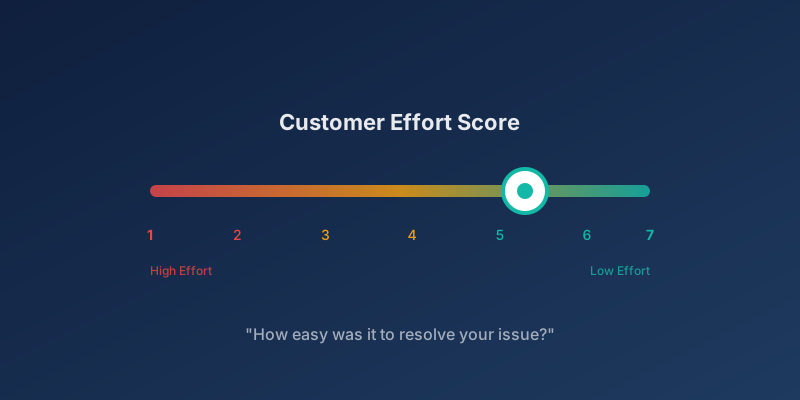
What Is CES? Customer Effort Score Explained
Customer Effort Score (CES) measures how hard it was for a customer to get something done. It predicts churn better than satisfaction does.
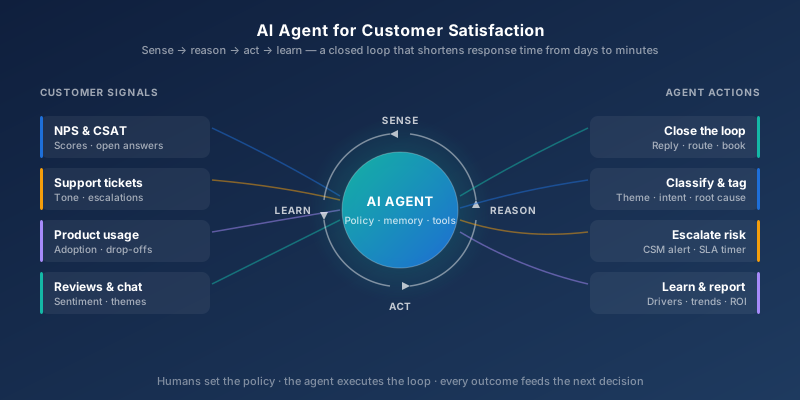
AI Agents for Customer Satisfaction: From Feedback to Action in Minutes
An AI agent is not a chatbot. It reads feedback, prioritises, acts and learns. Here is how to use one to cut your response time on unhappy customers from days to minutes.
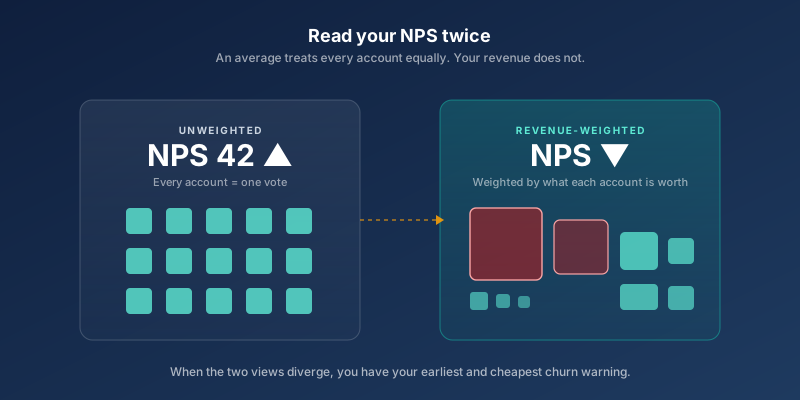
Account-Based CX: Run Your Feedback Programme on the Accounts That Pay the Bills
In most B2B companies a small share of accounts carries most of the revenue, yet every account gets the same survey and the same weight in the score. Account-based CX fixes that mismatch: weight feedback by account value, survey the whole buying group, and tier your follow-up.

What Is CSAT? Guide to Customer Satisfaction Score
CSAT is the most direct satisfaction metric you can use, but it is also the most abused. Therefore, here is how to deploy it properly, when to trust it, and when it misleads.
![Close the Loop: The Complete Guide to NPS Follow-Up [2026]](/img/knowledge/close-the-loop.svg)
Close the Loop: The Complete Guide to NPS Follow-Up [2026]
Most B2B companies that measure NPS never act on it. This guide breaks down the 48-hour rule for Detractors, segment-specific workflows for Detractors, Passives and Promoters, the CRM integration that makes it stick, and the four numbers that prove it is working.

How to Reduce Churn: 7 Strategies That Work
Churn is the most expensive problem most B2B companies underestimate. Seven strategies that work, from NPS early warning systems to win-back campaigns, with the CustomerGauge and Bain research behind each one.