TL;DR
- An **AI agent** is different from a chatbot. It has memory, tools and a mandate. It reads feedback, decides what to do, and executes the action across your systems.
- The biggest win in customer satisfaction is **time to action**. An agent shortens close-the-loop from days to minutes without removing human empathy: humans handle the hard conversations, the agent frees up the time.
- Start narrow. Let the agent **classify and route** feedback before you let it talk to customers. Trust is built in small steps, not a single big rollout.
- An agent without guardrails and **human-in-the-loop** on Detractors is not production-ready. Put SLAs, escalation rules and QA sampling in place from day one.
Contents10 sections
Customer Satisfaction Fails on Time, Not Intent
Most CX teams know what they should do when a Detractor shows up. Call within 48 hours. Ask the right questions. Close the loop with a concrete action. In practice it rarely happens in time.
Among the companies we work with, the typical response time on an NPS Detractor is 3-7 days. Not because the CSM team doesn't care, but because feedback lives in one inbox, CRM in another, support tickets in a third, and nobody has a complete picture until the Friday sync.
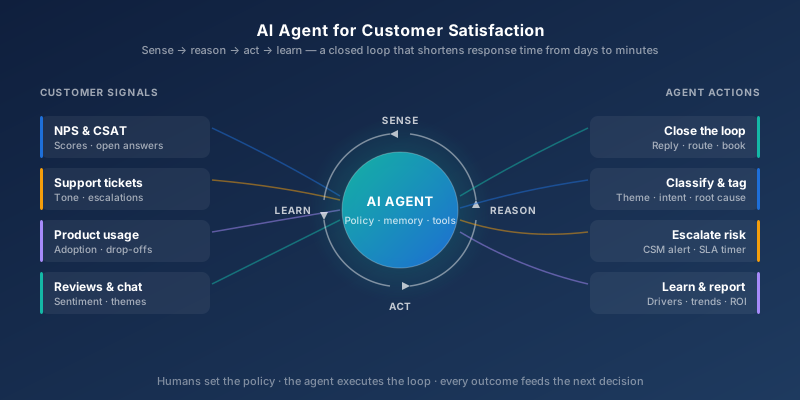
An AI agent closes that gap. It reads the feedback the second it arrives, sees who the customer is, assesses the risk and takes action. That is the real value: time to action.
What an AI Agent Is, and What It Is Not
An AI agent is a system that can independently sense, reason and act within a defined mandate. Three properties set it apart from a chatbot:
- Memory: It remembers prior interactions, the customer's history and your business rules.
- Tools: It has access to CRM, survey platform, ticket system, calendar, email. It can read and write, not just generate text.
- Mandate: It has a policy that defines which actions it may take alone and which require human approval.
A chatbot answers questions. An AI agent does work. The difference is fundamental.
A chatbot says: "I can see you're unhappy. Would you like to talk to an agent?" An agent says nothing: it has already created a task for the CSM, qualified the risk as high, booked 15 minutes on the calendar and sent the customer a confirmation that an advisor will call within two hours.
The Five Places Where Agents Actually Move Satisfaction
Not every part of the CX stack is equally ready for agentic AI. Among the companies we work with, five use cases consistently deliver value.
1. Classifying and Theming Open-Text Responses
The most under-used data point in most CX programmes is the open-text answer. It contains the reasons, but it rarely gets read systematically.
An agent can tag every open-text response by theme, sentiment, intent and root cause, in real time, across 30+ languages. That makes it feasible to run systematic open-text analysis weekly instead of quarterly. How that tagging becomes urgency- and account-weighted routing is covered in AI text analytics for customer feedback.
Start here. It is the area with the lowest risk and the highest value.
2. Prioritising and Routing Feedback
Not all feedback is equally critical. A Detractor on a £2M contract complaining about an integration issue is not the same case as a Passive complaining about a button colour.
An agent can score each piece of feedback on (a) churn risk based on the customer's health score, (b) commercial value, the same account-weighting logic covered in account-based CX, and (c) urgency, then route it to the right owner with the right SLA. Without that, the CSM inbox is equally full of noise and critical items.
3. Closing the Loop on Detractors
The most direct value point. The agent can:
- Read the Detractor response and summarise it
- Pull the customer's history from CRM, support and the product
- Draft a response based on previous successful close-the-loop conversations
- Send a confirmation to the customer within minutes, with a follow-up appointment
- Create a task for the CSM with context, risk score and suggested talking points
Important: the agent should not run the conversation alone. It prepares it. Closing the loop must be human, but the preparation does not have to be.
4. Predicting Churn and Risk
Once the agent has 6-12 months of historical data, it can start to predict. Which customers are trending toward Detractor? Which will fall below a critical health score threshold in the next 60 days?
This is not a new capability: key driver analysis and customer health scoring have delivered it for years. The difference is that the agent can run the prediction continuously, at individual account level, and tie it to actions. A red flag is not just a number on a dashboard. It is a task in a CSM's queue. The earliest place this pays off is onboarding: an agent watching first-value milestones can flag a stalled new account before anyone notices the survey that never got answered, the non-event trigger described in the B2B onboarding survey.
5. Summaries and Executive Reporting
CX teams typically spend 20-40% of their time on reporting. The agent can generate quarterly NPS reports, driver analyses and executive summaries across both quantitative and qualitative data. The CX team spends its time acting, not assembling slides.
Reference Architecture
An agent for customer satisfaction typically consists of four layers:
| Layer | Responsibility | Example components |
|---|---|---|
| Data | Collect and normalise signals | Survey platform, CRM, support, product analytics, sentiment API |
| Reasoning | Understand, classify, prioritise | LLM, classifiers, rules, prompt library |
| Action | Execute tasks via tools | CRM API, calendar, email, ticket system, survey follow-up |
| Governance | Manage mandate, quality and audit | Guardrails, human-in-the-loop, QA sampling, logging |
The fourth layer is what separates a toy from production. Without governance the agent becomes either too cautious (and delivers no value) or too boundless (and generates customer complaints faster than it resolves them).
- Governance
- DataCollect and normalise signals
- ReasoningUnderstand, classify, prioritise
- ActionExecute tasks via tools
Adoption Is Accelerating. So Is the Cancellation Rate.
Two numbers describe the same 12 months, and neither one is wrong.
Adoption of AI agents in customer service organisations rose 1.7x between 2025 and 2026, from 39% to 66% (Salesforce, State of Service: AI Agents Edition, a survey of 3,075 service professionals, 2026). Seventy percent of the organisations that deployed one saw measurable value within 60 days. When asked which KPI improved the most, respondents ranked customer satisfaction above productivity, average handle time, retention and first-response time.
At the same time, Gartner predicts that over 40% of agentic AI projects will be cancelled by the end of 2027, due to escalating costs, unclear business value or inadequate risk controls. According to a January 2025 Gartner poll, only 19% of organisations had made a significant investment in agentic AI, 42% were conservative, and 31% were still watching from the sidelines. Gartner also flags "agent washing": vendors rebranding existing chatbots and RPA tools as agentic AI without the underlying capability. By Gartner's own count, only around 130 of the thousands of vendors claiming agentic AI actually deliver it.
Both statistics are real, and they are not in tension. They describe the same population split into two groups: teams that treated the agent as a scoped discipline with an evaluation set, guardrails and an owner, and teams that treated it as a platform purchase. The first group sits inside the 66% adoption figure and is reporting satisfaction gains. The second group is heading toward Gartner's cancellation number. Nothing in this guide changes because adoption sped up. If anything, it is the reason Step 3 and Step 4 below matter more, not less.
- 202539%
- 202666%
How to Implement an AI Agent in Practice
Step 1: Define the narrow use case
Pick one clearly scoped problem. For example: "Every NPS Detractor in our largest customer segment must receive a qualified summary and a calendar appointment with a CSM within 4 hours."
Avoid broad mandates like "handle all customer feedback". That is how projects fail.
Step 2: Map the data and systems
Which systems does the agent need access to? Typically: survey platform, CRM, calendar, email, and a place to log its actions. Who owns each system? Who approves the API integration?
Step 3: Define the mandate and guardrails
Three levels of autonomy:
| Level | Example | Human-in-the-loop |
|---|---|---|
| Read | Classify responses, summarise, suggest | No, the agent reads and proposes |
| Write internally | Create tasks, tag feedback, update health score | No, within defined rules |
| Write externally | Send email to customer, book meeting | Yes, must be approved for the first 90 days |
Start conservatively. Expand once the error rate is documented as low.
Step 4: Build the evaluation set before deploying
Collect 50-100 historical feedback cases where you know the correct outcome. Run the agent against them. Measure:
- Classification accuracy: Does it hit the right theme and sentiment?
- Prioritisation: Does it escalate the cases that actually ended in churn?
- Action quality: Is its draft response something a CSM could send?
Without an evaluation set you are running blind. This is the step most often skipped.
Step 5: Pilot on a single segment
Run the agent on one region, one segment or one channel for 4-8 weeks. QA-sample 10-20% of all actions. Measure:
- Time to first contact on Detractors
- Close-the-loop rate
- Error rate on agent actions
- Customer complaints or escalations related to the agent
Step 6: Scale or stop
If the pilot's KPIs are green, expand scope and autonomy gradually. If not, stop. An AI agent that delivers poor results is more expensive than no agent, because it shifts risk from people to systems without shifting accountability.
A Real-World Example
A Nordic B2B SaaS company with about 900 customers had an NPS of +18 and a close-the-loop rate of 31%. The CSM team was four people and had no capacity for systematic follow-up on Detractors.
We built an agent with a narrow mandate:
- Read every NPS Detractor within 5 minutes
- Summarise the response and pull the customer's context
- Score risk (high/medium/low) based on ARR, health score and history
- High risk → create a task for the CSM with context, book 15 minutes on the calendar, send a confirmation email to the customer
- Medium/low risk → create a task for the CSM without calendar booking
- Log every action for weekly QA
Result after 6 months:
| KPI | Before | After |
|---|---|---|
| Average time to first contact | 4.2 days | 38 minutes |
| Close-the-loop rate (Detractors) | 31% | 89% |
| Recovery rate (Detractor → Passive/Promoter) | 18% | 34% |
| CSM hours spent on admin | 32% | 14% |
| NPS | +18 | +29 |
Note that the NPS shift did not come from the agent itself. It came from the CSM team finally having the time and structure to have the conversations they should have been having all along.
- Close-the-loop rate (Detractors)+58%Before31%After 6 months89%
- Recovery rate (Detractor to Passive/Promoter)+16%Before18%After 6 months34%
- CSM time spent on admin-18%Before32%After 6 months14%
Common Pitfalls
The agent should do everything. The broader the mandate, the more opaque it becomes. Start with one use case, document the effect, expand.
Automating a process that never ran. An agent that closes the loop faster only helps if someone was closing it at all. If your programme sits at level 2 on the CX maturity model, collecting feedback without acting on it, the agent automates the gap rather than filling it.
No evaluation set. Without known-good answers you cannot measure quality. Without quality metrics the agent becomes either feared or over-trusted, rarely used well.
The agent answers customers directly from day one. High risk, low trust. Start internally. Let the agent prepare conversations before it runs them. Forrester expects a third of brands to erode customer trust in 2026 by putting AI self-service in front of customers before it is ready, which is why great B2B customer service keeps a fast, visible escalation path to a named human.
You assume your customers trust the agent because your team does. Trust in AI agents grows with hands-on experience, and that creates a blind spot: 65% of customer service professionals who have deployed an agent believe their customers fully trust AI-powered service. The actual figure, according to the Metrigy Consumer CX Index, is 44%. Build in a visible, one-click path to a human for every AI-led interaction. Not because the technology is unreliable, but because your team's confidence in it is not the same measurement as your customer's.
No audit log. When something goes wrong (and it will), you need to see exactly what the agent did and why. Log every input, decision and action from day one.
No owner. An agent without an accountable person becomes nobody's. Define who owns its performance, its guardrails and its audits. The same discipline as for a product, because that is what it is, and the same governance question we cover in CX governance: if nobody in your organisation is accountable for customer experience, an AI agent will not fix that. It will just make the gap move faster.
- Service professionals who believe their customers fully trust AI-powered service65%
- Consumers who actually say they do44%
Relationship to Existing CX Metrics
The agent does not replace your metrics. It accelerates them.
| Metric | Agent's role |
|---|---|
| NPS | Classifies responses, prioritises follow-up, summarises drivers |
| CSAT | Real-time tagging of negative responses, automatic escalation |
| CES | Identifies friction points and repeat complaints |
| Health Score | Updates the score with live signals, triggers action on red accounts |
The agent is the glue between measurement and action. Without it, most close-the-loop programmes fall apart on volume. With it, you can scale systematic follow-up across the entire customer base.
Getting Started
You do not need an agentic platform on day one. Most of the companies we work with start with:
- One narrow use case, typically open-text classification or close-the-loop on Detractors
- An evaluation set of 50-100 historical cases
- A 4-8 week pilot on one segment
- Clear governance: who owns it, who QA-samples, who escalates
When that runs well, you widen the mandate. Not before.
An AI agent is not a magic solution. It is a discipline, the same kind as survey design, close-the-loop or customer health scoring. The difference is that the discipline can now be executed in real time and at scale.
And as always: the technology is the easy part. Closing the loop with the customer is still what determines whether customer satisfaction actually moves. Start there.
Frequently asked questions
What is the difference between an AI agent and a chatbot?
A chatbot follows a script or an LLM prompt and responds reactively. An AI agent has memory, access to tools (CRM, survey platform, ticket system) and a defined mandate: it can independently read an NPS response, decide that it is a Detractor with churn risk, create a task for the CSM, send a follow-up email and update the customer's health score. The difference is autonomy and action, not just dialogue.
Can an AI agent replace our Customer Success team?
No. It should free them up. Empathy, difficult negotiations and strategic customer relationships should still be human. The agent takes the routine work: feedback classification, automatic acknowledgements, inbox prioritisation, briefings for CSM 1:1s. The KPMG report on AI and customer experience in 2026 shows that the Empathy pillar is growing fastest, precisely as AI adoption accelerates. Humans become more important, not less.
How do we stop the agent from responding incorrectly to customers?
Three mechanisms. Scope: start with internal actions (classify, route, prioritise) before letting the agent respond to customers directly. Guardrails: define which actions the agent may take autonomously and which require human approval - Detractors and VIP accounts should always route through a human. QA sampling: 10-20% of the agent's actions should be manually reviewed for the first 90 days. Once the error rate is below 2%, you can gradually widen the mandate.
How much data do we need before an AI agent makes sense?
Less than you think for classification: a modern LLM-based agent can categorise open-text responses with good quality from a handful of examples. For prediction (churn risk, next-best-action) you should have at least 6-12 months of historical feedback tied to business outcomes. Start with classification and routing, and add predictive capabilities once the data foundation is mature.
How do we measure ROI on an AI agent for customer satisfaction?
Four primary KPIs: (1) Time to first contact on Detractors (target: days to minutes), (2) Close-the-loop rate, the share of Detractors actually contacted, (3) Recovery rate, the share that move from Detractor to Passive/Promoter at the next measurement, (4) CSM hours freed up for strategic work. Connect it to revenue impact by tracking retention on accounts touched by the agent versus a control group.
Does the fast adoption of AI agents mean we are already behind if we have not started?
No. Adoption in customer service jumped from 39% to 66% in a year (Salesforce, 2026), but Gartner still expects over 40% of agentic AI projects to be cancelled by 2027, for the same three reasons every time: rising cost, unclear ROI and weak risk controls. Falling behind competitors is a real risk in B2B CX. The bigger risk the data actually documents is starting broad and unscoped. Follow the narrow-use-case-first sequence in this guide rather than racing to match a headline adoption number.

Written by
SurveyGauge Team
The advisors and developers behind SurveyGauge. We run customer satisfaction programmes for B2B companies, from 20 key accounts to global banks.