
Voice of Customer Across Business Units: Keeping VoC Consistent in a Decentralized B2B Organization [2026]
Running Voice of Customer across multiple business units, brands or countries breaks the moment you either standardize everything or standardize nothing. Here is the governance split that actually holds, and why a single blended group score can hide a business unit in real trouble.
![Voice of Customer Across Business Units: Keeping VoC Consistent in a Decentralized B2B Organization [2026]](/img/knowledge/voice-of-customer-across-business-units.svg)
- A single blended VoC score across business units can look stable while every individual unit is moving in a different direction. That is not noise, it is a well-documented statistical effect called Simpson's paradox.
- Centralize the metric definition, the closed-loop SLA and the reporting cadence. Leave question wording, channel mix and local case handling to each business unit.
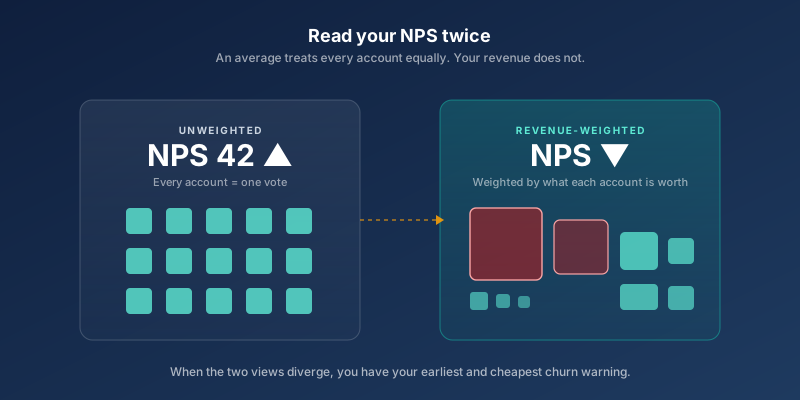
- Weight the group roll-up by account value or unit revenue, never by raw response volume, or your largest, loudest business unit sets the entire group narrative.
- Autorola Group runs Voice of Customer across three business units in 19 countries under one governance layer, with local execution, not one survey translated 19 times.
Contents7 sections
What Does It Mean to Run Voice of Customer Across Business Units?
Voice of customer across business units means one governance model, not one survey. It is a single metric definition, a single closed-loop standard and a single reporting structure, applied consistently across multiple legally or operationally separate parts of the same company, each of which may sell different products, serve different markets, or operate in a different language. It is not the head office survey copy-pasted into every subsidiary with a translated logo, and it is not full local autonomy loosely held together by a shared dashboard template.
Most B2B groups get this wrong in one of two directions. Either corporate mandates an identical survey, identical cadence and identical wording for every unit, which local teams quietly route around because it does not match how their customers actually buy. Or every business unit builds its own programme, which means the CEO cannot compare unit A to unit B without a footnote explaining that they measure loyalty differently. Neither failure mode is rare: B2B International's tracking research on B2B customer experience programmes found that 61% of them are isolated to a single department, and 28% of large B2B companies have no central CX team at all. Multiply that fragmentation across business units and countries, and the group-level picture stops meaning anything.
Why One Blended Score Hides More Than It Reveals
Here is the part that surprises most CX leads the first time they see it: a group NPS can hold steady, or even improve, while every single business unit underneath it is declining. This is not a data quality problem. It is Simpson's paradox, a documented statistical effect where a trend that is consistent across every subgroup reverses, or simply disappears, once you combine the subgroups into one number. In a multi-entity VoC programme, it shows up when the mix shifts: if your fastest-growing business unit also happens to have a structurally higher score (a different market, a different buying pattern, a longer relationship history), the group average rises even as unit-level performance worsens across the board.
The practical implication is blunt: never report a group-level VoC score without also showing the unit-level breakdown, and never let a stable group number substitute for checking each unit individually. A board slide with one green number is the easiest way to miss a business unit in real trouble.
What Should Be Centralized, and What Should Stay Local?
The failure mode above is really a governance failure, and governance is the harder half of any multi-entity CX programme to get right, harder than the technology. The rule of thumb that holds up in practice: centralize anything that has to be comparable across units, and leave local anything that has to be culturally or operationally correct for one unit's customers.
Centralize the metric definition itself: if one business unit calculates NPS on a 0-10 scale and reports promoters minus detractors, and another quietly averages the raw scores, you do not have two versions of the same number, you have two different metrics wearing the same label. Centralize the closed-loop SLA, meaning the maximum time to first response on a Detractor, regardless of which business unit or country the response came from. And centralize the reporting cadence and format that goes up to group leadership, so a board member can flip between units without re-learning how to read the page.
Leave local the survey question wording (translated faithfully, not just literally), the channel mix (a unit selling through distributors will not reach customers the same way as one selling direct), and case ownership for follow-up, because the person closing the loop with a named account has to be someone that account actually recognizes.
| Element | Standardize centrally | Leave to the business unit |
|---|---|---|
| Metric definition and scoring formula | Yes | No |
| Survey question wording and translation | No, faithful local translation | Yes, local phrasing nuance |
| Closed-loop SLA (time to first response) | Yes | No |
| Channel mix (email, in-app, phone, in-person) | No | Yes |
| Escalation framework for Detractors | Yes, the process | Yes, the named owner |
| Reporting cadence and format to group leadership | Yes | No |
| Local case notes and account context | No | Yes |
How Do You Weight the Roll-Up So One Business Unit Doesn't Drown Out the Rest?
A simple average across business units is the second-most common way a multi-entity programme produces a misleading number. If your largest unit has ten times the survey volume of your smallest, a straight average of individual responses lets that unit's customers set the entire group score, whether or not that unit is representative of anything else. The fix is the same principle used in account-based CX: weight the roll-up by account value, or at minimum by business unit revenue, not by response count. A business unit with fewer, larger accounts should carry weight proportional to what it contributes to the group, not proportional to how many surveys it happened to send out that quarter.
This also protects against a second distortion: a business unit running a more aggressive survey cadence will naturally generate more responses, and more responses should never be confused with more importance to the group's revenue.
What Changes When You Add Language and Country to the Mix?
Once a multi-entity programme crosses borders, translation quality stops being a nice-to-have. CSA Research's global survey of over 8,700 consumers across 29 countries found that 76% prefer to receive information in their own language, and 75% are more likely to return as a customer if support is available in that language. The same logic applies to feedback collection: a customer asked to rate their experience in a second language will answer differently, and often more cautiously, than one surveyed in their own. If you translate the survey but not the follow-up conversation, you have only solved half the problem, and the closed-loop step (where a real person calls a Detractor back) is exactly where that gap shows up.
This is also where GDPR and cross-border data handling become a live operational question, not a footnote: see our guide to GDPR and customer feedback for what data minimisation actually requires when feedback and case notes move between entities in different countries.
The Autorola Group Model: Three Business Units, One Governance Layer
Autorola Group runs Voice of Customer across three business units spanning 19 countries. The operational choice worth naming is what they did not do: they did not run one identical survey translated 19 times, and they did not let each country team build an unrelated programme. A single governance layer defines the metric and the closed-loop standard; each business unit executes locally, with the language, channel and account context that fits its own customers. That split, one definition, many executions, is the practical answer to almost every question this article raises.
Where SurveyGauge Fits
A multi-entity VoC programme does not fail because of missing software. It fails because nobody owns the governance layer: the metric definition, the weighting logic, and the discipline to look at unit-level data before trusting the group number. That is the part SurveyGauge builds the platform around, and the part our advisory work spends the most time on with groups running CX across multiple business units or countries. The platform enforces one metric definition and one closed-loop SLA across every entity, while still letting each business unit run its own channel mix and case ownership. If you are earlier in the process of building a programme at all, start with our Voice of Customer guide before layering multi-entity governance on top.
Frequently Asked Questions
Ready to know what your customers actually think?
SurveyGauge helps Nordic B2B companies move from gut feeling to data-driven CX decisions.
SurveyGauge Team
Customer Experience Experts
SurveyGauge-teamet hjælper virksomheder med at måle og forbedre kundetilfredshed via professionelle surveys, analyser og rådgivning.
You might also be interested in
View all articles![Voice of Customer (VoC): The Complete B2B Guide [2026]](/img/knowledge/voc.svg)
Voice of Customer (VoC): The Complete B2B Guide [2026]
Most VoC programmes do not die from bad technology. They die from the action nobody owns. Here is how to build one that connects feedback to account value and revenue, not just a dashboard.
![CX Governance: Who Owns Customer Experience in a B2B Organization? [2026]](/img/knowledge/cx-governance.svg)
CX Governance: Who Owns Customer Experience in a B2B Organization? [2026]
Most B2B companies never decide who owns customer experience, so it defaults to whoever has the loudest voice when a renewal is at risk. Here is what a governance model that actually holds looks like, including who owns what an AI agent says to your customers.
Account-Based CX: Run Your Feedback Programme on the Accounts That Pay the Bills
In most B2B companies a small share of accounts carries most of the revenue, yet every account gets the same survey and the same weight in the score. Account-based CX fixes that mismatch: weight feedback by account value, survey the whole buying group, and tier your follow-up.
![GDPR and Customer Feedback in B2B: What You Can Actually Collect [2026]](/img/knowledge/gdpr-customer-feedback.svg)
GDPR and Customer Feedback in B2B: What You Can Actually Collect [2026]
You do not need consent to run a satisfaction survey. You need the right legal basis, disciplined data minimisation, and feedback data you can actually export. A 2024 CJEU ruling now shapes how you document that basis, and the EU Data Act's switching-fee ban has an exact date.