
Detractor Recovery: The Playbook for Saving Unhappy B2B Accounts
A detractor is not a lost account. It is the most recoverable revenue you have, but only if you treat recovery as a process with deadlines and owners, not a goodwill gesture. Here is the playbook.

- Detractor recovery is the structured process of contacting, fixing and winning back customers who scored you 0-6 on an NPS survey. It is a process with an SLA, not an apology email.
- Speed decides the outcome. CustomerGauge's research shows that closing the loop within 48 hours lifts retention by 12 percent and NPS by an average of 6 points. After a week, you are doing damage control, not recovery.
- Most companies never hit that window. CustomerGauge's 2026 benchmark puts the median B2B detractor follow-up rate at just 38 percent (61 percent for CPG, where sales teams are built for it). The best programmes reach 80 percent within 48 hours.
- The economics are brutal in your favour: detractors drive more than 80 percent of negative word of mouth (Bain), and a 5 percent lift in retention can raise profit by 25 percent or more (Bain). Few investments in B2B beat fixing an unhappy existing account.
- The contrarian part: not every detractor deserves a recovery effort. Triage by account value and fixability, and be willing to let some go on purpose. A recovery programme that treats every 0-6 the same will exhaust your team and save the wrong accounts.
Contents8 sections
A detractor is not a lost account. It is the most recoverable revenue on your books, but only if you treat recovery as a process with deadlines and owners rather than a goodwill gesture. This is the playbook.
What is detractor recovery?
Detractor recovery is the structured process of following up on customers who gave you a score of 0-6 on an NPS survey: contacting them fast, fixing what broke, and converting the account from churn risk back to stable revenue. The word that matters in that sentence is "structured". A named owner, a deadline for first contact, a defined escalation path, and a log of what caused the score. Without those four things you do not have a recovery process. You have good intentions. In close-the-loop terms, this is the inner loop in practice: the one-account-at-a-time half of a complete feedback programme.
This is where most programmes quietly fail. As we wrote in our guide to closing the loop, the large majority of companies that measure NPS never systematically follow up on individual responses. They report the score, discuss it in a quarterly meeting, and move on. Meanwhile the customer who took two minutes to tell you they are unhappy sits and waits. In B2B, where a single account can carry six or seven figures of annual revenue, that silence is the most expensive thing your CX programme produces.
If you need the fundamentals of the metric itself first, start with What Is NPS?. This article assumes you are already measuring and want to know what to do with the low scores. To judge whether your share of Detractors is unusual for your sector before you start, check it against the NPS benchmarks by industry.
Why is a detractor worth more than new pipeline?
Because the revenue is already in the building. Winning a new B2B account means months of pipeline, procurement and onboarding before the first krone of margin. Saving an existing one means fixing a problem for someone who already chose you, already integrated you, and already knows your team. Bain's research puts numbers on this: a 5 percent increase in customer retention can lift profit by 25 percent or more, because retained customers cost less to serve and expand over time (Bain & Company, "Prescription for Cutting Costs").
The downside risk is just as concrete. Detractors are responsible for more than 80 percent of negative word of mouth (Bain, Net Promoter System). In B2B that word of mouth does not spread on review sites. It spreads at industry events, in peer networks and in reference calls you never hear about. One unhappy account can quietly cost you deals you were never invited to bid on.
And here is the part that should reframe how you read your survey results: a detractor who tells you they are unhappy has handed you an advantage. The genuinely dangerous account is the one that stopped responding to surveys altogether and goes silent until the termination notice. A 3 with an angry comment is bad news you can act on. Silence is bad news you cannot. That is also why detractor recovery and churn reduction are two halves of the same discipline.
Why do the first 48 hours decide the outcome?
Because the score is a moment, not a state. A customer who scores you a 4 on Tuesday is angry about something specific: a failed delivery, a stalled project, an invoice dispute, a key contact who left. Reach them while the frustration is concrete and you can fix the thing itself. Wait two weeks and the frustration has generalised into a narrative: "they don't care". You can fix a delivery. You cannot easily fix a narrative.
The data backs the deadline. CustomerGauge's benchmark research finds that companies closing the feedback loop within 48 hours see retention improve by 12 percent and NPS rise by an average of 6 points. Their data also shows that companies that close the loop at every level of the organisation reduce churn year over year, while companies that never close the loop see churn creep upward instead.
So put the deadline in writing. Our recommendation for B2B: first personal contact within 48 hours of a detractor response, from a human, not an autoresponder. For strategic accounts, within 24. The contact does not need to contain the solution. It needs to prove that a person read the feedback and owns it. "I read your response, I understand the problem, here is what happens next and when you will hear from me" beats a polished resolution delivered ten days later.
How many detractors actually get a follow-up?
Fewer than you would assume, and probably fewer than at your own company. CustomerGauge's 2026 CPG Experience Benchmarks Report, built on more than a million B2B survey responses, found a median detractor follow-up rate of just 38 percent among non-CPG B2B companies, the category most SurveyGauge clients sit in. Consumer packaged goods companies do noticeably better, at a median of 61 percent, largely because their sales forces are equipped and tasked to act on feedback as part of the job. The best companies in both groups, CPG and non-CPG, close the loop with roughly 80 percent of detractors within 48 hours, and the top quartile of CPG programmes gets close to 100 percent.
That is a different number from the survey response rate benchmark itself, which averages 12.4 percent across B2B. A company can hit a healthy response rate and still leave most of its detractors unanswered, because response rate measures whether customers talk to you at all, and follow-up rate measures whether you talk back. Put the follow-up numbers next to Bain's finding that detractors drive more than 80 percent of negative word of mouth, and the gap becomes the real story. Most B2B companies are not failing at detractor recovery because the playbook is hard. They are failing because roughly six in ten detractors never hear back from anyone at all. The playbook below only works if it actually runs, on every response, not just the ones that land on an attentive account manager's desk.
- Non-CPG B2B, medianWhere most SurveyGauge clients sit38%
- CPG, medianSales forces tasked to act on feedback61%
- Best in class, within 48 hoursBoth groups80%
The playbook: five steps from low score to saved account
Step 1: Triage within hours. Route every 0-6 to a named owner the moment it lands. Not a shared inbox. Severity is set by two questions: how much revenue is at stake, and is the cause fixable? A strategic account with a fixable process failure is a drop-everything case. More on triage below.
Step 2: First contact within 48 hours. A short, personal message or call from someone with authority to act: the account manager, or for large accounts, a director. Acknowledge the specific issue from their comment. Do not send a survey about the survey.
Step 3: Own the fix, and name the date. Recovery dies in handoffs. One person carries the case from first contact to resolution, even when the fix sits with another department. Give the customer a date, and if the date slips, tell them before they notice.
Step 4: Close the loop with the account. When the fix ships, go back to the person who gave the score: here is what you said, here is what we changed. This is the moment recovery actually happens, and most companies skip it because the ticket says "resolved". As we argue in the close-the-loop guide, a fix the customer never hears about earns you nothing.
Step 5: Log the root cause. Every recovered detractor is a data point. If the same root cause shows up five times a quarter, you have a systemic issue, and key driver analysis will tell you whether it is one that moves your score at portfolio level. Recovery saves the account; the log saves the next ten.
A hypothetical example of what this looks like in practice. Nordika A/S, a mid-market B2B firm, ran quarterly NPS and averaged eleven days from detractor response to first contact, usually a templated email from support. We helped them set a 48-hour SLA with named owners and a weekly detractor review with management. The immediate change was not the score. It was that detractor comments started containing specifics again, because customers learned that responding actually triggered action. The score followed two quarters later.
How do you triage which detractors to fight for?
| Account profile | Signal | Response |
|---|---|---|
| High value, fixable cause | Strategic account, concrete complaint (delivery, project, support) | Full recovery: senior owner, 24-hour contact, executive visibility |
| High value, structural cause | Strategic account, unhappy about price/fit/strategy | Honest senior conversation about the relationship, not a service fix |
| Low value, fixable cause | Small account, concrete complaint | Standard recovery: owner, 48-hour contact, normal process |
| Low value, structural cause | Small account, wrong fit, high cost to serve | Considered exit: polite, professional, no heroics |
The triage matrix forces the uncomfortable question most CX teams avoid: is this account worth saving? Sometimes the honest answer is no. A small account that is fundamentally mismatched with your product will score you low forever, consume disproportionate support hours, and churn anyway. Spending your best people on it means the strategic account in the top row waits longer. A recovery programme without prioritisation is not customer-centric. It is unmanaged.
Triage of this kind is account-based CX applied to the unhappiest end of your portfolio: the account, not the response, is the unit you are prioritising. Your customer health score belongs in this triage. A detractor score from an account whose health was already declining for two quarters is a different case than a blip from an otherwise green account, and the response should differ accordingly.
The service recovery paradox, and why you should not chase it
There is a well-documented effect in service research called the service recovery paradox: a customer who experienced a failure that was resolved exceptionally well can end up more loyal than a customer who never had a problem at all. The effect was first described by McCollough and Bharadwaj in 1992, and it is real. It is also the most misused finding in customer experience.
Two caveats matter. First, later research shows the paradox is conditional and fairly rare: it appears when the failure is perceived as a one-off, not a pattern, and when the recovery clearly exceeds expectations rather than merely resolving the issue. A customer hit by the same failure twice does not become more loyal the second time, no matter how graceful your apology. Second, and obviously: the paradox is never a reason to relax about failures. The lesson is narrower and more useful. When a failure has already happened, an outstanding recovery is not just damage limitation. It is one of the strongest loyalty-building moments you will ever get with that account, precisely because expectations are on the floor. Treat every detractor case as that opportunity, and never engineer the opportunity on purpose. It also pays better than most CX initiatives: Bain's Dell study put the cost of a Detractor at $57 against the $328 a Promoter generates, which is the core of the business case laid out in customer satisfaction and revenue.
- Lifetime impact per customer
- Cost of a Detractor57 USD
- Value of a Promoter328 USD
What does detractor recovery look like with a system behind it?
The playbook above fails at scale if it depends on someone remembering to check the survey tool. The mechanics need automation: instant alerts when a detractor response lands, automatic routing to the right owner based on account and severity, SLA timers that escalate when the 48-hour window is about to close, and a case log that ties every recovery back to a root cause.
That workflow is exactly what SurveyGauge is built around. Detractor responses trigger real-time alerts to the account owner, cases are tracked from first contact to closed loop, and root causes accumulate into driver analysis your management team can act on. And because we run the programme with you rather than handing you a login, the weekly detractor review has someone at the table whose job is to make sure no case dies in a handoff. Platform plus advisory, as one subscription: partner, not tool.
Every detractor response is a deadline. SurveyGauge gives you the alerts, case management and advisory to hit it, so unhappy accounts get saved instead of surveyed. Get a Free Demo or see pricing.
Frequently Asked Questions
Ready to know what your customers actually think?
SurveyGauge helps Nordic B2B companies move from gut feeling to data-driven CX decisions.
SurveyGauge Team
Customer Experience Experts
SurveyGauge-teamet hjælper virksomheder med at måle og forbedre kundetilfredshed via professionelle surveys, analyser og rådgivning.
You might also be interested in
View all articles![Close the Loop: The Complete Guide to NPS Follow-Up [2026]](/img/knowledge/close-the-loop.svg)
Close the Loop: The Complete Guide to NPS Follow-Up [2026]
Most B2B companies that measure NPS never act on it. This guide breaks down the 48-hour rule for Detractors, segment-specific workflows for Detractors, Passives and Promoters, the CRM integration that makes it stick, and the four numbers that prove it is working.

How to Reduce Churn: 7 Strategies That Work
Churn is the most expensive problem most B2B companies underestimate. Seven strategies that work, from NPS early warning systems to win-back campaigns, with the CustomerGauge and Bain research behind each one.
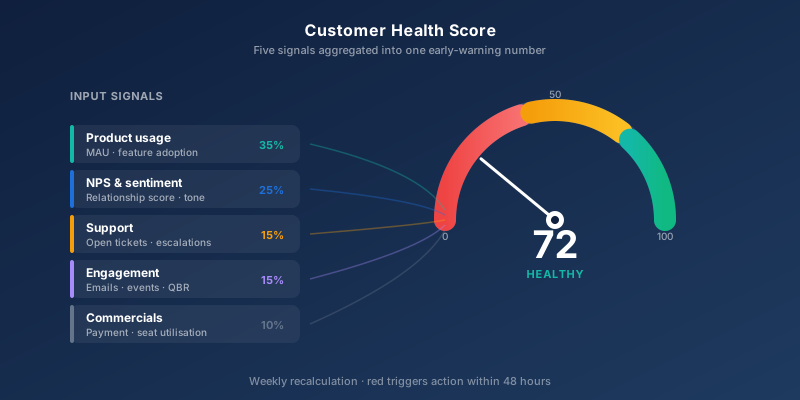
Customer Health Score: Build an Early Warning System for Churn
Customers decide to churn 60-90 days before the cancellation hits your CRM. A Customer Health Score surfaces the signal before you lose them. Here is how to build one that actually works.