
AI and Customer Experience in 2026: From Agentic AI to Anticipatory CX
KPMG's global CX benchmark shows 55% of CEOs rank AI as their top investment priority. A newer KPMG pulse survey shows the real divide isn't model quality, it's whether the CEO is actually accountable for AI-driven decisions.
- 79% of business leaders now call AI a top investment priority, per KPMG's Q2 2026 Global AI Pulse survey (up from 74% the previous quarter). Yet only 7% report having established ROI.
- Counterintuitive: the biggest gap between AI leaders and laggards isn't model quality. It's whether the CEO, not IT, is accountable for AI-driven decisions. Companies with clear CEO accountability are more than three times as likely to report established ROI (14% vs. 4%).
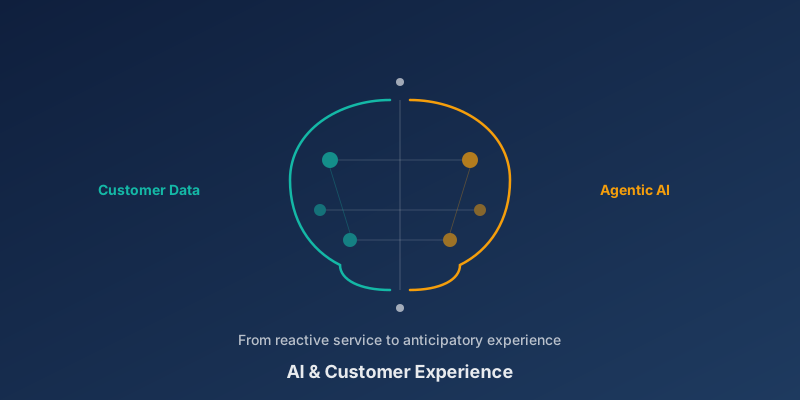
- Agentic AI doesn't just follow rules, it senses, reasons and acts. That shifts CX from reactive to anticipatory, but only for organizations with clean, integrated customer data.
- The companies winning with AI aren't replacing humans. They're freeing humans to do what AI cannot: build trust and show empathy.
Contents10 sections
KPMG interviewed 80,000 people about customer experience. Their conclusion: AI is no longer a future bet - it's the technology defining who wins and who falls behind. The 2025-2026 Global Customer Experience Excellence report positions agentic AI as the central enabler for the next generation of CX.
However, here's the uncomfortable truth. Most companies talking about AI in CX don't have the data foundation to make it work.
The Ambition-Capability Gap
55% of CEOs rank AI as their top investment priority. At the same time, 75% admit that competition for AI talent could slow their growth.
Everyone wants AI. Yet few have the infrastructure, data quality, or organisational readiness to use it well. Among the companies we work with, we see this gap constantly: ambitious AI roadmaps built on top of fragmented data, disconnected systems, and manual processes.
The question isn't whether to invest in AI. It's whether your foundation can support it.
What Is Agentic AI - and Why Should You Care?
KPMG defines agentic AI as systems that independently sense, reason, and act. This isn't the chatbot on your website. Agentic AI can:
- Coordinate processes across teams, channels, and systems in real time
- Adapt to changing customer needs without human intervention
- Act autonomously within defined guardrails
- Learn continuously from feedback loops
- Agentic AI
- OrchestratorCoordinates across teams, channels and systems - the customer never sees it
- ParticipantAnswers, recommends and transacts directly with the customer
Two Roles: Orchestrator and Participant
As an orchestrator, AI manages complexity the customer never sees. It ensures the right information reaches the right person at the right time across departments. The customer experiences coherence; behind the scenes, AI is preventing the chaos.
As a participant, AI interacts directly - answering questions, recommending next steps, completing transactions. Not as a poor substitute for a human, but as an informed agent drawing on the full breadth of organisational knowledge. This is the same shift we cover in AI agents for customer satisfaction: the agent doesn't just chat, it reads feedback, prioritises and acts.
What the Best Companies Actually Do with AI
They've moved from reactive to anticipatory
The real shift isn't faster responses. Instead, it's predicting needs and acting before the customer has to ask. That requires data, models, and processes most companies haven't built yet.
They use AI to amplify people, not replace them
KPMG's key finding: "Outperformers balance technology adoption with a relentless focus on people - especially customers."
In practice, this means AI handles:
- Pattern recognition across thousands of feedback responses
- Routine follow-up automation (close-the-loop notifications, task routing)
- Sentiment classification that would take analysts weeks to do manually
- Churn prediction based on behavioural signals
Meanwhile, humans invest the freed-up time in strategic advisory, relationship building, and the judgement calls AI cannot make.
The Empathy Paradox
The pillar with the strongest growth in KPMG's data? Empathy - up 4% in Australia, and the most underrated of the six pillars of customer experience. In an era of accelerating AI adoption, the human dimensions differentiate most. Indeed, AI that lacks empathy undermines trust. This is not a contradiction. It's the point: AI should make space for more human connection, not less.
Competition Is No Longer Brand vs. Brand
One of the report's most provocative claims: "Competition is no longer just between brands - it's brands competing for a place in the customer's personal AI's decision logic."
As consumers and businesses use AI assistants to evaluate providers, your structured customer data becomes a competitive asset. Consequently, if your feedback, reviews, and performance data aren't captured and accessible, you become invisible to AI-driven decisions.
This has direct implications for Voice of Customer programmes. In other words, systematic, structured data collection isn't just about internal improvement - it's about external visibility.
Three Prerequisites - and Where Most Companies Fail
1. Clean, Structured Customer Data
AI without data is blind. The most sophisticated model in the world cannot personalise experiences without a foundation of clean, structured feedback and behavioural data. Therefore, this starts with systematic NPS, CSAT, and open-ended question collection - and, increasingly, AI text analytics that turns those open-ended answers into prioritised action instead of a pile of unread verbatims.
2. Integrated Infrastructure
Only 25% of banks have enterprise-wide cloud platforms supporting data-driven services. The rest are fighting data silos and legacy systems. Your CX platform, CRM, support tools, and sales data must talk to each other. Without integration, AI has nothing to work with.
3. Expertise to Turn Insights into Action
AI generates insights. Humans turn them into decisions. Strategic prioritisation, stakeholder alignment, and implementation remain fundamentally human disciplines. Ignore this, and you'll have dashboards full of predictions that nobody acts on.
The Real Line Between AI Leaders and Laggards: Accountability, Not Technology
By mid-2026, the conversation has moved on from whether to invest in AI. KPMG's Global AI Pulse for Q2 2026, a survey of 2,145 C-suite and senior business leaders across 20 countries, found that 79% now name AI a top investment priority, up from 74% just one quarter earlier. Spending is steady at roughly $188 million per organisation on average.
And yet only 7% of leaders report having established ROI. The ambition-capability gap described above hasn't closed. If anything, it has become more visible, because more money is now chasing it.
Here's the counterintuitive part. When KPMG asked what actually separates the organisations that get value from AI from the ones that don't, the answer wasn't model choice, data volume, or even budget. It was accountability. Only 24% of organisations say their CEO is directly accountable for AI-driven business outcomes; another 29% spread that responsibility across the wider C-suite, which in practice often means nobody owns it. That is the same ownership gap that stalls organisations partway up the CX maturity model, which is why AI sophistication and CX maturity are two different scales rather than one.
The organisations that DO give the CEO clear, direct accountability report dramatically different results:
| Outcome | With CEO accountability | Without |
|---|---|---|
| Confidence in AI strategy | 60% | 22% |
| Meaningful value realised | 57% | 21% |
| Established ROI | 14% | 4% |
A second, related finding: cost visibility matters almost as much as accountability. A third of leaders (33%) say they don't fully understand their AI usage costs, and organisations with strong cost visibility are five times more likely to report established ROI than those without it (15% vs. 3%).
For CX specifically, this reframes the prerequisites above. Clean data and integrated infrastructure get you ready to deploy agentic AI. But somebody, ideally at the executive level, still has to own what the AI decides on your customers' behalf, and somebody has to be watching what it costs to run. Skip either one, and the same AI investment that could have moved your NPS ends up as an unmeasured line item.
- With CEO accountability
- Without
- Confidence in AI strategy60%22%
- Meaningful value realised57%21%
- Established ROI14%4%
What We See in Practice
Among the Nordic B2B companies we work with, we see three patterns:
Pattern 1: AI-ready but action-poor. Companies with good data and AI tools but no process for acting on insights. The AI identifies at-risk accounts. Nobody calls them.
Pattern 2: Action-ready but data-poor. Teams eager to follow up on feedback but working from fragmented, inconsistent data. They close the loop on what they see, but they're missing half the picture.
Pattern 3: The integrated approach. Clean data flowing into AI analysis, with automated routing to the right people, who have the authority and context to act. These are the companies seeing measurable impact on churn and expansion revenue.
Most companies are in pattern 1 or 2. Thus, getting to pattern 3 requires investment in data integration first, AI second, and, per the accountability data above, a named executive owner third.
Common Mistakes with AI in CX
- Buying AI tools without the data infrastructure. Only 25% of banks have cloud platforms covering the whole enterprise. The rest are still fighting silos.
- Using AI as a substitute for human contact. Customers see through it. Empathy cannot be automated.
- Focusing on technology instead of change management. AI requires new processes and skills, not just new systems.
- No owner and no measurement of business impact. Without a named accountable executive and without cost visibility, companies can document neither whether AI is improving the customer experience nor what it costs to run.
What This Means for Your CX Strategy
Start with the foundation. Before investing in AI tools, ensure you have clean, structured customer data. Implement systematic feedback collection and integrate it with your CRM.
Connect your systems. AI requires data flowing across platforms. A customer journey map helps you identify the touchpoints where data capture matters most.
Use AI to amplify, not replace. Automate analysis and routine follow-up. Invest the freed-up time in strategic advisory and personalised customer relationships.
Assign real ownership. Established ROI is more than three times as likely when the CEO, not just the CIO, is accountable for what your AI decides about customers. Put a name on it.
Keep the human at the centre. KPMG's data is clear: the best companies balance technology with human focus. AI is an amplifier. Empathy is the differentiator. Don't confuse the two.
SurveyGauge and AI-Powered Customer Intelligence
We're building the next generation of our platform: an AI-powered Customer Intelligence Platform that:
- Predicts churn by identifying at-risk customers before they leave, the same early-warning logic behind our Customer Health Score
- Automatically prioritises follow-up based on business value
- Classifies feedback with AI-powered sentiment and topic analysis
- Recommends actions grounded in your adviser's expertise
All built on SurveyGauge's three pillars: Platform, Administration, and Advisory. AI without expertise is just data. Expertise without AI is just slow. We deliver both.
Source: KPMG Global Customer Experience Excellence 2025-2026, "Total Experience: Redefining excellence in the age of agentic AI". KPMG Global AI Pulse, Q2 2026 (surveyed 28 April - 25 May 2026, n=2,145 C-suite and senior business leaders across 20 countries), published 24 June 2026.
Frequently Asked Questions
Ready to know what your customers actually think?
SurveyGauge helps Nordic B2B companies move from gut feeling to data-driven CX decisions.
SurveyGauge Team
Customer Experience Experts
SurveyGauge-teamet hjælper virksomheder med at måle og forbedre kundetilfredshed via professionelle surveys, analyser og rådgivning.
You might also be interested in
View all articles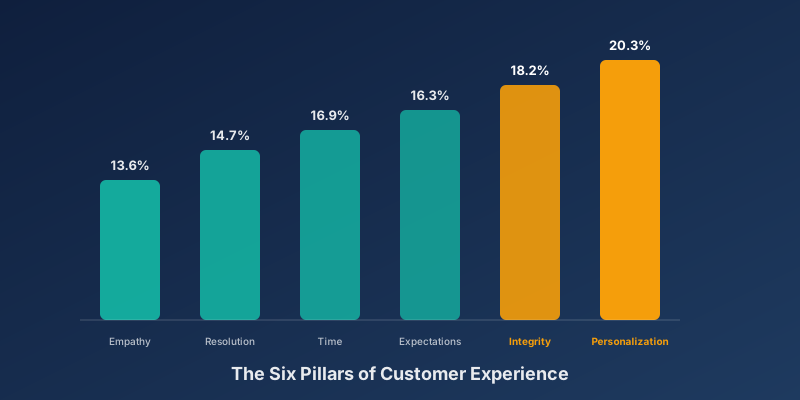
The 6 Pillars of Customer Experience: What Drives Loyalty and NPS
KPMG's Customer Experience Excellence report identifies six universal drivers behind NPS and loyalty, weighted from 80,594 interviews. Integrity and Personalization combined drive 39% of loyalty, and B2B buying committees make Personalization structurally harder than in B2C.
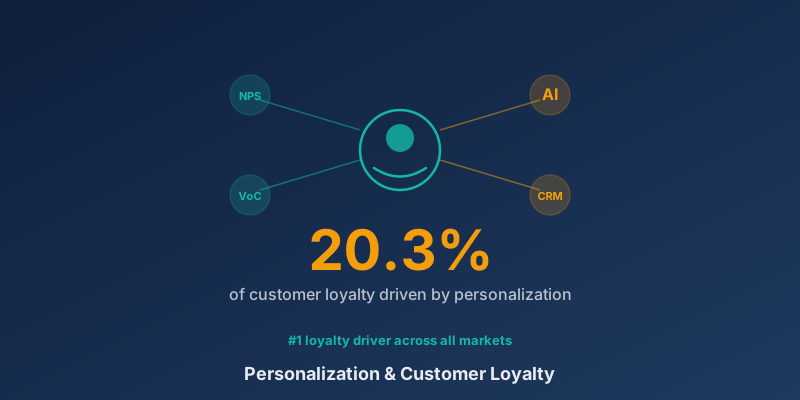
Personalization Drives 20% of Customer Loyalty: What It Means for Your CX Strategy
Personalization drives the single largest share of customer loyalty in KPMG's global CX benchmark. But Gartner's 2025 data shows it backfires for over half of customers when it feels like surveillance rather than help. Here is how to get it right in B2B.
![Voice of Customer (VoC): The Complete B2B Guide [2026]](/img/knowledge/voc.svg)
Voice of Customer (VoC): The Complete B2B Guide [2026]
Most VoC programmes do not die from bad technology. They die from the action nobody owns. Here is how to build one that connects feedback to account value and revenue, not just a dashboard.
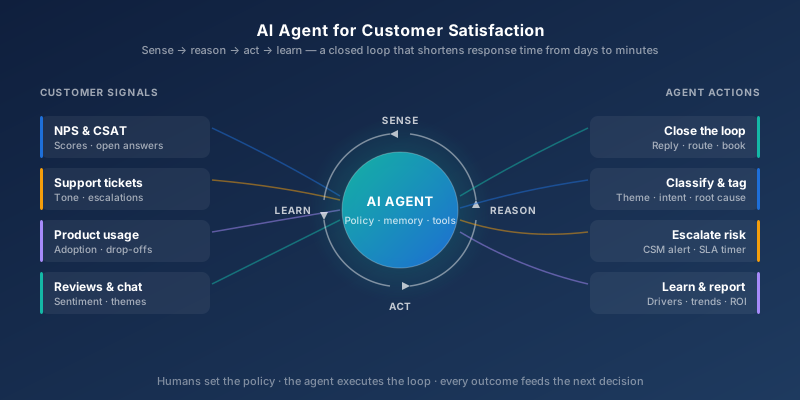
AI Agents for Customer Satisfaction: From Feedback to Action in Minutes
An AI agent is not a chatbot. It reads feedback, prioritises, acts and learns. Here is how to use one to cut your response time on unhappy customers from days to minutes.
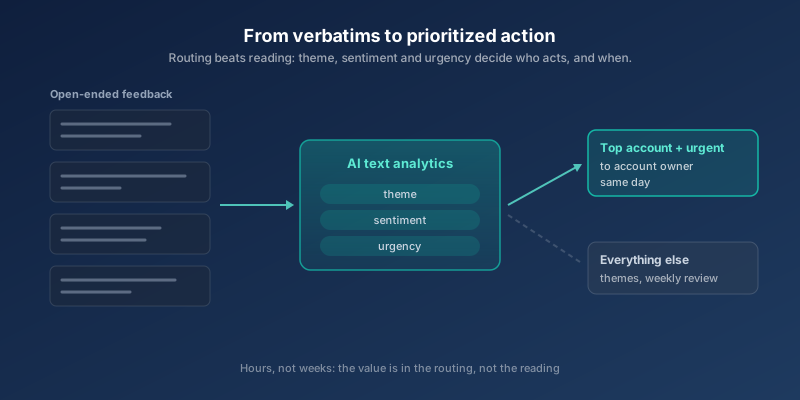
AI Text Analytics for Customer Feedback: From Verbatims to Prioritized Action
Most B2B teams buy AI text analytics to save analyst hours. The real return comes from something different: routing high-value, high-urgency feedback to the right owner in hours, not weeks.