TL;DR
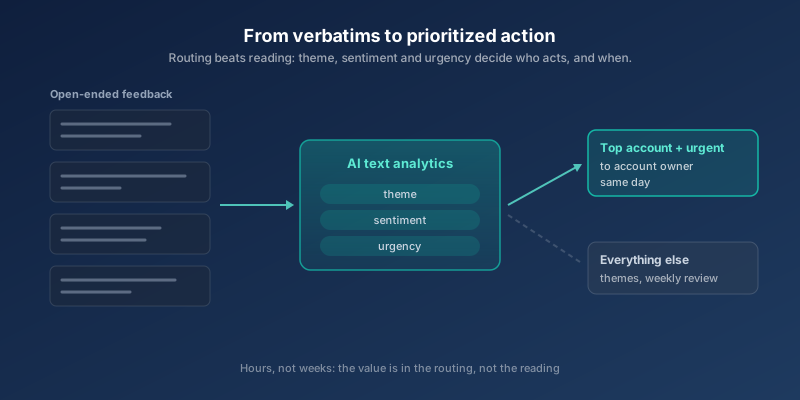
- AI text analytics reads open-ended feedback and tags it by theme, sentiment and urgency, at a volume no analyst team can match by hand.
- The real value is not time saved on reading. It is routing: getting the right comment to the right account owner before the relationship cools.
- Nearly one in five consumers who experienced AI-driven customer service said it delivered no benefit, a failure rate close to four times higher than AI use overall (Qualtrics XM Institute, 2026). Teams that deploy text analytics purely to cut headcount tend to produce exactly that outcome.
- Bain & Company links structured voice-of-customer programmes, including systematic use of verbatim feedback, to retention gains of up to 55%. The technology only pays off inside a process that acts on what it finds.
- Only 2% of B2B companies have fully integrated AI into customer experience, and Forrester's 2026 research found that AI enhancements widen the gap between what companies buy and what they actually use, they do not close it.
- For B2B accounts, urgency and account value should decide what gets read first, not chronological order or a generic sentiment score.
Contents8 sections
Most B2B companies buy AI text analytics to save analyst hours. That is the wrong reason, and it shows in the results. Here is what the technology is actually good for, and how to use it so a Detractor's comment reaches the right account owner in hours, not weeks.
What Is AI Text Analytics for Customer Feedback?
AI text analytics for customer feedback means using natural language models to read open-ended survey responses, support tickets and reviews, then automatically tag them by theme, sentiment and urgency. Instead of a person reading and coding 2,000 verbatims by hand, a model does the first pass in minutes and hands a structured, searchable output to the team.
That sounds like a productivity story. It is usually sold as one. But the productivity framing is where most B2B programmes go wrong. If you are still deciding whether to invest in this at all, our guide on analyzing open-ended responses covers the basics. This article assumes you are past that decision and focuses on how to make it pay off. Open text is also only one half of the picture: how to measure customer satisfaction covers the scoring question the verbatims sit behind, and why the two have to be read together.
Why Most B2B Teams Buy It for the Wrong Reason
Ask a vendor why you should buy AI text analytics, and the pitch is almost always about hours saved. Qualtrics' own Automated Text Analytics reduces deployment time from months to hours and cuts analysis cost four to five times over. That is a real, measurable gain, and it is also the least interesting part of the story.
The Qualtrics XM Institute's 2026 Consumer Experience Trends Report, based on a Q3 2025 study of more than 20,000 consumers across 14 countries, found something less flattering: nearly one in five consumers who had used AI in a customer service interaction reported no benefit from it, a failure rate almost four times higher than for AI use in general. As Isabelle Zdatny, the report's author, put it: too many companies deploy AI to cut costs, not to solve problems, and customers can tell the difference.
That finding matters directly for text analytics. If the business case for a tool is "we can reduce headcount by two analysts," the rollout gets built around cost, not around getting feedback to the person who can act on it. Themes get tagged. Dashboards get built. Nobody's actual workflow changes, because the whole point of the project was headcount, not speed.
The B2B version of this mistake is worse than the B2C one. You have fewer accounts and each one is worth more. Missing the signal in one comment from a strategic account is not a rounding error. It is a renewal at risk.
The Uncomfortable 2026 Finding: AI Enhancements Widen the Usage Gap, They Do Not Close It
Forrester's Customer Feedback Management and Analytics Solutions Landscape, Q1 2026 made a point that should worry anyone about to buy a text analytics add-on: historically, organizations did not fully use the feedback management platforms they already purchased, and AI enhancements are widening that gap, not closing it. The report's own framing is blunt. The most important trend in this market is not technical. It is organizational. The technology is ready. The harder work is ensuring your organization is ready too.
CustomerGauge's 2025 State of AI and B2B CX Benchmarks Report, based on responses from over 300 CX professionals across tech, manufacturing, financial services and consulting, puts a number on that gap. Nearly nine in ten B2B companies say they are exploring AI to improve customer experience. Only 2% report full integration. Sixty-two percent allocate less than a tenth of their CX budget to it, and 44% say they simply do not trust AI's accuracy enough to act on its output unsupervised.
Put those two findings together and the uncomfortable conclusion is this: a company that is not currently acting on the open-text feedback it already collects will not fix that by adding a text analytics layer on top. The AI just tags the same neglected comments faster and sorts them into a nicer-looking dashboard. If nobody owned the follow-up before, faster tagging produces faster, better-organized neglect, not better outcomes. Before you evaluate a vendor, check who at your company owns acting on a flagged comment today. If the honest answer is "nobody, currently," that is the gap to close first, and it is a CX governance question, not a procurement one.
- Exploring AI for CX88%
- Fully integrated2%
- Do not trust the accuracy44%
What AI Actually Gets Right, and Where It Still Needs a Human
Text analytics is genuinely strong at three things: scale, consistency and speed. A model reads every verbatim, not a sample. It tags theme and sentiment the same way on the tenth comment and the ten-thousandth. And it does this while your team is still in the morning stand-up.
It is weaker at exactly what Bain's own verbatim-coding methodology relies on: distinguishing a comment about "the sales process" from one about "the onboarding process" when a customer conflates both in the same sentence, catching sarcasm, or knowing that "fine" from a usually-enthusiastic contact is actually a warning sign. Forrester's research on the feedback analytics market is blunt about this: despite real progress from machine learning and generative AI, consistent quality still depends on human validation and enterprise-grade guardrails. Accuracy is not a solved problem. It is a managed one.
In our experience with Nordic B2B feedback, this shows up most clearly in language nuance. Danish and Norwegian understatement, and the polite indirectness common in Swedish responses, are easy for a model trained mostly on English text to flatten. A comment that reads as mild in Danish can mask a serious frustration. That is exactly the kind of signal where a second human read makes the difference.
The practical answer is not choosing between AI and humans. It is deciding which comments get machine tagging only, and which get a human second look before anyone acts, typically anything flagged as high urgency, low sentiment, or tied to a top-tier account. That decision is a governance question, not a modelling one, and it is the same gap the wider 2026 picture of AI in customer experience keeps surfacing: value comes from someone owning what the AI concludes, not from the model itself.
From Theme to Action: Routing Feedback by Urgency and Account Value
Here is the part most write-ups on this topic skip. A theme dashboard is not the deliverable. Routing is.
CustomerGauge's benchmark data shows that B2B companies that close the loop with a Detractor within 48 hours see roughly a 12% increase in retention on that account. Text analytics only contributes to that number if the flagged comment reaches an account owner inside that 48-hour window, not at the next monthly review. A theme report that says "onboarding friction is up 14% this quarter" is analysis. A routing rule that sends a specific comment from a top-20 account directly to that account's CSM the same day is a system.
For a company like Nordika A/S, a mid-market logistics business with perhaps 60 named B2B accounts, the calculation is straightforward: a handful of those accounts represent most of the revenue. A single Detractor comment from one of them, tagged for urgency and routed immediately, is worth more than a perfectly coded quarterly report on sentiment trends across the full base. Weight the routing by account value, the same principle behind account-based CX, and the technology starts paying for itself in saved accounts rather than saved analyst hours.
A comment that never gets routed does not just vanish. It resurfaces later as a declining Customer Health Score, the same underlying account risk, discovered weeks later and with far less context to act on.
Four Ways to Analyze Open-Ended Feedback
| Method | What it captures | Speed | Best for |
|---|---|---|---|
| Manual reading and coding | Full nuance, context, tone | Slow, does not scale past a few hundred responses | Small samples, exploratory research, qualitative depth |
| Keyword or rule-based tagging | Explicit mentions of known terms | Fast, but brittle | Simple, well-defined categories that rarely change |
| AI/LLM-based text analytics | Theme, sentiment and urgency at full volume | Near real-time | Continuous monitoring across thousands of responses |
| Hybrid (AI first pass, human review on flagged items) | Scale plus judgment on the comments that matter most | Fast, with a deliberate slow step | B2B accounts where a handful of comments carry outsized weight |
The hybrid row is where most mature B2B programmes end up, and for good reason. Full manual coding cannot keep pace with feedback volume once a company passes a few hundred active accounts, the same ceiling that shows up in key driver analysis work on isolating what moves the score. Pure automation, run without any human check, is what produces the disappointing outcomes Qualtrics documented.
How to Roll This Out When You Have 40 Accounts, Not 40,000
Most guidance on AI text analytics assumes B2C volume: hundreds of thousands of reviews, a data science team, a dedicated NLP pipeline. That is not the reality for most B2B companies, and applying B2C logic here wastes budget on infrastructure you do not need.
Start narrow. Feed the model your existing open-ended NPS and CSAT responses, the ones you are probably already collecting through your Voice of Customer programme, rather than building a new data source. Define three or four urgency tiers up front, tied to account value, not just sentiment score. Route anything in the top tier to a named owner with a same-day service level, and check weekly whether that service level is actually being met, not whether the dashboard looks good.
Resist the temptation to fully automate the response too. An AI agent that reads and prioritises feedback is a genuine time-saver for triage. Letting it also draft and send the follow-up to a strategic account, with no human review, is how you end up inside that unflattering 19% statistic.
Where SurveyGauge Fits
We do not sell AI text analytics as a replacement for judgment. Our platform tags theme, sentiment and urgency automatically across your Nordic B2B feedback, and our advisory team helps you build the routing rules and account-weighting that actually turn that tagging into saved accounts. Partner, not just a tool with a dashboard.
SurveyGauge helps Nordic B2B companies turn open-ended feedback into action within hours, not quarters. Get a Free Demo or see pricing.
Frequently asked questions
What is AI text analytics for customer feedback?
AI text analytics uses natural language models to automatically read open-ended feedback, survey comments, support tickets or reviews, and tag each one by theme, sentiment and urgency. It replaces manual coding of large volumes of unstructured text with a structured, searchable output produced in minutes rather than weeks.
Does AI text analytics replace manual reading of feedback?
No, not for the comments that matter most. It replaces manual reading at scale, across the full volume of feedback, but flagged high-urgency or high-value comments still benefit from a human check before action is taken. The mature approach is hybrid, not fully automated.
How accurate is AI sentiment analysis?
Accuracy has improved substantially with modern language models, but Forrester's research still flags human validation as necessary for consistent quality, particularly for nuance like sarcasm, mixed sentiment in a single comment, or context-dependent phrasing. Treat AI output as a strong first pass, not a final verdict.
Why do B2B companies need this more than B2C companies?
B2B accounts are fewer and worth more individually. A single missed signal in a comment from a strategic account carries more risk than a missed signal in one of a million consumer reviews. Account-weighted routing, prioritizing feedback from your highest-value accounts, is more valuable in B2B than volume-based sentiment dashboards.
What is the biggest mistake companies make when adopting this technology?
Buying it primarily to reduce analyst headcount rather than to speed up action. Qualtrics XM Institute's 2026 research found that AI-driven customer service delivered no benefit for nearly one in five consumers who experienced it, a failure rate close to four times higher than AI use in general, largely because it was deployed to cut cost rather than solve the customer's problem.
How does this connect to closing the loop on NPS?
Text analytics is only as valuable as the action it triggers. CustomerGauge's data shows B2B companies that close the loop with a Detractor within 48 hours see about a 12% retention lift on that account. AI tagging that does not feed a fast routing process does not capture that value; it just produces a nicer-looking report.
Do we need a data science team to implement this?
No. Most B2B companies with under a few hundred active accounts can start with existing survey platform text analytics features rather than build custom NLP infrastructure. The bottleneck is rarely the technology. It is defining urgency tiers and account weighting, then holding the team to the routing service level.
Should you add AI text analytics before fixing how feedback gets used today?
No. Forrester's Q1 2026 Customer Feedback Management and Analytics Solutions Landscape found that AI enhancements widen, rather than close, the gap between what companies buy and what they actually use. If nobody currently owns acting on a flagged comment, adding AI tagging on top just produces faster, better-organized neglect. Fix ownership and routing first, then add the AI layer.

Written by
SurveyGauge Team
The advisors and developers behind SurveyGauge. We run customer satisfaction programmes for B2B companies, from 20 key accounts to global banks.