
Close the Loop: The Complete Guide to NPS Follow-Up
95% of companies that measure NPS never follow up. Instead, they track a number and call it a programme. This is the operational playbook for the 5% who use NPS as an actual management system.
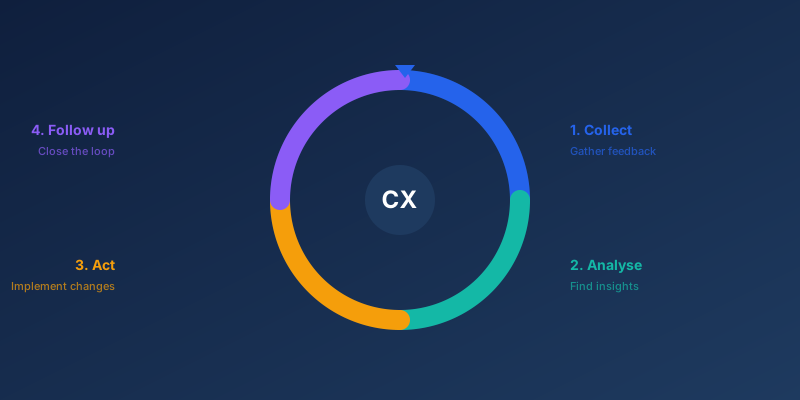
- 95% of companies that measure NPS never follow up with respondents. They have a survey programme, not a customer experience programme.
- The 48-hour SLA is based on Bain's finding that each 24-hour delay halves your chance of recovering a Detractor. Therefore, speed is not optional.
- Close the loop is not a support function. It is a cross-functional management system with workflows, CRM integration, escalation paths, and KPIs.
- Best-in-class programmes convert 30-40% of Detractors. The ROI typically exceeds 5:1 when you measure retained revenue against programme cost.
Contents9 sections
The score is the least important part
Most companies that launch an NPS programme make the same mistake: they obsess over the number and ignore the signal behind it. For example, they debate whether 32 is better than 28. They present dashboards at quarterly reviews. Yet they never call the customer who gave them a 3.
Indeed, that gap between collecting feedback and acting on it is where customer relationships die. Bain & Company, the firm that co-created the Net Promoter System, found that only 5% of companies that measure NPS actually close the loop with respondents. The other 95% have a survey programme. Not a customer experience programme.
According to CustomerGauge's research, closing the loop within 48 hours increases retention by 12% and lifts NPS by an average of 6 points. The effect compounds at the account level: companies that close the loop at every level, from frontline through executive, cut churn by at least 2.3% a year. Companies that skip it see churn increase by at least 2.1% a year instead, a swing of more than 4 percentage points driven by nothing except whether someone followed up (CustomerGauge, 2026). Closing the loop consistently at every level of the organisation, not just in support, is one of the clearest markers of a mature CX operating model, not merely a process improvement.
Do the math on a mid-sized B2B portfolio and the swing stops looking abstract. A USD 500 million book of business with 20% annual churn that closes that 4-point gap over five years adds tens of millions to the bottom line, according to CustomerGauge's own modelling. You do not need a portfolio that size to feel the same direction of effect at a smaller scale.
Here is the part most closing-the-loop advice skips. Detractors are not your least engaged customers, they are your most engaged. CustomerGauge's analysis of its own B2B survey data found that Detractors leave a written reason 64% of the time, more than double the rate for Promoters, and write on average 13 more words of feedback. They also spend up to 36 seconds longer completing the survey. An account that hands you three extra sentences about what broke is not a nuisance. It is handing you a root-cause analysis for free.
The real warning sign is not the Detractor score. It is the account that opens the survey and closes it without a word, or does not open it at all. Treat non-response as the higher-risk signal, and closing the loop with your most vocal Detractors as the cheapest research programme you run.
Businesses that close the loop after an NPS survey see three times the number of Promoters in their next measurement, compared to those that do not (CustomerGauge). Closing the loop also makes customers 21% more likely to answer your next survey. The two effects compound: a better response rate gives you a fuller signal, which surfaces more Detractors to act on, which creates more Promoters, which improves the response rate again. The 5% who close the loop are not just fixing individual accounts. They are running a flywheel the other 95% never start.
This is the operational playbook for the 5%. It covers the 48-hour SLA, segment-specific workflows with call scripts, CRM integration architecture, escalation procedures, and the five KPIs that prove the programme delivers ROI. If you are new to NPS, start with What is NPS? first.
For the introductory overview of close-the-loop concepts (inner loop, outer loop, service recovery paradox), see Close the Loop: What Is It, and How Do You Do It?. Closing the loop looks different depending on whether the score came from a relational or a transactional survey, so decide which you are running before you design the workflow: transactional vs. relational NPS.
The 48-hour rule
Speed is the single most important variable in Detractor recovery. Specifically, Bain & Company's research across hundreds of NPS programmes found that the chance of retaining a Detractor drops sharply with every day of delay. Contact every Detractor within 48 hours.
Why 48 hours and not "when we get around to it":
- Recency. The experience is still vivid. The customer can articulate exactly what went wrong, giving you richer diagnostic data.
- Signal of care. A fast callback tells the customer their feedback triggered immediate action. A response a week later tells them it disappeared into a database.
- Service recovery window. The service recovery paradox, where a well-handled complaint increases loyalty above the pre-failure baseline, only works when the response is timely.
How to enforce the SLA
- Automated alerting. The moment a Detractor response lands, the system should create a task and notify the owner via email, Slack, or CRM dashboard.
- Escalation timer. If no action is logged within 24 hours, escalate the task to the owner's manager. If still untouched at 36 hours, escalate to the CX lead.
- Daily standup review. Include open Detractor cases in your team's daily standup or morning briefing. Visibility creates accountability.
- SLA dashboard. Track the percentage of Detractors contacted within 48 hours as a headline metric, visible to leadership.
A realistic target for a mature program is 85% of Detractors contacted within 48 hours and 95% within 72 hours.
One widely cited example of what structured closing-the-loop can look like in practice comes from CustomerGauge's own published research: Eaton Corporation, a multinational manufacturer, cut its closing-the-loop process from 3-4 months down to 48 hours after standardising surveys and case management across regions and splitting issues into a fast "hot loop" and a slower "cold loop" by severity. The lesson is not the vendor. It is the structure: one system, one set of escalation rules, and a hard ceiling on how long a case can stay open.
If your team cannot realistically hit 48 hours on every single case from day one, prioritise by account value rather than diluting the SLA across the board. Account-based CX means the loop on your top 20% of accounts closes first, even if the long tail waits a little longer.
Segment-specific workflows
Not every NPS respondent needs the same follow-up. A Promoter who gave you a 10 does not need the same treatment as a Detractor who gave you a 2. The best programs define distinct workflows for each NPS segment and, within the Detractor segment, for different severity levels.
Workflow 1: Detractors (score 0-6)
The person making that call is not interchangeable. The same employees who close the loop with your Detractors are the ones eNPS measures, and a disengaged owner reading from a script will not recover the relationship. Check the engagement of the team carrying this workflow before you scale it up.
- CRM receives the NPS response and auto-creates a "Detractor Follow-Up" task assigned to the relationship owner.
- Owner reviews the score, open-ended comment, and customer history before making contact.
- Owner calls the customer (phone is always preferred over email for Detractors).
- Owner follows the Detractor call script (see below).
- Owner logs the root cause category, agreed action items, and next follow-up date in the CRM.
- If the issue requires cross-functional help (e.g., product bug, billing dispute), owner creates an internal escalation ticket and remains the single point of contact for the customer.
- Owner follows up on the agreed date to confirm resolution.
- 30-60 days later, a re-survey is sent to measure score recovery.
For the full playbook behind this workflow, including how to triage which Detractors are worth fighting for and why the first 48 hours decide the outcome, see Detractor Recovery: The Playbook for Saving Unhappy B2B Accounts.
"Hi [Name], this is [Your Name] from [Company]. Thank you for taking the time to share your feedback in our recent survey. I saw that your experience hasn't been what it should be, and I wanted to reach out personally to understand what happened."
[Listen. Do not interrupt. Take notes.]
"I appreciate you explaining that. I completely understand why that would be frustrating. Here is what I am going to do: [specific action]. I will have an update for you by [specific date]. Does that work for you?"
[Confirm agreement and next steps.]
"Thank you again, [Name]. Your feedback is genuinely helping us improve, and I want to make sure we get this right for you."
| Condition | Action |
|---|---|
| Score 0-3 with comment mentioning churn intent | Immediate escalation to CX lead + account manager call within 24 hours |
| Score 0-3 from top-20% revenue customer | Immediate escalation to VP of Customer Success |
| Score 4-6 with product-related complaint | Standard 48-hour SLA, product team tagged on internal ticket |
| Score 4-6 with service-related complaint | Standard 48-hour SLA, support lead reviews the case |
| No comment provided | Attempt email outreach first: "We noticed your score and would love to understand more" |
Workflow 2: Passives (score 7-8)
- CRM auto-creates a "Passive Engagement" task.
- Owner sends a personalized email (phone call optional for high-value accounts).
- The message acknowledges the score and asks one targeted question: "What would it take for us to earn a 9 or 10 from you next time?"
- Owner logs insights and identifies any quick wins that could move the needle.
- If the Passive mentions a specific unmet need, owner connects them with the right resource (e.g., a feature demo, an onboarding refresher, a pricing review).
Subject: Thank you for your feedback, [Name]
Hi [Name],
Thank you for sharing your thoughts in our recent survey. We are glad things are going reasonably well, but we noticed there might be room for us to do better.
I would love to hear: What is the one thing we could improve that would make the biggest difference for you?
No agenda on my side, I simply want to understand what "great" looks like from your perspective.
Best regards, [Your Name]
However, Passives are often overlooked, but they represent the largest swing opportunity in your NPS program. In fact, moving a Passive from a 7 to a 9 has the same mathematical impact on your NPS as preventing a Detractor entirely.
Workflow 3: Promoters (score 9-10)
- Send a personalized thank-you message (email is fine; automation is acceptable here).
- Invite the Promoter to participate in one advocacy action: write a review, join a case study, provide a testimonial, or refer a colleague.
- For strategic accounts, the account manager calls to reinforce the relationship and explore expansion opportunities.
- Log advocacy participation in the CRM for future reference.
Subject: You made our day, [Name]
Hi [Name],
We just saw your feedback, and it genuinely made our team's day. Thank you for the kind words.
If you have a moment, we would be incredibly grateful if you could share your experience on [review platform]. It helps others like you find us, and it means a lot coming from someone who has been through the journey firsthand.
[Link to review platform]
Thank you for being part of this, [Your Name]
CRM integration architecture
A close-the-loop program that relies on spreadsheets and manual task assignment will fail within weeks. Instead, the backbone of a sustainable program is tight integration between your survey platform and your CRM or customer success tool.
Core integration requirements
- Real-time response sync. NPS responses should flow into the CRM within minutes, not hours. Each response should create or update a record tied to the customer's account.
- Automated task creation. Based on segment rules (Detractor/Passive/Promoter), the system auto-creates follow-up tasks with the correct owner, priority, and due date.
- Escalation automation. If a task is not marked as "in progress" within 24 hours, the system escalates per the matrix defined above.
- Activity logging. Every call, email, and resolution note is logged against the NPS response record, creating a full audit trail.
- Re-survey trigger. 30-60 days after resolution, the system automatically sends a short follow-up survey to measure score recovery.
- Reporting rollup. A dashboard aggregates contact rates, resolution rates, score recovery, and churn outcomes across all segments.
Example integration flow (Salesforce/HubSpot)
- Create or update Contact property "Latest NPS Score"
- Create or update Contact property "NPS Segment"
- Create Task with title "[Segment] Follow-Up: [Contact Name]"
- Assign owner via account owner lookup
- Set due date: Now + 48h (Detractor) / Now + 5d (Passive) / Now + 7d (Promoter)
- Set priority: High (Detractor) / Medium (Passive) / Low (Promoter)
- If task not updated within 24h, send Slack alert to manager
- If task not updated within 36h, reassign to CX lead
As a result, this architecture ensures that no response ever goes unacknowledged. For a deeper look at connecting NPS to business outcomes, see Customer Satisfaction and Revenue.
Measuring effectiveness: the five KPIs that matter
Running a close-the-loop program without measuring its impact is like running a marketing campaign without tracking conversions. Therefore, here are the five KPIs every program should track, along with targets based on benchmarks from Bain & Company and Temkin Group (now part of Qualtrics XM Institute).
1. Contact rate
2. Resolution rate
3. Score recovery rate
4. Churn delta
5. Program ROI
Sample effectiveness dashboard
| KPI | Q1 Actual | Q2 Actual | Target |
|---|---|---|---|
| Contact rate (48h) | 72% | 86% | 85% |
| Resolution rate | 54% | 63% | 60% |
| Score recovery rate | 18% | 29% | 25% |
| Churn delta | -15% | -32% | -20% |
| Program ROI | 3.2:1 | 6.8:1 | 5:1 |
The outer loop: turning individual feedback into systemic improvement
Everything described so far is the "inner loop," the individual, case-by-case follow-up. Additionally, a complete close-the-loop program also includes an "outer loop" that aggregates patterns and drives structural changes across the organization.
Monthly root-cause analysis
Every month, the CX team should aggregate all Detractor root-cause categories logged during follow-up calls and identify the top themes.
| Root cause theme | Frequency | Avg. NPS score | Revenue at risk |
|---|---|---|---|
| Onboarding complexity | 38 mentions | 3.2 | $420K ARR |
| Billing errors | 27 mentions | 2.8 | $310K ARR |
| Slow support response | 24 mentions | 4.1 | $185K ARR |
| Missing feature X | 19 mentions | 5.0 | $290K ARR |
Closing the loop is what gives you the verbatims behind this table in the first place. Key driver analysis is the next step, telling you statistically which of these themes actually move the score, rather than which one simply got the most mentions this month.
Cross-functional escalation
Each top theme should be assigned to a functional owner with a clear mandate:
- Onboarding complexity - Head of Customer Success - redesign onboarding flow by Q3.
- Billing errors - VP of Finance - audit billing system and fix recurring issues within 30 days.
- Slow support response - Support Director - hire two additional agents and implement routing optimization.
- Missing feature X - Product Manager - evaluate for roadmap inclusion, report back within two sprints.
"You Said, We Did" communication
Once improvements are shipped, tell your customers. Furthermore, this step is critical and almost universally skipped. A simple "You Said, We Did" email or in-app announcement closes the outer loop and proves to customers that feedback leads to real change.
"Earlier this year, many of you told us that onboarding was too complex. We heard you. Today we are launching a redesigned onboarding experience with guided setup, progress tracking, and live chat support at every step. Thank you for pushing us to be better."
Qualtrics XM Institute research shows that customers who see their feedback led to change are 3x more likely to respond to future surveys. They also score significantly higher on loyalty metrics.
What we see go wrong
Treating close the loop as a support function. It is a cross-functional discipline. Product, engineering, finance, and leadership all participate in the outer loop. If close the loop lives only in support, systemic problems never get fixed.
Automated emails to Detractors. Near-zero impact on retention. The personal phone call is what creates the recovery moment. Automation is for Promoter thank-you messages and infrastructure (task creation, escalation timers). Everything involving a dissatisfied customer needs a human voice.
Follow-up without resolution. A call that ends with "I'll pass this on" can increase frustration. The caller must have authority to fix things or a clear, fast escalation path to someone who does.
Ignoring Passives. Passives are the silent majority. They are not angry enough to churn loudly, but not loyal enough to stay when a competitor makes an offer. Moving a Passive from 7 to 9 has the same NPS impact as preventing a Detractor. Ask them: "What would make this a 9 or 10?"
No re-survey after resolution. Without re-surveying, you cannot prove the programme works. The re-survey transforms anecdotal success stories into measurable KPIs that justify continued investment.
Getting started: a 30-day launch plan
If you are building a close-the-loop program from scratch, here is a practical 30-day roadmap. For more on setting up your NPS program overall, see Getting Started with NPS.
Week 1: Foundation
- Define SLA rules (48h for Detractors, 5d for Passives, 7d for Promoters).
- Map account ownership so every customer has a clear follow-up owner.
- Draft call scripts and email templates for each segment.
Week 2: Integration
- Connect your survey platform to your CRM.
- Build automated task creation and escalation workflows.
- Test the end-to-end flow with a small batch of internal test responses.
Week 3: Training and pilot
- Train the team on scripts, CRM logging, and escalation procedures.
- Run a pilot with one segment or region.
- Collect feedback from the team and iterate on the process.
Week 4: Full launch and measurement
- Roll out to all segments and regions.
- Publish the KPI dashboard and review it in weekly standups.
- Schedule the first monthly outer-loop review for 30 days after launch.
The difference between measuring and managing
The score is a number. The follow-up conversation, the resolved issue, the recovered relationship, the systemic fix that prevents the problem from recurring, that is where value lives.
Start with the 48-hour rule. Build segment-specific workflows. Integrate with your CRM so nothing falls through the cracks. Measure contact rate, resolution rate, score recovery, churn delta, and ROI. Run the outer loop monthly: aggregate root causes, assign owners, fix the systemic problems, and tell customers what you changed because of them.
The Net Promoter System is not a survey. It is a management system. Closing the loop is its engine.
For the introductory guide to close-the-loop concepts: Close the Loop: What Is It?. For the business case behind CX investment: Customer Satisfaction and Revenue.
Frequently Asked Questions
Ready to know what your customers actually think?
SurveyGauge helps Nordic B2B companies move from gut feeling to data-driven CX decisions.
SurveyGauge Team
Customer Experience Experts
SurveyGauge-teamet hjælper virksomheder med at måle og forbedre kundetilfredshed via professionelle surveys, analyser og rådgivning.
You might also be interested in
View all articles
Getting Started with NPS: A 5-Step Implementation Guide
NPS only delivers value when it is implemented as a system, not just a metric. Therefore, here are the five steps we recommend, based on what we see working in practice.
![Customer Satisfaction and Revenue: How to Build the Business Case [2026]](/img/knowledge/revenue.svg)
Customer Satisfaction and Revenue: How to Build the Business Case [2026]
Your CFO does not care about NPS. They care about revenue. Here is how to translate customer satisfaction into retention, expansion and profit, and why fixing your Detractors is worth more than creating new Promoters.
What Is NPS? The Complete Guide to Net Promoter Score [2026]
NPS is the most widely used loyalty metric in the world, and also the most frequently misused. Indeed, the score means nothing without follow-up. Here is how to use it properly.