
Transactional vs. Relational NPS: When to Use Each in B2B
Relational NPS tells you if the relationship is healthy. Transactional NPS tells you where a process broke. Most B2B companies measure one, too rarely, and then compare two numbers that were never comparable.
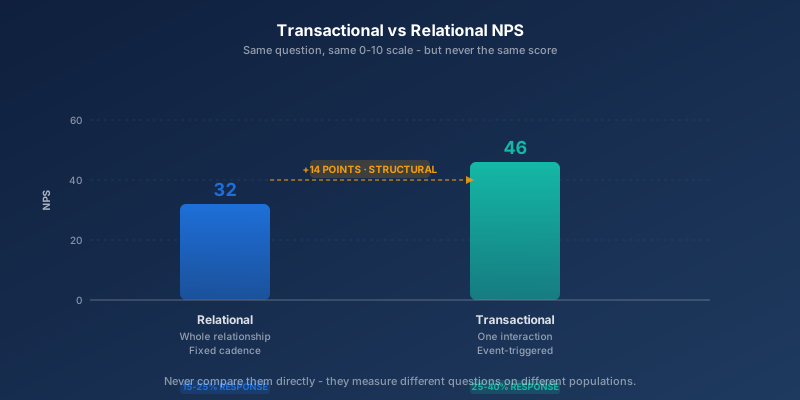
- Relational NPS measures the whole relationship on a fixed cadence, usually quarterly or twice a year. Transactional NPS measures one interaction, right after it happens.
- The two scores are not comparable. Transactional NPS typically runs 10 to 15 points higher because it catches customers at a moment of engagement. Comparing them is one of the most common measurement mistakes in B2B.
- Relational NPS is the number that tracks renewal risk. Transactional NPS is the number that tells you which touchpoint to fix. You need both, for different jobs.
- The contrarian part: a rising transactional score can hide a falling relationship. A customer can rate every support ticket a 9 and still not renew, because the relationship is decided by more than the sum of its tickets.
Contents9 sections
Relational NPS tells you whether the relationship is healthy. Transactional NPS tells you where a specific process broke. Confuse the two, and you will draw the wrong conclusion from the right data.
What is the difference between transactional and relational NPS?
Transactional and relational NPS use the same question and the same 0 to 10 scale, but they answer different questions. Relational NPS asks how the customer feels about you as a whole, on a fixed cadence, independent of any single event. Transactional NPS asks how one specific interaction went, triggered by that interaction and sent while it is still fresh.
That difference in timing changes everything downstream: who you survey, how often, what the score means, and what you do with it. Relational NPS is a strategic instrument. It answers "is this account getting stronger or weaker?" Transactional NPS is an operational instrument. It answers "did onboarding, support, or delivery just work or fail?" If you only remember one thing, remember this: relational is about the relationship, transactional is about the process. Start with What Is NPS? if you need the fundamentals first.
Why you can never compare the two scores
Here is the trap. A company runs relational NPS at 32 and transactional NPS on support at 46, sees the gap, and concludes support is carrying the relationship. That conclusion is wrong, because the two numbers were never on the same scale to begin with.
Transactional NPS typically runs 10 to 15 points higher than relational NPS for the same customer base. The reason is structural, not performance-related. A transactional survey reaches someone at a moment of engagement, often right after a problem was solved, when goodwill is highest. A relational survey reaches the whole account at an arbitrary moment, including the customers who are quietly unhappy and would never open a support ticket. Different populations, different emotional states, different numbers.
This shows up in response rates too. Transactional surveys land 25 to 40 percent response rates because the trigger makes them feel relevant; relational surveys sit at 15 to 25 percent (Zonka Feedback, 2026). The higher engagement is exactly why transactional scores are inflated relative to relational ones.
So compare like with like. Track relational against relational over time, and transactional against transactional per touchpoint. Never put them in the same chart and draw a line between them. Our 2026 NPS benchmarks make the same point about comparing across industries and regions: a number without matched context misleads.
When to use relational NPS
Use relational NPS to answer the question your leadership actually cares about: are our accounts getting more or less loyal? It is the metric that belongs in the board pack, because it moves slowly and reflects the whole relationship rather than the last thing that happened.
Run it on a fixed cadence. Quarterly works for most B2B companies with active account management. Twice a year is fine for lower-touch models, and annual is the floor below which you cannot see a trend. Survey the decision-makers and key users across the account, not just your day-to-day contact, because in B2B the person who renews the contract is often not the person who files the tickets. Covering the whole buying group like this, and weighting the result by account value, is the core of account-based CX.
Relational NPS is also where key driver analysis earns its keep. Because the survey covers the whole relationship, the open-text follow-up tells you what is actually shaping loyalty: product, price, partnership, or support. That is a strategic input. A transactional survey cannot give you that, because it only ever asks about one moment.
When to use transactional NPS
Use transactional NPS to find and fix the specific touchpoints that make or break the experience. Trigger it right after the interaction that matters: onboarding completion, a resolved support case, a delivery, a quarterly business review. Send it within 24 hours, while the customer still remembers the detail.
The value of transactional NPS is diagnostic precision. When onboarding transactional NPS drops, you know where to look. When support transactional NPS climbs after you change your resolution process, you have evidence the change worked. It is fast feedback on operations, and it feeds closing the loop directly: a low transactional score is a named customer, a specific event, and a reason, which is everything you need to follow up within 48 hours.
The risk with transactional NPS is over-collection. Because it is easy to bolt onto every workflow, teams end up surveying the same contacts after every interaction and burn the relationship for a metric. More on that below, and in our guide to survey response rates.
Transactional vs. relational NPS at a glance
| Dimension | Relational NPS | Transactional NPS |
|---|---|---|
| What it measures | The whole relationship | One specific interaction |
| Trigger | Fixed calendar (time-based) | An event (interaction-based) |
| Cadence | Quarterly to annually | Immediately after the event |
| Typical response rate | 15 to 25 percent | 25 to 40 percent |
| Who you survey | Decision-makers and key users | The person who had the interaction |
| Best for | Renewal risk, strategy, the board pack | Fixing touchpoints, operations |
| Score behaviour | Baseline; moves slowly | Runs 10 to 15 points higher; moves fast |
Response-rate ranges: Zonka Feedback NPS response-rate benchmarks (2026). Score offset is widely reported across NPS practitioners and is consistent with our own benchmark data.
- Low end of range
- High end of range
- Relational NPS15%25%
- Transactional NPS25%40%
The Coverage Problem: A Healthy Relational Score Can Still Hide a Churning Account
Everything above assumes your relational NPS actually reflects the account. It often does not, and the reason has nothing to do with cadence or channel.
CustomerGauge's own framing of the problem is blunt: you survey one contact in a ten-stakeholder account. That contact is a Promoter. You have no idea the other nine are furious, because nobody asked them. A quarterly relational NPS built on a single respondent per account is not meaningfully more reliable than a one-off transactional score. It just runs on a slower clock. Coverage, not cadence, is what makes a relational score trustworthy.
This is a real, common gap, not an edge case. CustomerGauge estimates that 40 percent of B2B leaders lack a clear view of their customers and their communication points, which is precisely the condition that lets a single happy contact stand in for a whole buying committee. If your champion answers the survey and your economic buyer, who is quietly evaluating a competitor, never gets asked, your relational NPS will tell you the account is healthy right up until the renewal call that ends badly.
The fix is not a new metric. It is tracking response coverage, the share of named stakeholders in an account who actually responded, alongside the score itself. A relational NPS of +45 built on 80 percent stakeholder coverage means something different from the same +45 built on one contact out of eight. Weighting feedback by account value and surveying the whole buying group, the core of account-based CX, solves the coverage problem directly. For accounts too small to reach a statistically comfortable response volume in the first place, see B2B survey sampling with a small n.
The B2B mistake: measuring one, and measuring it too rarely
Most B2B companies do one of two things, and both are wrong. Either they run a single annual relational survey and call it a Voice of Customer programme, or they scatter transactional surveys across every workflow and never step back to measure the relationship as a whole. The first group cannot see problems until renewal season. The second group drowns in touchpoint data and still cannot answer whether the account is at risk.
The relationship is not the sum of the transactions. This is the point that trips up teams who lean entirely on transactional NPS. A customer can rate every single support ticket a 9 and still churn, because loyalty in B2B is decided by things a ticket survey never touches: whether your product still fits their strategy, whether a competitor got cheaper, whether their champion left. A rising transactional score feels like progress while the relationship quietly erodes underneath it. If you only watch transactional NPS, you will be surprised by a cancellation you should have seen coming. That is why relational NPS, run on a real cadence, is not optional.
How to run both without survey fatigue
You do not need more surveys. You need the right survey at the right moment, and a rule that protects the customer's inbox. Here is the model we recommend to Nordic B2B clients.
Set relational NPS as your backbone: quarterly, to decision-makers and key users, with one open-text follow-up on the main reason for the score. Layer transactional NPS only on the two or three touchpoints that genuinely predict loyalty, usually onboarding and support resolution, not every email exchange. Then apply a contact-frequency cap so no individual gets more than one survey in a rolling four-to-six week window, and relational always takes priority over transactional if both would fire.
Take a hypothetical mid-market client, Nordika A/S. They were sending a transactional survey after every support ticket, which meant their power users got surveyed weekly and stopped responding. We cut transactional NPS to onboarding and first-resolution only, added a quarterly relational survey to the buying committee, and set a six-week contact cap. Response rates on the relational survey moved from the low twenties into the high thirties, and for the first time they could see a renewal risk two quarters before the contract date. Fewer surveys, better signal. For the full playbook on lifting response rates, see our guide for B2B teams.
From two scores to one system
Two NPS programmes are worse than none if neither leads to action. The point of separating relational and transactional is that each drives a different response. Relational NPS drives strategy: which accounts get an executive sponsor, where the product roadmap needs to bend, which segment is slipping. Transactional NPS drives operations: which touchpoint gets fixed this month, which support pattern needs a process change.
Both feed the same close-the-loop discipline. A relational detractor is a strategic conversation with the account owner. A transactional detractor is a same-week fix on a specific event. Run them as one system with two inputs, not two dashboards that never meet. That is the difference between measuring NPS and managing with it.
SurveyGauge helps Nordic B2B companies run relational and transactional NPS as one system, so you fix the touchpoints and see renewal risk early, without burning the relationship on surveys. Get a free demo or see pricing.
Frequently Asked Questions
Ready to know what your customers actually think?
SurveyGauge helps Nordic B2B companies move from gut feeling to data-driven CX decisions.
SurveyGauge Team
Customer Experience Experts
SurveyGauge-teamet hjælper virksomheder med at måle og forbedre kundetilfredshed via professionelle surveys, analyser og rådgivning.
You might also be interested in
View all articles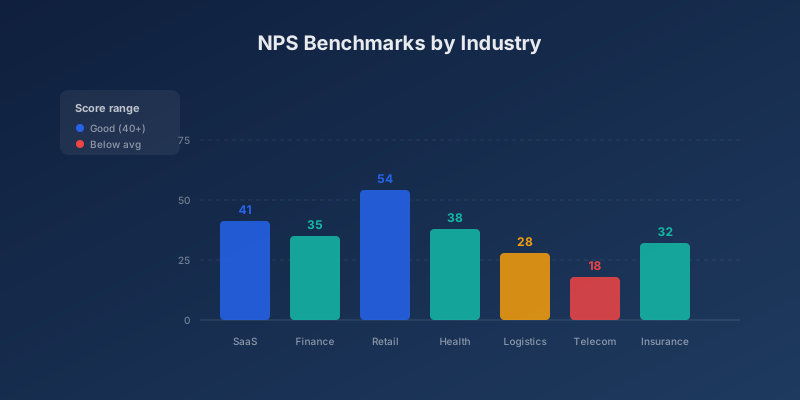
NPS Benchmarks 2026: What Is a Good NPS Score by Industry?
An NPS of 30 is excellent in telecoms but mediocre in SaaS. See good NPS scores by industry, region and business model for 2026 - and how to read them.
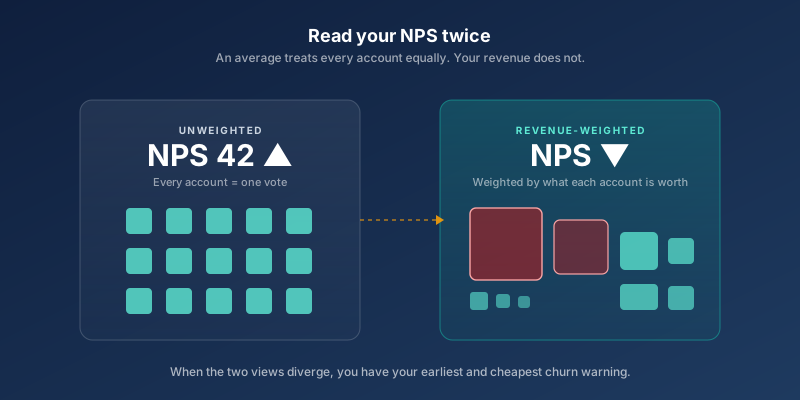
Account-Based CX: Run Your Feedback Programme on the Accounts That Pay the Bills
In most B2B companies a small share of accounts carries most of the revenue, yet every account gets the same survey and the same weight in the score. Account-based CX fixes that mismatch: weight feedback by account value, survey the whole buying group, and tier your follow-up.
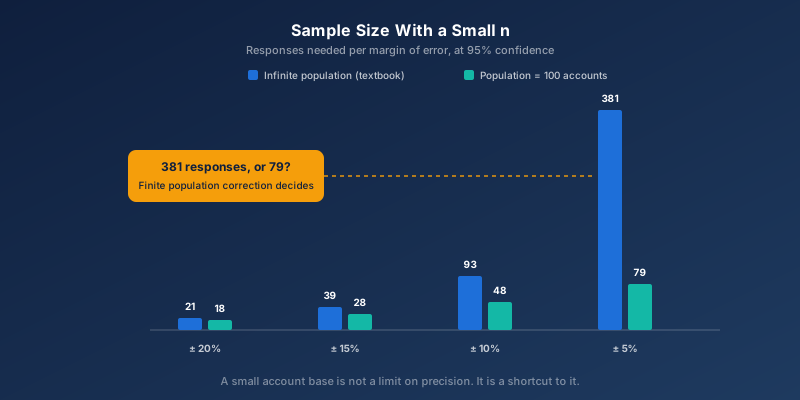
B2B Survey Sampling With a Small n: How Many Responses Do You Actually Need?
Classic sample-size formulas assume you are drawing from millions of people. When your entire customer base is 40 or 100 named accounts, the math works differently, and often in your favor.
![What Is NPS? The Complete Guide to Net Promoter Score [2026]](/img/knowledge/nps.svg)
What Is NPS? The Complete Guide to Net Promoter Score [2026]
NPS is the most widely used loyalty metric in the world, and also the most frequently misused. Indeed, the score means nothing without follow-up. Here is how to use it properly.