
How to Build Customer Loyalty: Strategies That Drive Loyal B2B Customers [2026]
How do you build customer loyalty in B2B? Why satisfied customers still leave, the real drivers, and the concrete moves that turn accounts into advocates.
![How to Build Customer Loyalty: Strategies That Drive Loyal B2B Customers [2026]](/img/knowledge/customer-loyalty.svg)
- Loyalty is not the same as satisfaction. A satisfied customer stays until something better appears. A loyal customer stays because the relationship itself has value.
- Between 60% and 80% of B2B customers who switch suppliers said they were "satisfied" or "very satisfied" shortly before they left (Reichheld & Sasser). A high satisfaction score does not protect an account.
- The strongest loyalty drivers in B2B are reliability, low effort and feeling understood, not discounts. See the six pillars.
- Closing the loop is the single most effective loyalty engine: a customer whose problem was handled well is often more loyal than one who never had a problem.
- Measure loyalty with relationship NPS over time, and connect it to retention and expansion so you can see the impact on revenue, instead of trusting the score on its own.
Contents8 sections
How do you build customer loyalty?
You build customer loyalty by consistently delivering on your promises, removing friction from the relationship, responding quickly and visibly when something goes wrong, and providing value beyond the product itself. Loyalty is the result of many small, reliable experiences over time, not of one-off campaigns or discounts. In B2B, where relationships are long and switching costs high, it is proactive contact and demonstrated value that bind a customer to you.
In other words, loyalty is not something you can buy. It is something you earn, one experience at a time.
Loyalty is not the same as satisfaction
This is the most important point to settle first. Satisfaction is a judgement of an experience right now. Loyalty is a behaviour over time: staying, buying more and recommending you to others.
The distinction matters because a satisfied customer can still churn, and the research on this is uncomfortably consistent. Frederick Reichheld and W. Earl Sasser's classic defection research found that 60 to 80 percent of customers who switch suppliers had rated themselves "satisfied" or "very satisfied" shortly before they left. Satisfaction, in other words, is a poor early warning system. It tells you the last interaction was good enough. It does not tell you whether the customer would notice, or care, if you disappeared.
| Satisfied customer | Loyal customer | |
|---|---|---|
| Attitude | "It works fine" | "I would not want to be without you" |
| When a better offer appears | Considers switching | Stays |
| Expansion | Has to be convinced | Is open and proactive |
| Recommendation | Rarely | Actively |
Satisfaction is the floor. Loyalty is what you build on top of it.
Why "satisfied" customers still walk
Bain & Company has documented this gap directly in B2B. In one account the firm studied, 94 percent of customers described themselves as satisfied or very satisfied, yet within eight weeks two of the company's largest accounts had quietly put their business out to competitive bid. Nothing in the satisfaction data predicted it, because satisfaction was never the question that mattered.
The same firm's broader research on what it calls the "delivery gap" found that 80 percent of companies believe they deliver a superior customer experience, while only 8 percent of their customers agree. That 72-point gap is where B2B accounts quietly disengage: procurement quietly starts a benchmarking exercise, a competitor gets a foot in the door at the next renewal conversation, and the incumbent supplier finds out only when the RFP lands.
The counterintuitive part is what actually separates a satisfied customer from a loyal one: emotion, not evaluation. A multi-year Motista study covering more than 100,000 customers across 100-plus brands found that emotionally connected customers deliver 306 percent higher lifetime value than customers who are merely satisfied, stay on average 5.1 years versus 3.4 years, and recommend the supplier at a rate of 71 percent versus 45 percent. In B2B, that emotional connection is built by the account team a customer deals with every week, not by a product spec sheet. It is also why a well-handled problem often creates more loyalty than a clean track record: it is the one moment where the relationship, not just the transaction, actually got tested.
What drives loyalty in B2B?
The real drivers are rarely the ones companies assume. It is not loyalty programs or discounts. The strongest drivers are reliability, low effort and the feeling of being understood.
A useful framework is the six pillars of customer experience: personalisation, integrity, expectations, resolution, time and effort, and empathy. In B2B, three carry particular weight:
- Reliability (integrity and expectations): Do you deliver what you promise, every time? Predictability is underrated. A supplier you can count on is hard to say goodbye to.
- Low effort (time and effort): How easy is it to work with you? Every extra hurdle, every time the customer has to repeat themselves, erodes the relationship.
- Being understood (empathy and personalisation): Is the customer treated as a known partner or as a case number? In B2B, where relationships are personal, this matters enormously.
All three depend on the engagement of the specific people who serve the account, which is why eNPS sets a ceiling on your customer experience: loyalty cannot climb higher than the team delivering it on a bad week.
Closing the loop: the loyalty engine
If you do only one thing to build loyalty, close the loop on dissatisfied customers. Closing the loop means following up on negative feedback and visibly doing something about it.
The counterintuitive result: a customer who experienced a problem that was solved well and quickly is often more loyal than a customer who never had a problem at all. A well-handled problem is proof that you can be trusted when it counts.
In practice, this means: when a customer gives a low score, someone responsible reaches out shortly after, understands the cause, resolves it and reports back. It signals that you are listening, and that signal is exactly what loyalty grows from.
Retention, expansion and advocacy
Loyalty shows up in three kinds of behaviour, and all three can be managed.
Retention is the foundation. Acquiring a new customer costs 5-7x more than retaining an existing one (Bain & Company), and a 5% improvement in retention increases profit by 25-95%. Prevent churn by catching warning signs early, as we describe in the guide on reducing churn.
Expansion comes almost naturally from loyal customers. A customer who trusts you is open to extending the relationship. Expanding an existing, loyal account is both cheaper and more likely than winning a new one, and it is the exact revenue lever a business case for CX should lead with; see customer satisfaction and revenue for how to make that argument to your CFO.
Advocacy is the strongest form of loyalty: the customer actively recommends you. In B2B, where buying is heavily driven by peer recommendations, a loyal advocate is worth more than a large marketing budget.
Concrete B2B moves that build loyalty
- A dedicated point of contact with authority. The customer should know who to call, and that person should be able to act.
- Proactive rather than reactive contact. Reach out before the problem grows. A check-in ahead of a renewal signals that you are invested in the relationship.
- Structured QBRs. Use quarterly reviews to show concrete value and align expectations going forward.
- Visible follow-up on feedback. Tell customers what you changed because of what they told you. It is the best reason to respond next time.
- Strong onboarding. The first 90 days often shape the entire relationship. Early value realisation builds loyalty from the start.
- Do not reward only the new. Make sure loyal customers feel that their loyalty is recognised. The quietest, most loyal accounts are often the ones companies survey least, because they rarely complain; account-based CX exists precisely to stop those accounts from going unheard.
How to measure loyalty
You cannot manage loyalty without measuring it. The most widely used metric is NPS, which measures willingness to recommend you and is a strong proxy for future behaviour.
But NPS alone is not enough, and most B2B companies stop at exactly the point where it becomes useful. CustomerGauge's benchmark research finds that 47 percent of B2B companies do not measure upsell, cross-sell or other loyalty-driven revenue at all: they track a score and stop there. NPS only becomes truly useful when you connect it to actual behaviour:
| Loyalty signal | What it measures |
|---|---|
| Relationship NPS | Willingness to recommend over time |
| Retention rate | How many accounts stay |
| Net revenue retention | Whether existing accounts grow |
| Referrals | How many new customers loyal customers bring |
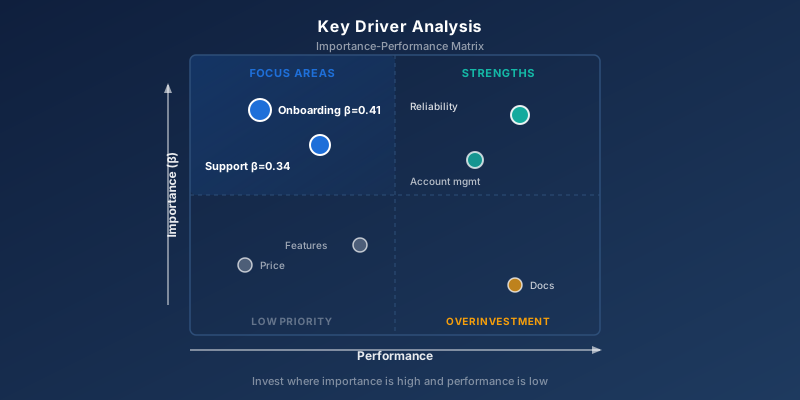
Track the trend over time rather than fixating on a single number, and segment by account type. An overall score can hide the fact that your most important accounts are slipping away while smaller ones prop up the average. Reading and weighting loyalty per account, the heart of account-based CX, is what keeps that blind spot from forming. When the number moves, a key driver analysis tells you which underlying experience actually caused the move, so you can fix the driver rather than just the score. It is precisely the link between loyalty and revenue that turns loyalty into a business discipline rather than a soft value.
Frequently Asked Questions
Ready to know what your customers actually think?
SurveyGauge helps Nordic B2B companies move from gut feeling to data-driven CX decisions.
SurveyGauge Team
Customer Experience Experts
SurveyGauge-teamet hjælper virksomheder med at måle og forbedre kundetilfredshed via professionelle surveys, analyser og rådgivning.
You might also be interested in
View all articles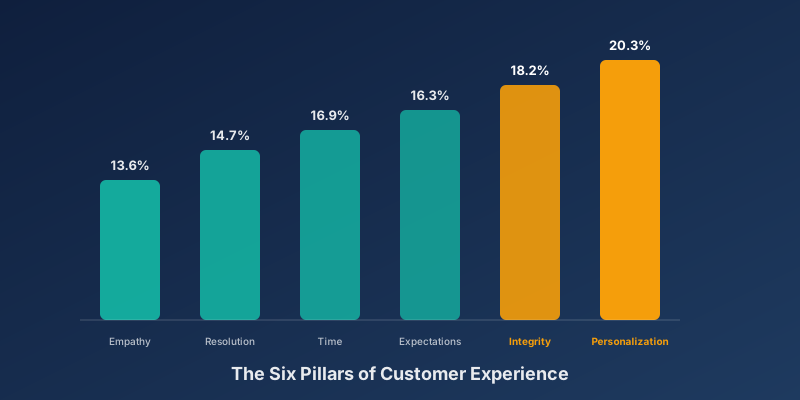
The 6 Pillars of Customer Experience: What Drives Loyalty and NPS
KPMG's Customer Experience Excellence report identifies six universal drivers behind NPS and loyalty, weighted from 80,594 interviews. Integrity and Personalization combined drive 39% of loyalty, and B2B buying committees make Personalization structurally harder than in B2C.
![Customer Satisfaction and Revenue: How to Build the Business Case [2026]](/img/knowledge/revenue.svg)
Customer Satisfaction and Revenue: How to Build the Business Case [2026]
Your CFO does not care about NPS. They care about revenue. Here is how to translate customer satisfaction into retention, expansion and profit, and why fixing your Detractors is worth more than creating new Promoters.
![Close the Loop: The Complete Guide to NPS Follow-Up [2026]](/img/knowledge/close-the-loop.svg)
Close the Loop: The Complete Guide to NPS Follow-Up [2026]
Most B2B companies that measure NPS never act on it. This guide breaks down the 48-hour rule for Detractors, segment-specific workflows for Detractors, Passives and Promoters, the CRM integration that makes it stick, and the four numbers that prove it is working.
Key Driver Analysis: Find Out What Actually Moves Your NPS
NPS tells you THAT something is wrong. Key driver analysis tells you WHAT. Here is the method that turns a score into a prioritised action plan.

How to Reduce Churn: 7 Strategies That Work
Churn is the most expensive problem most B2B companies underestimate. Seven strategies that work, from NPS early warning systems to win-back campaigns, with the CustomerGauge and Bain research behind each one.
![What Is NPS? The Complete Guide to Net Promoter Score [2026]](/img/knowledge/nps.svg)
What Is NPS? The Complete Guide to Net Promoter Score [2026]
NPS is the most widely used loyalty metric in the world, and also the most frequently misused. Indeed, the score means nothing without follow-up. Here is how to use it properly.