
What Is Customer Satisfaction? The Complete B2B Guide [2026]
Every company says they care about customer satisfaction. Yet few can define it, measure it properly, or connect it to revenue. Here is how to do all three.
![What Is Customer Satisfaction? The Complete B2B Guide [2026]](/img/knowledge/customer-satisfaction.svg)
- Customer satisfaction is the gap between what customers expect and what they receive. It is always relative, always multi-dimensional, and always shifting.
- Three metrics cover the territory: CSAT for touchpoint quality, NPS for loyalty prediction, CES for friction and churn risk.
- Bain & Company's research is clear: a 5% improvement in retention increases profit by 25-95%. Satisfaction is the mechanism that makes retention possible.
- Instead, satisfaction is not a goal. It is a diagnostic instrument. The companies that treat it as a vanity metric get vanity results.
- In B2B, satisfied accounts renew, expand, and refer. Dissatisfied ones leave quietly and tell their peers to avoid you.
- External benchmarks move faster than most companies plan for. One industry's CSAT benchmark dropped 24 points in a single year in 2026, so treat any external number as a sanity check, not a fixed target.
Contents8 sections
What Is Customer Satisfaction? The Complete B2B Guide
"Customer satisfaction" appears in every annual report and every company mission statement. It is also one of the most poorly understood concepts in business.
Most organisations treat satisfaction as a goal: "Improve customer satisfaction." That sounds reasonable but is essentially meaningless. In other words, it is like saying "be healthier" without diagnosing what is wrong or measuring whether treatment works.
Customer satisfaction is not a goal. It is a diagnostic instrument. It tells you where your business creates value and where it falls short. Indeed, when you connect it to retention, expansion, and referral data, it becomes the most reliable predictor of commercial performance you have.
A Working Definition
Customer satisfaction is the gap between what customers expect and what they receive. Simple to state. Hard to manage. Because it has three properties that most companies underestimate.
Satisfaction is relative
A customer who expects basic functionality and receives it is satisfied. A customer who expects premium service and receives average service is dissatisfied, even if the objective quality is identical. Expectations are the baseline, not your product specifications.
Satisfaction is multi-dimensional
Your customer does not have a single opinion about your company. They might love your product but resent your invoicing process. They might rate support highly but find onboarding confusing. One aggregate score hides all of this. Effective measurement captures satisfaction at each dimension separately.
Satisfaction is a moving target
What satisfied customers last year will not satisfy them this year. Competitors improve. Expectations rise. Markets evolve. Consequently, a programme that measures satisfaction once and assumes the results are permanent is a programme that will be blindsided.
In B2B, these dynamics carry extra weight. A SaaS company serving enterprise clients must satisfy multiple stakeholders within a single account: end users, managers evaluating ROI, and executives approving renewals. Each group has different expectations. Overall account health depends on meeting all of them.
Why Satisfaction Matters More in B2B
B2B contracts are larger, sales cycles are longer, and the cost of acquiring a new customer is 5-25x higher than retaining an existing one (Harvard Business Review). As a result, the financial stakes of satisfaction are not comparable to B2C.
The revenue connection
Bain & Company's research found that a 5% increase in customer retention increases profits by 25-95%. In B2B, this effect is amplified by three revenue mechanisms that depend directly on satisfaction:
-
Renewal revenue. Satisfied customers renew. In SaaS, renewal rates above 90% require consistently high satisfaction. There is no shortcut.
-
Expansion revenue. Satisfied accounts buy more. Gainsight's 2023 report found that companies with strong satisfaction programmes generate 2-3x more expansion revenue than those without structured feedback.
-
Referral revenue. 84% of B2B buyers start the purchasing process with a peer recommendation (Gartner). Satisfied customers are 3-7x more likely to refer than neutral ones.
The cost of dissatisfaction
Only 1 in 26 unhappy customers complains directly (Esteban Kolsky's research). The other 25 either leave silently or tell peers to avoid you. Moreover, in tightly connected B2B industries, a single dissatisfied account can poison dozens of potential deals.
A concrete example: a mid-market SaaS company with 200 accounts at $50,000 average contract value. If satisfaction drops and annual churn rises from 8% to 14%, that is 12 additional lost accounts per year, $600,000 in recurring revenue. Factor in replacement costs (typically 5-7x retention cost) and the annual impact exceeds $3 million.
The Three Metrics That Matter
No single metric captures customer satisfaction. The three most adopted metrics each measure a different dimension. Therefore, effective programmes use them in combination.
Customer Satisfaction Score (CSAT)
CSAT is the most direct measure. Ask how satisfied the customer was with a specific experience, on a 1-5 scale. The score is the percentage who rated 4 or 5.
Net Promoter Score (NPS)
NPS measures loyalty through willingness to recommend, on a 0-10 scale. Promoters (9-10) minus Detractors (0-6) gives you the score.
Customer Effort Score (CES)
CES measures how easy or difficult it was for a customer to accomplish a task. Scored on a 1-7 scale.
How they compare
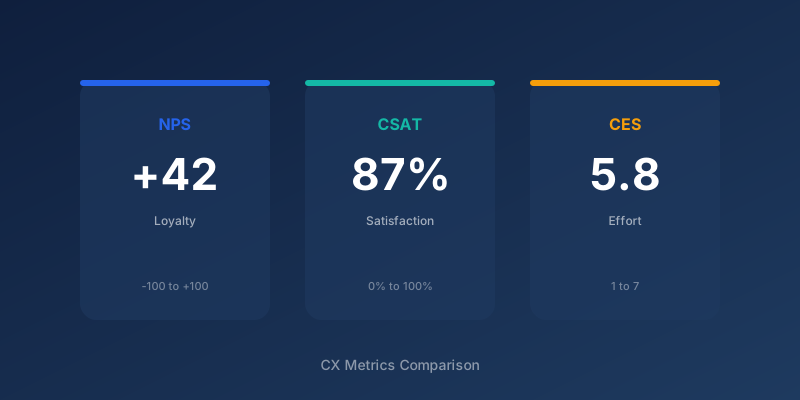
| Dimension | CSAT | NPS | CES |
|---|---|---|---|
| Measures | Touchpoint satisfaction | Loyalty and recommendation | Effort and friction |
| Scale | 1-5 | 0-10 | 1-7 |
| Typical B2B benchmark (2026) | 65-80% cross-industry; 70-90% is a strong result¹ | Median 58 in healthcare to 31 in telecommunications² | 5.0-5.8 cross-industry average, 6.2+ in the top quartile² |
| Orientation | Transactional | Relational | Transactional |
| Predicts | Touchpoint quality | Growth and referrals | Churn (Gartner) |
| Timing | After specific interaction | Quarterly or biannually | After support or process |
| B2B strength | Process diagnostics | Account health | Operational friction |
| Limitation | Poor at predicting loyalty | Misses specific pain points | Narrow scope |
¹ Retently, 2026 CSAT Benchmarks by Industry. ² CustomerGauge, global B2B NPS and CX benchmarks, 2026. Full breakdown in our NPS benchmarks by industry.
For the full comparison: NPS vs. CSAT vs. CES.
What Counts as a Good Score, and How Fast It Moves
Ask what a "good" CSAT or NPS score is, and most answers default to a fixed number. That number is more fragile than it looks.
Retently's 2026 CSAT benchmark study puts the cross-industry range at 65-80%, with 70-90% counted as a strong result. B2B Software and SaaS companies cluster in the high 70s, close to Consulting and Digital Marketing Agencies at 83, the strongest performers this year. On NPS, CustomerGauge's global B2B survey shows healthcare with the highest median score at 58 and telecommunications the lowest at 31, with most industries in between (see our full NPS benchmarks by industry for the complete breakdown). CES sits on its own 7-point scale, and CustomerGauge puts the cross-industry average between 5.0 and 5.8, with top-quartile programmes reaching 6.2 or higher.
Here is the counterintuitive part: these numbers move more than most companies assume, and not always in the direction you would guess. Healthcare's CSAT benchmark fell from 81 in 2025 to 57 in 2026, one of the steepest year-over-year drops Retently has recorded, after several years near the top of the ranking. If you set this year's target using last year's industry number, you may be aiming at a target that no longer exists. Track your own trend against your own history first. Use the external benchmark as a sanity check, not a fixed target.
There is a second, quieter gap worth naming. Qualtrics' XM Institute research on B2B CX practice found that 75% of B2B firms track NPS as a core CX metric, while only 41% track satisfaction (CSAT) with the same discipline. Most companies have picked one metric to institutionalise and treated the others as optional, which is exactly the mistake the comparison above warns against. If your organisation only reports NPS, you may be able to say the relationship is healthy without being able to say why, or where the friction actually sits.
- HealthcareCSAT 202581%
- HealthcareCSAT 202657%
Common Mistakes
1. Measuring without acting
The most damaging mistake. CustomerGauge found that 75% of B2B companies collect feedback, but fewer than 30% have a structured process for acting on it. Specifically, customers who give feedback and see no change become more dissatisfied than if you had never asked.
2. Surveying too often or too rarely
Bombarding customers with surveys after every minor interaction creates fatigue and biased results. Measuring once a year means you are always reacting to stale data.
3. Obsessing over the score instead of the trend
An NPS of 35 means nothing in isolation. Is it rising? Falling? Flat? What is driving the change? Those questions matter. The number does not.
4. Ignoring qualitative feedback
Numbers tell you something is wrong. Open-text comments tell you what and why. Most programmes invest in quantitative measurement and barely glance at the qualitative data.
5. Not segmenting
An average satisfaction score across your entire base hides everything that matters. Different segments have different experiences.
Building a Measurement Programme
Step 1: Define what you want to achieve
Before choosing metrics, clarify the objective. "Improve customer satisfaction" is not an objective. These are:
- Reduce annual churn from 12% to 8%
- Identify the top three friction points in the customer journey
- Establish an NPS baseline for competitive benchmarking
- Connect satisfaction data to renewal and expansion outcomes
Step 2: Map key touchpoints
Identify the moments where satisfaction has the greatest impact on business outcomes. For a typical B2B SaaS company:
- Onboarding completion: Does the customer feel confident?
- First value milestone: Have they achieved their initial goal?
- Support interactions: Was the issue resolved quickly?
- Renewal decision point: Is account health strong enough for renewal?
- Business reviews: Does the customer perceive ongoing value?
Assign a metric (CSAT, CES, or transactional NPS) to each touchpoint, with automated triggers.
Step 3: Design a survey strategy
Relational surveys (quarterly NPS) capture overall relationship health across a broad cross-section of contacts within each account.
Transactional surveys (CSAT, CES) capture satisfaction with specific experiences, triggered by events like ticket closure or onboarding milestones.
Keep transactional surveys to one scaled question plus one open-ended question. Keep relational surveys under eight questions.
Step 4: Close the loop
Bain & Company's research shows that companies with structured closed-loop processes achieve 10-15% higher retention than companies that simply collect scores. The workflow:
- Acknowledge feedback within 24 hours
- Route critical feedback to the right owner
- Investigate the root cause, not just the symptom
- Implement a fix
- Follow up with the customer to confirm resolution
For the detailed playbook: Close the Loop.
- 1AcknowledgeWithin 24 hours
- 2RouteTo the right owner
- 3InvestigateRoot cause, not symptom
- 4ImplementShip the fix
- 5Follow upConfirm resolution
Step 5: Connect satisfaction to revenue
The test of a programme is whether it moves commercial numbers. Build reporting that links satisfaction to retention, expansion, and referral outcomes. Do accounts with NPS above +50 renew at higher rates? Do low-effort customers expand faster? Those correlations justify investment and guide resource allocation.
Where you land on these five steps says less about your survey tool than about your organisation's overall CX maturity. See our CX maturity model for a self-diagnostic before you set next year's targets.
What We See in Practice
Among the B2B companies we work with, the difference between effective and ineffective satisfaction programmes comes down to three things:
Effective programmes measure at the right moments. Not once a year. Not after every micro-interaction. At the touchpoints that actually determine whether customers stay, expand, or leave. Onboarding, support, renewal.
Effective programmes connect feedback to revenue data. When you can show that accounts with NPS above +40 renew at 96% while those below +10 renew at 72%, the CX programme stops being a cost centre and starts being a revenue driver.
Effective programmes have closed-loop discipline. Every detractor contacted within 48 hours. Root causes documented. Actions tracked. Customers informed of changes.
A concrete example: a B2B analytics platform with 500 accounts at $75,000 average contract value. They run quarterly NPS to 3-5 contacts per account, CSAT at three onboarding milestones, and CES after every support ticket. After 12 months, they demonstrated a 24-point renewal gap between high-NPS and low-NPS accounts, representing $4.5 million in at-risk revenue. That number secured executive sponsorship and budget.
From Measurement to Commercial Impact
Customer satisfaction is one of the most powerful tools available to B2B companies. However, it only works when it is treated as an instrument, not a dashboard decoration.
The companies that get it right share three characteristics:
- Systematic measurement. The right metric at the right touchpoint, with consistent methodology over time.
- Disciplined action. Every piece of feedback enters a closed-loop process with clear ownership and deadlines.
- Revenue connection. Satisfaction data linked to retention, expansion, and referral outcomes, making the business case undeniable.
Start by understanding what NPS measures, how CSAT works at the touchpoint level, and which metric fits which situation.
For the commercial case: Customer Satisfaction and Revenue.
Frequently Asked Questions
Ready to know what your customers actually think?
SurveyGauge helps Nordic B2B companies move from gut feeling to data-driven CX decisions.
SurveyGauge Team
Customer Experience Experts
SurveyGauge-teamet hjælper virksomheder med at måle og forbedre kundetilfredshed via professionelle surveys, analyser og rådgivning.
You might also be interested in
View all articles![How to Measure Customer Satisfaction: Methods, Metrics and Best Practice [2026]](/img/knowledge/measure-satisfaction.svg)
How to Measure Customer Satisfaction: Methods, Metrics and Best Practice [2026]
How do you measure customer satisfaction in practice? The methods, the three metrics, who to survey in the buying group, and where passive signals fit alongside the survey.
![What Is NPS? The Complete Guide to Net Promoter Score [2026]](/img/knowledge/nps.svg)
What Is NPS? The Complete Guide to Net Promoter Score [2026]
NPS is the most widely used loyalty metric in the world, and also the most frequently misused. Indeed, the score means nothing without follow-up. Here is how to use it properly.
What Is CSAT? Guide to Customer Satisfaction Score
CSAT is the most direct satisfaction metric you can use, but it is also the most abused. Therefore, here is how to deploy it properly, when to trust it, and when it misleads.
NPS vs. CSAT vs. CES: Which Metric Should You Choose?
NPS, CSAT, and CES measure different things, and the real question in 2026 is not which one wins. It is when to layer a second metric on top of NPS, and when adding one just adds noise.