
10 Rules for Surveys That Deliver Real Insights
A poorly designed survey is worse than no survey. It gives you confidence in data that is wrong. Here are ten rules that fix the most common mistakes we see in B2B survey programmes.
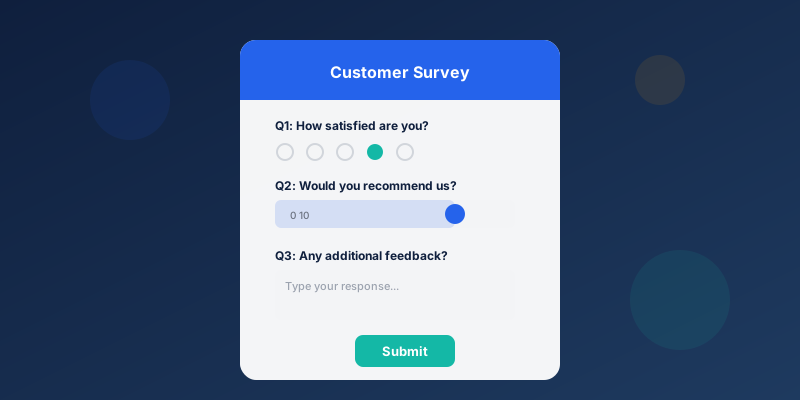
- Every question you add beyond five costs you 5-10% of your respondents. If you will not act on the answer, delete the question.
- Leading questions and double-barrelled questions give you inflated scores that hide real problems. They are worse than not measuring.
- Timing matters as much as question design. A CSAT survey sent within an hour of a support interaction outperforms one sent the next day. The difference is 2-3x in response rate.
- The open-text answer that looks the most polished may be the least trustworthy. Estimates of AI-generated survey text range from 4% to 45% depending on detection method, and a well-written, generic paragraph is now a red flag, not a good sign.
- Test the survey on real people before distributing. What is clear to you is often ambiguous to your customer.
Contents14 sections
A bad survey does not just waste time. It produces data that looks credible but is wrong. Indeed, decisions made on misleading survey data are worse than decisions made on no data, because they carry false confidence.
However, the good news: survey design mistakes are predictable and fixable. These ten rules address the ones we see most often in B2B survey programmes.
Rule 1: Fewer questions, better data
This is the single most impactful rule. Response rates collapse as surveys get longer:
| Questions | Typical Response Rate |
|---|---|
| 1-3 | 65-80% |
| 4-6 | 50-65% |
| 7-10 | 35-50% |
| 11+ | Under 35% |
For every question, ask: "Will we make a different decision based on this answer?" If not, remove it.
For transactional surveys (NPS, CSAT, CES), one metric question plus one open-ended follow-up is enough. That gives you the score and the reason.
Length is one half of scoping a survey. The other half is deciding how many responses the result has to carry: with a countable account base, that target is lower than the textbook rule suggests, as B2B survey sampling with a small n sets out.
- 1-3 questions65-80%72%
- 4-6 questions50-65%57%
- 7-10 questions35-50%42%
- 11+ questionsunder 35%30%
Rule 2: One thing per question
"How satisfied were you with the price and quality?" is a double-barrelled question. If the customer is happy with quality but unhappy with price, what do they answer? As a result, you get a compromised score that tells you nothing.
Split it. One question about price. One about quality. Each answer is now actionable.
Rule 3: No leading questions
The preamble in the leading version implies you should be satisfied. Consequently, it inflates scores, hides problems, and gives you data that feels reassuring but is fiction.
If you are getting suspiciously high scores, check your question wording first.
Rule 4: Write like a human
No jargon. No internal terminology. No complex sentence structures.
Test this way: if a 16-year-old without industry knowledge would not understand the question instantly, rewrite it.
Rule 5: Pick the right scale and never change it
- NPS: 0-10. Industry standard. Do not modify it.
- CSAT: 1-5 Likert. Most intuitive for respondents.
- CES: 1-7. Provides useful nuance.
- Agreement scales: 5-point Likert from "Strongly disagree" to "Strongly agree".
Critical rules: do not mix scale directions within a survey (high = positive on one question, high = negative on the next). Always label the endpoints with words, not just numbers, and consider including a labelled midpoint on odd-numbered scales. And never change your scale mid-programme, it destroys your trend data.
Rule 6: Question order shapes answers
Questions create context for subsequent questions. Therefore, a poorly ordered survey distorts responses.
- "Did you experience any problems with your order?"
- "How satisfied were you with your order?"
Question 1 forces the customer to think about problems, which drags down the CSAT score in question 2.
- Lead with your most important metric question (NPS or CSAT)
- Put open-ended questions at the end
- General before specific
- Do not prime the respondent with negative context before a satisfaction question
Rule 7: Let people say "I don't know"
If a customer has not used a feature, forcing them to rate it creates noise. Instead, include "Not applicable" or "Haven't used this" where relevant. Fewer valid responses are better than more invalid ones.
Rule 8: Design for mobile first
Over half of surveys are opened on phones. As a result, a survey that does not work on mobile loses half your potential respondents before they start.
- Large, touch-friendly buttons
- Radio buttons, not dropdowns
- Short text fields with clear prompts
- No matrix tables on mobile
- Test on iOS and Android before sending
Rule 9: Send at the right moment
Timing affects response rates and data accuracy equally.
Rule 10: Test before you send
The most skipped step. After all, what is clear to you is often confusing to your respondent.
The Open-Text Field Has a New Problem: AI-Written Answers
Rule 7 assumes the biggest risk in an open-text field is a blank one. In 2026, there is a second risk that did not exist when this article was first written: an answer that looks complete, polished, and reasonable, but was generated by an AI assistant rather than typed by the person you surveyed.
The scale of the problem is genuinely disputed, which is itself worth knowing. Pew Research Center's long-standing baseline for online opt-in panels puts bogus respondents at 4-7%, and found they bias results toward positive answers rather than adding random noise. A Nature feature from June 2026 cites estimates as high as 45% of survey responses now containing text copied from an LLM's output, though other studies using behavioural detection, such as paste events and typing speeds above 800 characters per minute, flag a much narrower 4-7% as confirmed AI-contaminated. The range itself is the honest answer: nobody has settled on one number yet, but the direction is consistent, this is growing, not shrinking.
NORC, the University of Chicago's survey research institute, built a detector specifically for this problem in December 2025. It reaches over 99% precision and recall identifying AI-written open-ended responses, far outperforming generic AI-text detectors, precisely because it was trained on real survey response patterns rather than essays.
For a B2B feedback programme, the practical takeaway inverts the instinct most CX teams have. A messy, specific, slightly ungrammatical open-text answer that references your product by its actual name is more trustworthy than a smooth, generic paragraph that could describe any vendor. If your platform supports it, watch for paste events and unusually fast, unusually polished responses on open-text fields, and weight the specific, concrete answer over the articulate one. See AI text analytics for customer feedback for how to route and prioritise verbatims once you trust them, and our guide to analyzing open-ended responses for the underlying method.
What We See Go Wrong
Six mistakes that recur across the survey programmes we review:
1. Too many questions. The internal stakeholder says: "While we have them, can we ask about..." The answer is almost always no. Every added question costs you 5-10% of respondents.
2. No open-ended questions. The metric tells you something is wrong. The text response tells you what and why. Skipping the open-ended question throws away the most actionable data.
3. Unanchored scales. "Rate us from 1 to 5" with no labels on what 1 and 5 mean. Respondents interpret the scale differently, and your data is unreliable.
4. Same survey for everyone. A customer in their first week should not see the same questions as a three-year customer. Use conditional logic and segmentation to keep the survey relevant.
5. No follow-up on responses. The most damaging mistake of all. Customers who take time to respond and never hear back are less likely to respond in the future, and more likely to churn. If you are not going to close the loop, do not open it.
6. Treating the open-text field as neutral. Respondents paste names, contact details, and sometimes sensitive information into free-text boxes, so the field label matters. Warn against sensitive details, and decide up front how long you keep the answers. See our guide to GDPR and customer feedback in B2B.
What We See in Practice
The most common failure is not badly worded questions. It is surveys that never lead to action. Data gets collected, dashboards update, and then nothing happens. The customer answers next time with a little less engagement. And the time after that, even less. Until they stop answering, and not long after, stop being a customer.
The second most common failure: internal stakeholders who "just want to add one more question." A good survey starts at three questions and ends at fifteen because every department wants theirs represented. Set a hard limit and hold it. Read more about closing the loop and why following up matters more than the survey itself.
Summary
Good survey design combines psychology, data literacy, and respect for your respondent's time. Keep it short. Be precise. Test before you send. And most importantly, act on what you learn. A perfectly designed survey that never leads to action is still wasted effort. In the end, it is the willingness to act on what customers tell you that separates companies that improve from companies that just measure.
Frequently Asked Questions
Ready to know what your customers actually think?
SurveyGauge helps Nordic B2B companies move from gut feeling to data-driven CX decisions.
SurveyGauge Team
Customer Experience Experts
SurveyGauge-teamet hjælper virksomheder med at måle og forbedre kundetilfredshed via professionelle surveys, analyser og rådgivning.
You might also be interested in
View all articles![What Is NPS? The Complete Guide to Net Promoter Score [2026]](/img/knowledge/nps.svg)
What Is NPS? The Complete Guide to Net Promoter Score [2026]
NPS is the most widely used loyalty metric in the world, and also the most frequently misused. Indeed, the score means nothing without follow-up. Here is how to use it properly.
![Voice of Customer (VoC): The Complete B2B Guide [2026]](/img/knowledge/voc.svg)
Voice of Customer (VoC): The Complete B2B Guide [2026]
Most VoC programmes do not die from bad technology. They die from the action nobody owns. Here is how to build one that connects feedback to account value and revenue, not just a dashboard.

What Is CSAT? Guide to Customer Satisfaction Score
CSAT is the most direct satisfaction metric you can use, but it is also the most abused. Therefore, here is how to deploy it properly, when to trust it, and when it misleads.
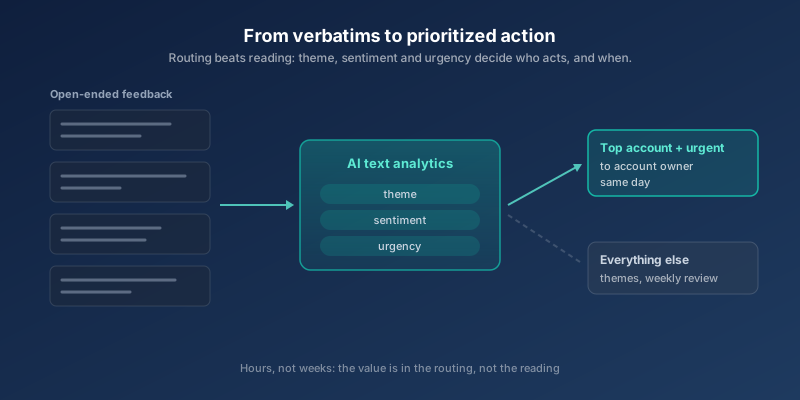
AI Text Analytics for Customer Feedback: From Verbatims to Prioritized Action
Most B2B teams buy AI text analytics to save analyst hours. The real return comes from something different: routing high-value, high-urgency feedback to the right owner in hours, not weeks.
Analyzing Open-Ended Responses: From Free Text to Actionable Insight
Most organisations collect open-ended feedback but never extract real value from it. Therefore, here is the approach we recommend for turning free text into prioritised, actionable insight.