TL;DR
- Retention as a Service (RaaS) is a delivery model where the vendor shares accountability for the customer's retention outcome: platform, advisory and the operation of the feedback loop in one subscription, measured on churn and NRR instead of licences and logins.
- Classic SaaS gets paid whether or not you succeed. 51% of all purchased SaaS licences are never used (Zylo, 2025), and a CX tool nobody operates keeps no customers.
- The test for real RaaS: advisory is included in the subscription, success criteria are business numbers (churn, NRR, detractor save rate), there is a fixed cadence with a named advisor, and the vendor reacts when your usage drops.
- RaaS is not outsourced retention. The vendor owns the measurement, the early-warning system and the cadence. You own the action, the product and the relationship. Neither half works without the other.
Contents7 sections
What is Retention as a Service (RaaS)?
Retention as a Service (RaaS) is a delivery model where the vendor shares accountability for the customer's retention outcome instead of only supplying the software to measure it. In practice, that means platform, advisory and the operation of the feedback loop are combined in one subscription, and the partnership is measured on business numbers such as churn rate, Net Revenue Retention and the save rate on dissatisfied customers, not on licence counts, logins or features.
The term is not our invention. It surfaces here and there in the customer success world, typically among agencies offering outsourced customer follow-up, but there is no established category behind it and no shared definition. The definition above is the one we work by at SurveyGauge. The rest of this article is the argument for why the model deserves its own name, and why "SaaS" has become a misleading description of what B2B companies actually need to buy when the goal is retention.
What is the problem with buying CX as SaaS?
The SaaS deal is simple: you pay a subscription, and the vendor gives you access to software. What you get out of it is your own problem. The model has made software cheaper to start with and easier to leave, and for many tool categories it is perfectly sensible.
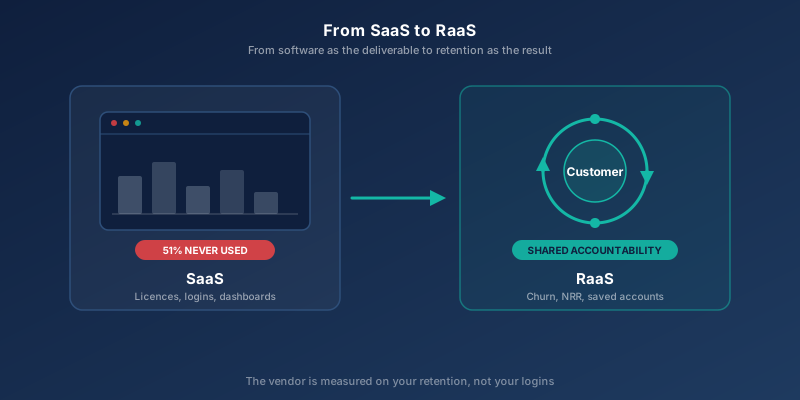
But it carries a built-in bias: the vendor gets paid whether or not you succeed. Zylo's SaaS Management Index 2025 found that 51% of the licences companies buy are never used at all. The software does not fail. It simply goes unused, and the invoice keeps arriving anyway.
For CX and feedback software the problem is bigger than wasted seats, because here the tool is only half the delivery. An NPS score in a dashboard retains nobody. Retention happens when someone calls the detractor and closes the loop within 48 hours, when the patterns in the feedback are translated into priorities, and when someone is accountable for the number quarter after quarter. That work does not ship with the licence, and the numbers show how often it never gets built: according to CustomerGauge's State of B2B Account Experience research, 44% of B2B companies do not calculate their retention rate at all, and 62% do not measure the ROI of their CX programme.
That is the quiet failure behind many CX projects. The tool was bought. The surveys ran. But the operating model around them was missing, so retention never came out the other end.
- Purchased SaaS licences that are never usedZylo, 202551%
- B2B companies that do not calculate their retention rateCustomerGauge, 202644%
- B2B companies that do not measure the ROI of their CX programmeCustomerGauge, 202662%
What is the difference between SaaS and RaaS?
The difference is not the feature list. The difference is who owns the outcome, and what the vendor is measured on.
| Classic SaaS | Retention as a Service | |
|---|---|---|
| What you buy | Access to software | A retention outcome, with software as the engine |
| Success metric | Licences, logins, feature usage | Churn, GRR/NRR, detractor save rate |
| Advisory | Paid add-on or external partner | Included in the subscription |
| When usage drops | Nothing happens, the invoice continues | The vendor reacts, low usage is a warning signal |
| Accountability for the outcome | The customer's alone | Shared and agreed: the vendor owns measurement and cadence, the customer owns the action |
| The relationship | Support queue and renewal email | Fixed cadence with a named advisor |
Note what RaaS does not promise: that the vendor can retain your customers for you. Nobody can, and anyone claiming otherwise should make you suspicious. The promise is different: that the vendor's own business only succeeds when your retention numbers move, and that the whole partnership is built around that.
How do you measure whether Retention as a Service works?
A RaaS agreement without measurable success criteria is just a SaaS subscription with nicer words. Four numbers belong in the contract, or at minimum in the standing quarterly report.
Gross Revenue Retention (GRR) shows what share of existing revenue you keep, with expansion excluded. It is the purest measure of retention. Net Revenue Retention (NRR) adds expansion and upgrades on top; above 100 means the customer base grows even without a single new customer. SaaS Capital's 2025 benchmark for private B2B software companies puts median NRR right around 100-102 depending on contract size, so anything above that is genuinely a growth engine. Churn rate has to be read against your own industry median, not a generic average; the spread across B2B industries is enormous, as we cover in the guide to reducing churn. And the detractor save rate shows whether the feedback loop actually works: CustomerGauge's research shows that companies closing the loop on all feedback within 48 hours see up to 12% higher retention.
Why the effort pays is well documented. Bain & Company's classic research shows that a 5 percentage point improvement in retention lifts profit by 25-95%, and that acquiring a new customer costs 5-7 times more than keeping an existing one. If you want to run the business case on your own numbers, take the model connecting satisfaction and revenue and plug in your own account values.
What does the vendor own, and what stays yours?
The honest answer to "can you buy retention?" is no. Your product quality, your pricing and your delivery are yours, and no external partner can fix them for you. What the RaaS model moves onto the vendor is all the systematic work around the action, the part most organisations never manage to build themselves:
- The measurement: one methodical way of measuring across the customer journey, so numbers can be compared over time instead of being re-litigated every quarter
- The early-warning system: a customer health score and detractor alerts, so at-risk accounts are spotted inside the 60-90 day decision window before the cancellation, not after
- The prioritisation: key driver analysis that turns hundreds of comments into the three things that actually move retention
- The cadence: standing reviews where the numbers go on the table, and someone from outside asks why last quarter's action plan was not executed
What stays with you is the action: calling the unhappy account, fixing the product problem the feedback points to, and keeping leadership's attention on the number. That division of labour is not a weakness of the model. It is the model. It does assume the action has a named owner on your side, though, and deciding who that should be is a governance question in its own right; who owns customer experience in a B2B organization covers how to settle it.
Is RaaS just another buzzword?
The scepticism is deserved. The software industry has named everything from storage to payments "as a Service", and a new acronym changes nothing by itself. Whether RaaS means anything is decided by whether the word changes anything in the contract and in the operation. The test is simple, and you can apply it to any vendor, including us:
- Is advisory included in the subscription, or is it an hourly-rate add-on when things go wrong?
- Do the success criteria contain business numbers: churn, NRR, save rate, time to loop closure?
- Is there a fixed cadence with a named person who knows your numbers, or a support queue?
- Does the vendor react when your usage drops, or do you discover it yourselves at renewal?
If a vendor cannot answer yes to all four, it is SaaS with a new sticker, whatever the pitch deck says.
Why we call SurveyGauge Retention as a Service
We have never seen ourselves as a tool. From the start, SurveyGauge has combined the feedback platform with strategic CX advisory in one subscription, because we kept seeing the same pattern: B2B companies that had bought perfectly decent survey software and still had no retention outcome, because nobody operated the work between the measurements. "A partner, not a tool" has been our way of saying it for years. Retention as a Service is the precise version of the sentence.
In practice it means our advisors sit at the table when your numbers are read, that the close-the-loop process is designed and followed up as part of the agreement, and that we are ourselves measured on the four numbers above, quarter by quarter. We do not promise a specific churn rate; that would be unserious, because the action sits with you. We promise to build and operate the system that moves it, together with you.
If you want to see what that looks like on your customer base, book a conversation. The price for the whole model, platform and advisory combined, is on the pricing page.
Frequently asked questions
What does Retention as a Service (RaaS) mean?
Retention as a Service is a delivery model where the vendor shares accountability for the customer's retention outcome. Platform, advisory and the operation of the feedback loop are combined in one subscription, and the partnership is measured on business numbers such as churn rate, Net Revenue Retention and the save rate on dissatisfied customers, not on licence counts or logins.
What is the difference between SaaS and RaaS?
SaaS sells access to software, and the outcome is the customer's own problem; the vendor is measured on licences and usage. RaaS sells a retention outcome with the software as the engine: advisory is included in the subscription, success criteria are business numbers such as churn and NRR, and the vendor reacts when usage drops instead of simply sending the next invoice.
Is RaaS the same as outsourcing customer success?
No. With outsourcing, an agency takes over the customer contact itself. In a RaaS model you keep the relationship and the action, while the vendor owns the measurement, the early-warning system, the prioritisation and the fixed cadence. Your customers should be retained by you, not by a third party they have never met.
Which numbers should a RaaS partner be measured on?
Four numbers cover the essentials: Gross Revenue Retention (the share of existing revenue you keep, excluding expansion), Net Revenue Retention (the same number including expansion and upgrades), churn rate read against your own industry median, and the detractor save rate, meaning the share of dissatisfied customers who are contacted, followed up and retained.
Can you outsource customer retention entirely?
No. No external partner can fix your product quality, your pricing or your delivery, and loyalty is built in your own relationship with the customer. What a RaaS partner can take over is the systematic work around the action: methodical measurement, early warning on at-risk accounts, prioritisation of initiatives and the discipline of following up quarter after quarter.
Who is Retention as a Service relevant for?
Primarily B2B companies with named accounts and recurring revenue, where losing individual customers hurts directly, and which do not have a large internal CX or customer success team. If you already run a mature setup with your own analysts, a pure tool purchase may be enough. If you do not, it is the operation and the discipline, not the software, that decides the outcome.
Is Retention as a Service just a buzzword?
The word is only worth as much as the contract behind it. The test has four questions: Is advisory included in the subscription? Are success criteria defined in business numbers such as churn, NRR and save rate? Is there a fixed cadence with a named advisor? And does the vendor react when your usage drops? If the vendor cannot answer yes to all four, it is classic SaaS under a new name.

Written by
SurveyGauge Team
The advisors and developers behind SurveyGauge. We run customer satisfaction programmes for B2B companies, from 20 key accounts to global banks.