
Close the Loop: What Is It, and How Do You Do It?
You sent the survey. Now what? Specifically, close the loop is the practical execution of following up on every response, recovering Detractors, and turning patterns into systemic fixes.
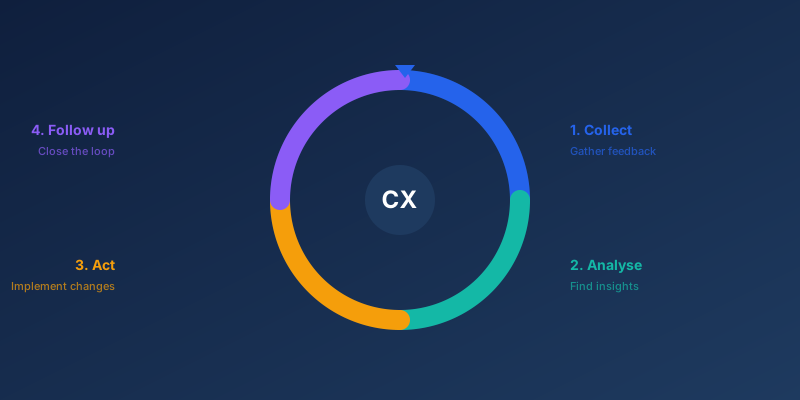
- Close the loop is the practical execution of following up on feedback. Without it, you are collecting data, not managing relationships.
- Inner loop: contact every Detractor within 48 hours. Personal call, not automated email. Listen, resolve, document.
- Outer loop: aggregate root causes monthly. Prioritise by frequency and revenue impact. Fix the systemic problems, not just the individual complaints.
- Indeed, the service recovery paradox is real: customers whose problem was resolved well become more loyal than those who never had one.
Contents14 sections
The gap between collecting and acting
You send an NPS survey. Customers take time out of their day to respond. Some are frustrated. Some are enthusiastic. Most are somewhere in between.
What happens next defines whether you have a feedback programme or a customer relationship programme. If the answers sit in a database and appear in a quarterly slide deck, you have the former. However, if every response triggers a workflow, a conversation, and a resolution, you have the latter.
Close the loop is the practical execution that turns feedback into action. Not as a philosophy. As a process.
Two loops, not one
Every close-the-loop guide, including this one, has spent years talking about one loop. There are actually two, and confusing them is a big part of why so many B2B CX programmes stall on a plateau.
Bain & Company, the firm behind the Net Promoter System, calls them the inner loop and the outer loop. The inner loop is what most people mean when they say "close the loop": someone hears a detractor's complaint and follows up, one account at a time. The outer loop is different. It is the work of finding the systemic, root-cause problem behind a whole cluster of complaints, the confusing onboarding step, the recurring billing error, the delivery delay that keeps showing up across three regions, and fixing it so fewer customers ever need saving in the first place.
You need both. Bain built its "huddle" step specifically to connect the two, so frontline patterns reach the people who can fix the root cause fast enough to matter. Skip the outer loop, and you will spend the next decade closing the same loop with a different customer.
The Outer Loop Crisis
Here is the uncomfortable part. Getting better at the inner loop can quietly make your CX programme worse, not better.
CustomerGauge described exactly this pattern in an April 2026 analysis it calls the "Outer Loop Crisis": over the past decade, B2B companies got meaningfully better at following up with individual detractors, then quietly stopped doing the harder work of fixing what caused the complaints in the first place. Scores plateau. The CFO asks what the programme delivered, and there is no clean answer. As CX veteran Ben Phillips put it in a CustomerGauge webinar on the topic: "You cannot have one without the other. If those issues keep recurring, there's something systemic inside the business causing customers to experience that pain."
Think of it as two kinds of firefighter. One runs into burning buildings. The other installs smoke detectors and enforces the building code, so fewer buildings catch fire in the first place. A CX team that only does the first job will keep doing that job forever.
Inner loop and outer loop at a glance
| Loop | What it fixes | Time horizon | Typical owner | Example |
|---|---|---|---|---|
| Inner loop | One customer's specific issue | Days | Account manager / CS rep | A detractor gets a call within 48 hours and a resolution plan |
| Outer loop | The root cause behind a cluster of issues | Quarters | Cross-functional owner (product, ops, finance) | An onboarding step gets redesigned after three regions flag the same friction |
How much of your revenue does your feedback actually cover?
Before you can close any loop, you need to know whose voice you are actually hearing. CustomerGauge's own benchmark: aim for at least 80% revenue coverage, meaning your feedback data represents at least 80% of your total account revenue, not 80% of your account count. A handful of your largest accounts can carry the bulk of your book. If they are not answering, your NPS is measuring the wrong company.
Response rate is the other half of the picture. CustomerGauge's median contact response rate across its B2B client base is around 12%. Best-in-class programmes reach 25-30%, largely by doing the one thing this article keeps arguing for: closing the loop visibly and consistently enough that customers trust their answer will actually change something. See our guide to improving your survey response rate for the specific tactics.
Pick 3-5 systemic themes a quarter, not twelve
Once you can see revenue-at-risk instead of a single aggregate score, resist the urge to fix everything at once. CustomerGauge's guidance for outer loop work is blunt: pick three to five systemic themes per quarter, not more. CX teams have shrunk over the past few years, not grown, and a programme spread across ten themes makes real progress on none of them. A key driver analysis is the fastest way to find which systemic themes actually move loyalty before you commit.
One example from outside SurveyGauge's own client base: at Fujitsu, CX leader Ben Phillips built an account-by-account governance cadence that reviewed outer loop progress every quarter, not just once a year in a slide deck. The trigger was the relationship survey. The follow-through was a named owner per theme and a hard deadline. That structure, not the vendor, is the part worth copying.
For a Nordika A/S-style B2B portfolio with a few hundred key accounts, that might mean picking the one onboarding step that generates the most support tickets, the one billing process that generates the most disputes, and the one delivery pattern that shows up across multiple regions, then giving each a named owner and a quarterly check-in. Three fixes, tracked properly, beat ten good intentions.
Why it works: the service recovery paradox
Research from the Customer Experience Board found that customers who complained and received a quick, professional resolution are more loyal than customers who never had a problem. That finding is counterintuitive, yet it is robust.
In short, close the loop is not customer service. It is churn prevention with measurable ROI.
Inner loop: saving individual accounts
Inner loop is the fast, individual follow-up on customers who gave negative feedback. It is the most direct form of close the loop and has the biggest immediate impact on retention.
A real example
- Quarterly NPS goes out to the customer base.
- John, a mid-market account, scores 4 with the comment: "Integration with our ERP is far too complicated."
- Your CRM automatically creates a task for his account manager, Sarah, with a 48-hour SLA.
- Sarah calls John within 24 hours. She does not email. She calls.
- Sarah listens. She does not defend. She acknowledges the frustration and involves a technical specialist.
- The integration issue is resolved within a week. John confirms it works.
- 30 days later, a re-survey goes out. John scores 8.
That is one recovered account. Consequently, multiply it across your Detractor base and the commercial impact is significant. For the full inner-loop playbook, from triage through service recovery, see Detractor Recovery: The Playbook for Saving Unhappy B2B Accounts.
Outer loop: fixing systemic problems
Inner loop saves individual accounts. Meanwhile, outer loop prevents the same problems from affecting the next hundred customers.
Example
Monthly analysis reveals 40 customers mentioned ERP integration problems. The CX lead presents the data to the product team: frequency, NPS impact, revenue at risk. Product prioritises integration improvements in the next sprint. When the fix ships, a "You said, we did" communication goes out to all affected customers.
Inner loop solved John's individual problem. Outer loop ensures the next 40 customers never have it.
Implementing inner loop: step by step
Step 1: Define triggers and ownership
Decide what activates the loop:
- NPS 0-6: always follow up
- CSAT 1-2: always follow up
- Negative keywords in open-ended responses: follow up
- No survey response from a historically engaged customer: consider proactive outreach
Assign clear owners. Every customer must have one person responsible for follow-up. No orphaned accounts.
Step 2: Automate the workflow
Integrate your survey platform with your CRM or helpdesk. Manual processes create delays and forgotten cases. Automatic task creation with owner assignment and deadline is the minimum viable setup.
Step 3: Execute the conversation properly
The follow-up call has a structure:
After all, generic apologies are worthless. Specific commitments with timelines are what change perception.
Step 4: Document root causes
For every Detractor interaction, log:
- The specific problem
- Category (product, service, communication, pricing)
- Whether it was resolved
- The customer's state after resolution
This data feeds the outer loop.
Step 5: Re-survey after 30-60 days
Send a short follow-up survey to confirm the problem was genuinely resolved and the customer's perception has changed. Without re-surveying, you cannot prove the programme works.
Implementing outer loop: the monthly review
Theme analysis
Aggregate all Detractor root causes from the past month:
| Theme | Mentions | NPS impact |
|---|---|---|
| Integration problems | 42 | -8 points |
| Onboarding complexity | 31 | -5 points |
| Support response time | 28 | -4 points |
| Price increases | 19 | -3 points |
Prioritise and assign
Each top theme gets:
- A clear owner (specific person, not a department)
- A timeline
- A metric that will confirm improvement
Communicate: "You said, we did"
Furthermore, this is the most underrated step. Tell customers what changed because of their feedback.
"Earlier this year, many of you told us that our ERP integration was too complex. We listened. Today we are launching a simplified integration guide and a dedicated setup wizard. Thank you for pushing us to do better."
Customers who see that feedback leads to action are 3x more likely to respond to future surveys (Qualtrics XM Institute).
Common mistakes
Sending automated emails to Detractors. An auto-generated "We're sorry you had a bad experience" email to someone who scored 2 is insulting. It signals that you processed their feedback, not that you care about it. Call them.
Following up without resolving. A call that ends with "I'll pass this on to the team" is worse than no call. The person making contact must have authority to fix things or a clear escalation path to someone who does.
Ignoring Passives. Passives are the largest swing opportunity in most NPS distributions. Moving a Passive from 7 to 9 has the same NPS impact as preventing a Detractor entirely. Ask them: "What would make this a 9 or 10?"
No outer loop. Companies that only do inner loop fix symptoms endlessly without curing the disease. If 40 customers complain about the same thing, the answer is not 40 individual phone calls. It is a systemic fix.
Measuring the programme
| KPI | Definition | Target |
|---|---|---|
| Contact rate | % of Detractors contacted within 48h | >85% |
| Resolution rate | % of cases with resolved problem | >60% |
| Score recovery | % of Detractors who improve at re-survey | >25% |
| Churn delta | Churn difference: contacted vs. non-contacted | >20% reduction |
| Programme ROI | Retained revenue / programme cost | >5:1 |
The commercial impact
The data is consistent across companies that implement close the loop systematically:
- 20-35% churn reduction among contacted Detractors
- 15-20 NPS points improvement over 12 months
- 3x higher future survey participation from customers who received follow-up
Ultimately, the service recovery paradox is not just a CX talking point. It is a retention strategy with measurable ROI.
For the strategic framework and CRM integration architecture: Close the Loop: The Complete NPS Follow-Up Playbook.
For reducing churn more broadly: How to Reduce Churn.
Frequently Asked Questions
Ready to know what your customers actually think?
SurveyGauge helps Nordic B2B companies move from gut feeling to data-driven CX decisions.
SurveyGauge Team
Customer Experience Experts
SurveyGauge-teamet hjælper virksomheder med at måle og forbedre kundetilfredshed via professionelle surveys, analyser og rådgivning.
You might also be interested in
View all articles![What Is NPS? The Complete Guide to Net Promoter Score [2026]](/img/knowledge/nps.svg)
What Is NPS? The Complete Guide to Net Promoter Score [2026]
NPS is the most widely used loyalty metric in the world, and also the most frequently misused. Indeed, the score means nothing without follow-up. Here is how to use it properly.

How to Reduce Churn: 7 Strategies That Work
Churn is the most expensive problem most B2B companies underestimate. Here are seven strategies that work, from early warning systems to win-back campaigns, with the numbers behind each.
![Voice of Customer (VoC): The Complete B2B Guide [2026]](/img/knowledge/voc.svg)
Voice of Customer (VoC): The Complete B2B Guide [2026]
Most VoC programmes do not die from bad technology. They die from the action nobody owns. Here is how to build one that connects feedback to account value and revenue, not just a dashboard.