
The B2B Onboarding Survey: Design One That Predicts Churn [2026]
Most onboarding surveys measure whether the customer finished your setup steps. That is the wrong question. Here is how to design a B2B onboarding survey that measures effort and value, and surfaces churn risk while you can still do something about it.
![The B2B Onboarding Survey: Design One That Predicts Churn [2026]](/img/knowledge/b2b-onboarding-survey.svg)
- An onboarding survey should measure effort and value, not satisfaction and not checklist completion. A customer who ticked every setup box can still churn, because finishing your steps is not the same as reaching their outcome.
- Trigger it at the moment of first value, not at an arbitrary "day 30" or when your CSM marks onboarding done. The trigger is the milestone, not the calendar.
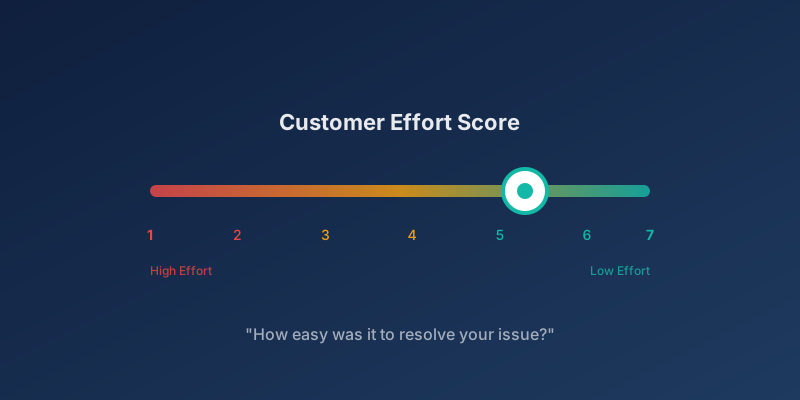
- Customer Effort Score is the right primary metric for onboarding, because early-life churn is driven by friction more than by delight. Pair it with a first-value question and a single open-text field.
- The contrarian part: the highest-risk onboarding survey response is not the low score you follow up on. It is the survey nobody answered, because in B2B a silent new account is usually a stalled one.
Contents9 sections
Most onboarding surveys ask whether the customer finished your setup steps. That is the wrong question. The one that predicts churn is whether they reached value, and how much effort it took to get there.
What is a B2B onboarding survey, and what should it actually measure?
A B2B onboarding survey is a short, triggered survey that captures how a new customer experienced the path from signing to first value, so you can fix friction and flag churn risk before the relationship sets. In B2B that path is rarely a single user clicking through a product tour. It is an implementation with multiple stakeholders, data migration, integrations, and internal change management on the customer's side. The survey has to reflect that reality.
Here is what most teams get wrong. They measure whether onboarding was completed: did the customer finish the setup wizard, attend the kickoff, connect the integration. Completion is easy to instrument and it feels like progress, but it is a vanity metric. The customer who completed every step can still be the one who churns, because your checklist measures your process, not their outcome. The question that predicts retention is different: did they reach the value they bought the product for, and how hard was it to get there?
So an onboarding survey should measure two things above all: effort (how much friction stood between the customer and value) and value (whether they actually reached it). Satisfaction is a distant third, because a customer can be politely satisfied with a smooth onboarding that never delivered the outcome they needed. If you want the fundamentals of choosing a metric, our guide to measuring customer satisfaction covers the trade-offs; this article is about applying them to the one moment that decides early churn.
Why onboarding is where B2B churn is decided
In B2B, a disproportionate share of first-year churn is set in motion during onboarding, long before the cancellation shows up in your CRM. The customer who never reached value in the first weeks does not usually rage-quit. They quietly deprioritise the rollout, the internal champion moves on, usage flatlines, and eleven months later the renewal conversation is already lost. By the time the number turns up in a health dashboard, the decision was made much earlier.
The evidence points the same way. Wyzowl's onboarding research found that 74 percent of potential customers will switch to a competitor if the onboarding process feels too complicated, and that 86 percent say they would stay more loyal to a business that invests in onboarding and ongoing education (Wyzowl, customer onboarding research). Complexity in the first weeks is not a minor annoyance. It is a churn driver in its own right.
This is why onboarding deserves its own measurement, separate from your relational programme. A quarterly relationship survey will eventually tell you an account is unhappy, but "eventually" is too late for a customer who is stalling in week three. The onboarding survey exists to catch the problem inside the window where you can still fix it. It is also the earliest, cleanest input into a customer health score: a poor onboarding signal is the first data point that predicts churn, and it arrives while the account is still winnable.
Why Customer Effort Score beats CSAT for onboarding
For most touchpoints you can argue about which metric to use. For onboarding, the case is clearer than usual: Customer Effort Score should be your primary question. Early-life retention is governed by friction more than by delight. A customer who found it easy to get set up and reach value is far more likely to stick than one who was charmed by your kickoff but then hit a wall at data import.
This is the core finding behind CES. Gartner's CEB research showed that reducing customer effort is a stronger predictor of loyalty than trying to exceed expectations, and that high-effort experiences are what push customers toward disloyalty. Onboarding is the highest-effort phase of the entire relationship, which makes it exactly where effort is worth measuring. Our explainer on Customer Effort Score goes into the mechanics; the practical point here is that "how easy was it to get up and running?" tells you more about renewal odds than "how satisfied are you?" ever will.
That does not mean you ignore satisfaction entirely. It means you rank your questions. Lead with effort, confirm value, and leave satisfaction as context rather than the headline metric. When you do report relational NPS later in the lifecycle, read it against your sector rather than a universal target: our NPS benchmarks by industry show why the same score means something different in every market.
What to actually ask: the four-question onboarding survey
The best onboarding survey is short enough that a busy B2B stakeholder answers it in under a minute, and structured so every answer maps to an action. Four questions do the job. More than that and your response rate falls, which for a new account is a signal you cannot afford to lose.
| # | Question | Metric | What it tells you |
|---|---|---|---|
| 1 | How much effort did it take to get up and running? | CES (1 to 7) | Whether friction is putting the account at risk |
| 2 | Have you reached the outcome you signed up for? | First-value (yes / partly / not yet) | Whether onboarding actually delivered |
| 3 | What was the hardest part of getting started? | Open text | The specific friction to fix, in the customer's words |
| 4 | How likely are you to still be using us in a year? | Forward-looking intent | An early, honest churn signal |
The order matters. Effort first, because it is the strongest predictor and the easiest to answer. Value second, because a low-effort onboarding that still did not deliver is a different problem than a high-effort one that did. The open-text question is where the real diagnostic sits, so keep it and read every answer; it is what turns a score into a fix. The final intent question is deliberately blunt, and in a new B2B account an honest "probably not" is worth more than any satisfaction rating.
Resist the urge to add a fifth and sixth question. Every extra field trades signal for length, and onboarding is precisely when you have the least right to ask for the customer's time. If you want a broader treatment of survey construction, our rules for surveys that deliver real insights apply here in full. If the response rate on this specific survey starts slipping, the general fixes in how to improve your survey response rate apply too, but read the next sections first: for an onboarding survey, a missing response is itself the more urgent signal, not just a metric to optimise in isolation.
When to trigger it: the milestone, not the calendar
The most common onboarding-survey mistake after asking the wrong questions is sending at the wrong time. Teams default to a calendar trigger, "day 30" or "two weeks after kickoff", because it is easy to automate. But onboarding does not run on your calendar. It runs on the customer's implementation, which for a complex B2B rollout might reach value in ten days or ten weeks.
Trigger the survey at the moment of first value, not on a fixed date. First value is the milestone where the customer gets the outcome they bought: the first report that replaces their manual process, the first campaign sent, the first integration live and returning data. Define that milestone per product or per segment, instrument it, and fire the survey within a day of the customer crossing it, while the experience is still fresh. Onboarding is one stage of the wider customer journey, and mapping where value actually lands is what tells you when to ask. In longer, project-based rollouts, pairing the effort question with a short milestone CSAT adds a satisfaction trend across kickoff, go-live and beyond.
There is a second, quieter trigger you should build: the non-event. If an account has not reached the first-value milestone by the point where most accounts do, that is itself the signal. Do not wait for a survey response that will never come. A new account that has gone silent and missed its value milestone is usually a stalled one, and it needs a human reaching out, not another automated email.
Why the non-event trigger usually never fires
The non-event trigger described above sounds simple: treat an account that misses its first-value milestone as a signal in itself. In practice, most teams cannot act on it, because nobody can see where a given account currently stands.
OnRamp's 2026 State of Onboarding Report, based on a survey of 161 customer success and onboarding leaders across B2B SaaS, healthcare tech, logistics and professional services, found that 62 percent of CS leaders lack real-time visibility into customer progress during onboarding, and one in three admit they simply do not know where their customers stand in onboarding at any given time (OnRamp, 2026 State of Onboarding Report, 161 respondents, surveyed Q4 2025). Without that visibility, the non-event trigger is a good idea nobody can execute: there is no system watching the milestone closely enough to notice it was missed.
The same report ties the gap directly to revenue. Fifty-seven percent of leaders say onboarding friction has a direct impact on revenue realisation, and fifty-seven percent of the companies that cut onboarding investment saw churn increase within six months. Visibility is not a nice-to-have layered on top of the survey. It is the infrastructure the survey depends on to mean anything at all.
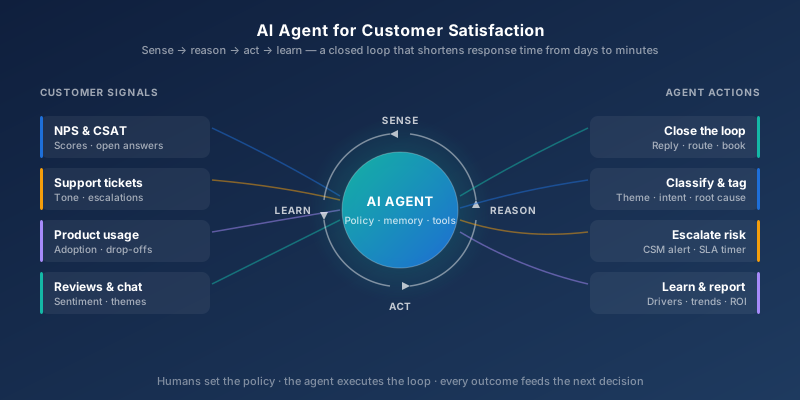
This is also the most concrete place to apply the shift covered in AI agents for customer satisfaction: not to answer the survey for the customer, but to watch milestone data continuously and flag the account the moment it stalls, before a CSM has to remember to check. The same OnRamp report found that 70 percent of CS leaders expect AI to handle half of all onboarding tasks by 2027, including progress summaries, milestone triggers and early risk detection, yet only 26 percent of the SaaS companies in the study are actively investing in onboarding automation today. That gap between expectation and execution is exactly where the non-event trigger keeps failing in practice: the intent to catch a stalled account exists everywhere, the system watching for it usually does not.
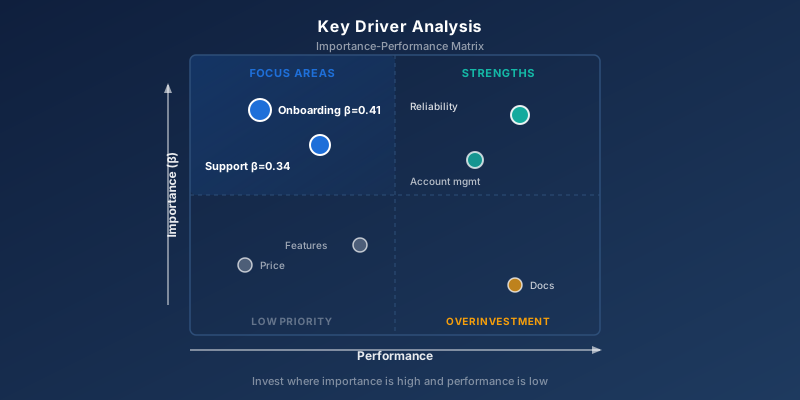
If you want to confirm which onboarding step actually predicts churn in your own accounts, rather than assume it, key driver analysis is the method for finding that out once you have enough completed onboarding cohorts to run it on.
- CS leaders who expect AI to handle half of onboarding tasks by 202770%
- SaaS companies actively investing in onboarding automation today26%
Who to survey: the buyer, not just the button-pusher
In B2B, the person clicking through your setup is often not the person who signed the contract or who decides on renewal. The hands-on admin may be perfectly happy exploring the product while the economic buyer, who cares only about the business outcome, is quietly wondering why nothing has changed yet. Survey only the admin and you will get a reassuring score that hides the risk.
Send the onboarding survey to the stakeholders who define success: the economic buyer and the sponsor, alongside the day-to-day users. You do not need identical questions for each. The buyer answers the value and intent questions; the hands-on user answers the effort and open-text questions, because they lived the friction. Reading both together is what separates "the tool works" from "this is delivering what we paid for", and those are very different statements about renewal risk.
What to do with a low score: close the loop in 48 hours
A low onboarding score is not a data point to log. It is a named customer, at the most fragile moment in the relationship, telling you something is wrong while there is still time to fix it. The value of the survey is entirely in the response, and a response you do not act on is worse than no survey, because you asked and then did nothing.
Set a hard rule: any low-effort score or any "not yet" on value gets a human follow-up within 48 hours, from someone who can actually change the outcome, not a templated apology. Onboarding is early enough that most problems are still solvable, an integration that stalled, a stakeholder who was never trained, a use case that was scoped wrong at the start. This is closing the loop applied to the point of maximum leverage: the same low score is far more recoverable in week three than in month eleven.
Take a hypothetical mid-market client, Nordika A/S. They ran a satisfaction survey 30 days after every kickoff and saw comfortable scores in the low 80s, yet first-year churn stayed stubbornly high. When we replaced it with an effort-and-value survey triggered at first value, and routed every low effort score to the assigned CSM within 48 hours, two things surfaced that the old survey had hidden: a recurring data-import problem that admins had quietly worked around, and a segment of buyers who had never seen the report that justified the purchase. Neither showed up as dissatisfaction. Both showed up as effort and as "not yet" on value. Fixing the import step and adding a buyer-facing value review inside onboarding did more for their retention than any win-back campaign, because it caught the risk while the account was still winnable. For the wider set of moves, see our guide to reducing churn.
From onboarding score to retention system
An onboarding survey on its own is just another number. It earns its place when it feeds two things: a fix and a forecast. The fix is operational, close the loop on every low score, and roll recurring friction back into the onboarding process so the next customer does not hit the same wall. The forecast is strategic, feed the onboarding signal into your health score so a poor start is visible in the renewal picture from day one, not discovered at renewal.
Run it that way and onboarding stops being the phase you hope goes well and becomes the earliest, most actionable churn signal you have. Most B2B companies measure onboarding completion and feel productive. The ones that measure effort and value, at the moment value lands, and act on a low score the same week, are the ones whose first-year retention quietly pulls ahead.
Frequently Asked Questions
Ready to know what your customers actually think?
SurveyGauge helps Nordic B2B companies move from gut feeling to data-driven CX decisions.
SurveyGauge Team
Customer Experience Experts
SurveyGauge-teamet hjælper virksomheder med at måle og forbedre kundetilfredshed via professionelle surveys, analyser og rådgivning.
You might also be interested in
View all articles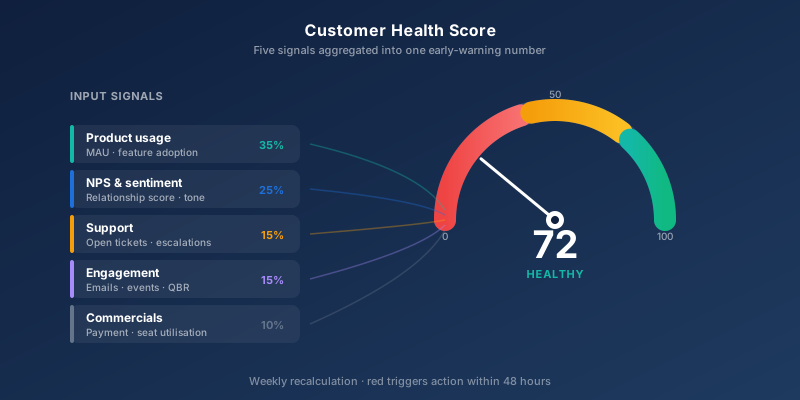
Customer Health Score: Build an Early Warning System for Churn
Customers decide to churn 60-90 days before the cancellation hits your CRM. A Customer Health Score surfaces the signal before you lose them. Here is how to build one that actually works.

How to Reduce Churn: 7 Strategies That Work
Churn is the most expensive problem most B2B companies underestimate. Seven strategies that work, from NPS early warning systems to win-back campaigns, with the CustomerGauge and Bain research behind each one.
What Is CES? Customer Effort Score Explained
Customer Effort Score (CES) measures how hard it was for a customer to get something done. It predicts churn better than satisfaction does.
AI Agents for Customer Satisfaction: From Feedback to Action in Minutes
An AI agent is not a chatbot. It reads feedback, prioritises, acts and learns. Here is how to use one to cut your response time on unhappy customers from days to minutes.
Key Driver Analysis: Find Out What Actually Moves Your NPS
NPS tells you THAT something is wrong. Key driver analysis tells you WHAT. Here is the method that turns a score into a prioritised action plan.