
NPS Benchmarks 2026: What Is a Good NPS Score by Industry?
An NPS of 30 is excellent in telecoms but mediocre in SaaS. See good NPS scores by industry, region and business model for 2026 - and how to read them.
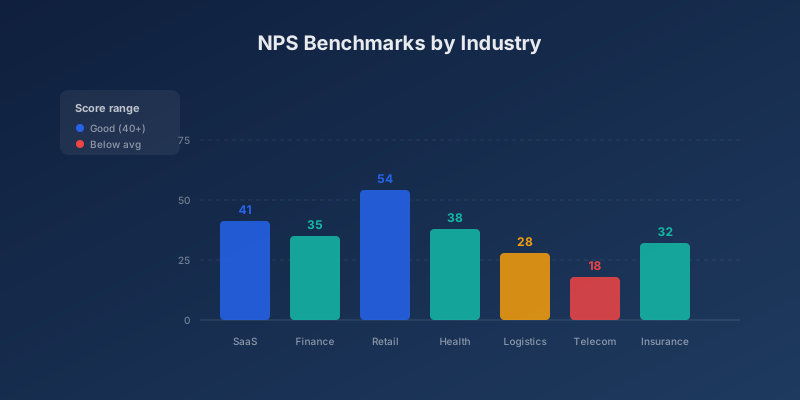
- A 'good' NPS depends on your industry, your region, and your business model. Without that context, the number is meaningless.
- Industry averages range from -15 (cable providers) to +70 (luxury brands). Comparing across industries is a mistake we see constantly.
- B2B typically scores higher than B2C because of closer relationships and managed accounts. However, that does not always mean better actual experience.
- Cultural response bias swings scores by 20-40 points. A Japanese subsidiary at NPS 15 may outperform an American subsidiary at NPS 45.
- Your own trend over time, measured with consistent methodology, is the most reliable benchmark you have.
Contents10 sections
"What is a good NPS?" is the wrong first question. The right first question is: "Good compared to what?"
For example, an NPS of 25 in telecoms is outstanding. The same score in premium SaaS is a concern. Similarly, an NPS of 40 from a Scandinavian customer base represents far stronger loyalty than 40 from an American one. Scandinavian respondents use the top of the scale less freely.
Benchmarks matter. However, only with context. This guide provides 2026 NPS benchmarks by industry, region, and business model. Sources include Bain & Company, Satmetrix (NICE), CustomerGauge, Retently, and Qualtrics XM Institute, alongside guidance on how to use them without misleading yourself. For the at-a-glance benchmark tables across NPS, CSAT and CES, see our industry benchmarks page.
New to NPS? Start with What Is NPS?, then return here. If you want the broader case for why benchmarking satisfaction matters at all, and how CSAT and CES fit alongside NPS, start with what customer satisfaction actually is.
The NPS Scale in Context
NPS ranges from -100 to +100. Here is the general classification:
| Score Range | Classification | Reality Check |
|---|---|---|
| -100 to -1 | Needs improvement | More Detractors than Promoters. But in some industries (utilities, cable), this is the norm. |
| 0 to 30 | Good | Positive. Room to grow, but you are ahead of many competitors. |
| 31 to 50 | Strong | Better than most companies in most industries. |
| 51 to 70 | Excellent | Customers are actively advocating for you. |
| 71 to 100 | World-class | Rare. Apple, Costco, USAA territory. |
These ranges are a starting point. The industry data below shows why they are insufficient on their own.
NPS Benchmarks by Industry (2026)
The following table compiles benchmark data from Bain & Company, Satmetrix, CustomerGauge, and Retently. The ranges reflect the fact that different sources use different methodologies and sample sizes, so we present a realistic range rather than a single number.
| Industry | Average NPS Range | Top Quartile | Notes |
|---|---|---|---|
| Consulting / Professional Services | 40 - 68 | 72+ | Deep client relationships drive high scores. |
| Technology / SaaS | 30 - 55 | 62+ | Varies widely by product maturity and support quality. |
| Retail / E-commerce | 35 - 60 | 65+ | Premium brands outperform discount retailers significantly. |
| Financial Services / Banking | 20 - 45 | 55+ | Digital-first banks tend to score higher than traditional banks. |
| Insurance | 15 - 40 | 50+ | Claims experience is the biggest driver of NPS. |
| Healthcare | 25 - 50 | 58+ | Private healthcare typically outscores public healthcare. |
| Logistics / Shipping | 20 - 40 | 48+ | B2B logistics scores higher than consumer parcel services. |
| Telecommunications | -5 - 20 | 30+ | One of the lowest-scoring industries globally. |
| Airlines | 10 - 35 | 50+ | Low-cost carriers score lower; premium carriers score higher. |
| Hotels / Hospitality | 30 - 55 | 65+ | Luxury segment consistently outperforms budget segment. |
| Automotive | 30 - 50 | 60+ | EV manufacturers are trending higher than legacy OEMs. |
| Utilities / Energy | -10 - 15 | 25+ | Limited choice depresses scores. Renewable energy providers score higher. |
| Internet / Cable Providers | -15 - 10 | 20+ | Consistently the lowest-scoring sector across markets. |
| Education / EdTech | 25 - 50 | 55+ | Live instruction scores higher than pure self-service platforms. |
| Food & Beverage | 30 - 55 | 62+ | Direct-to-consumer brands outperform CPG brands. |
Sources: Bain & Company NPS Prism (2025-2026), Satmetrix Global NPS Benchmarks (2025), CustomerGauge NPS Benchmarks Report (2025), Retently NPS Benchmark Data (2026).
2026 update. Retently's 2026 benchmark, covering thousands of companies, puts the all-industry average NPS at 32 and the median at 44, with every sector it analysed now scoring above zero. Two sectors moved sharply this year: insurance fell from 80 to 46, and healthcare from 53 to 37 (Retently, 2026). Industry averages usually drift slowly, so a double-digit annual swing is a signal that either the methodology or the market shifted. Read year-on-year benchmark movements with the same suspicion you would apply to a 12-point jump in your own score.
- Consulting / Professional ServicesRange 40-6840
- Retail / E-commerceRange 35-6035
- Technology / SaaSRange 30-5530
- Hotels / HospitalityRange 30-5530
- AutomotiveRange 30-5030
- Food & BeverageRange 30-5530
- HealthcareRange 25-5025
- Education / EdTechRange 25-5025
- Financial Services / BankingRange 20-4520
- Logistics / ShippingRange 20-4020
- InsuranceRange 15-4015
- AirlinesRange 10-3510
- TelecommunicationsRange -5 to 20-5
- Utilities / EnergyRange -10 to 15-10
- Internet / Cable ProvidersRange -15 to 10-15
What the data reveals
Four patterns are consistent across the benchmark data:
-
Relationships drive scores. Consulting, professional services, and B2B SaaS report the highest NPS. Dedicated account management and personal support create deeper loyalty. No amount of product quality compensates for feeling like a ticket number.
-
Limited choice depresses scores. Telecoms, utilities, and cable providers score lowest. When customers feel trapped, dissatisfaction accumulates. The service might be adequate, but the perceived lack of alternatives breeds resentment.
-
Premium tiers outperform budget tiers by 30-40 points within the same industry. This does not mean budget brands are failing. It means expectations differ. A budget airline at NPS 15 and a premium airline at NPS 55 may both be meeting their customers' expectations.
-
Digital-native companies are pulling ahead. Neobanks, D2C brands, and cloud-first SaaS outperform traditional counterparts because they iterate on customer experience faster. The gap is widening.
What Actually Drives Your NPS
Ultimately, the number matters less than understanding why it is what it is.
Product reliability
If your product solves a real problem and works consistently, NPS reflects that. Bugs, outages, and quality regressions push respondents into Detractor territory fast.
Support speed and empathy
CustomerGauge's 2025 B2B NPS report found that companies resolving support tickets within 24 hours score 20 points higher on average than those with resolution times over 72 hours. Speed matters. So does the feeling that the support agent genuinely cares.
Ease of doing business
Friction in purchasing, onboarding, billing, or cancellation creates Detractors. Qualtrics XM Institute's 2025 Global Consumer Study found that "ease of use" was the single strongest predictor of NPS across all industries studied. This is where CES measurement complements NPS.
Price-to-value perception
NPS does not just reflect product satisfaction. Additionally, it reflects whether customers believe the value justifies the price. Companies that communicate value well maintain higher NPS even at premium price points.
Employee engagement
Your customer NPS has a ceiling, and your own people often set it. In B2B, a handful of named account managers and support engineers carry the relationship. When they disengage, customers feel it before any survey catches it. Tracking eNPS alongside customer NPS is the cheapest early warning you have for a score that is about to slide.
Survey methodology
When you send the survey, to whom, and how you phrase the question all influence the score. Sending NPS right after a successful onboarding yields higher scores than sending it after a billing dispute. Consistency in methodology is non-negotiable for meaningful trend tracking. For more on survey design: Survey Design Best Practices.
Regional and Cultural Variation
This is the most overlooked factor in NPS benchmarking, and consequently it distorts more cross-border comparisons than any other variable. Bain & Company and Satmetrix have consistently shown that respondents in different countries use the 0-10 scale differently, even with identical satisfaction levels.
Regional tendencies
| Region | Typical NPS Impact | Explanation |
|---|---|---|
| United States | Higher scores (+10 to +20 vs. global mean) | American respondents are more likely to give 9s and 10s. Response style is generally generous. |
| India / South Asia | Higher scores (+10 to +15 vs. global mean) | Cultural tendency toward positive affirmation. High response rates at the top of the scale. |
| Japan / South Korea | Lower scores (-20 to -30 vs. global mean) | Strong cultural aversion to extreme responses. A score of 7 or 8 often represents genuine satisfaction. |
| Northern Europe (Scandinavia) | Slightly lower scores (-5 to -15 vs. global mean) | Reserved response style. Scandinavian respondents view a 7 or 8 as a good score. |
Source: Bain & Company NPS Prism cross-regional analysis (2025), Satmetrix Global Benchmark Study (2025).
What this means for global companies
If your company operates across borders, comparing raw NPS across regions produces misleading conclusions. Therefore, a Japanese subsidiary at NPS 15 may be genuinely outperforming an American subsidiary at NPS 45 once cultural bias is accounted for.
In our experience with Nordic B2B companies operating globally, three practices help:
- Benchmark each region against local industry norms, not a single global target.
- Track trends within each region rather than comparing absolute numbers across geographies.
- Be transparent about cultural bias if you create a global dashboard. Some organisations apply adjustment factors, but this requires careful validation and should be flagged clearly.
B2B vs. B2C: Different Dynamics, Different Scores
B2B and B2C operate under fundamentally different conditions, and their benchmarks reflect this.
Why B2B scores are typically higher
CustomerGauge's 2025 Account Experience report puts the median B2B NPS at approximately 42, versus roughly 28 for B2C. Four factors explain the gap:
- Dedicated account management. A named contact who manages the relationship creates personal connection that lifts scores.
- Higher switching costs. Contracts, integrations, and workflows create stickiness. This can inflate NPS because Detractors are "trapped" rather than genuinely loyal, an important nuance.
- Smaller, more engaged respondent pools. B2B surveys go to known stakeholders. B2C surveys sample broader, less engaged populations.
- Survey timing bias. B2B programmes often survey after business reviews, which are inherently relationship-affirming moments.
One caution before you use any B2B-versus-B2C number: the sources disagree on the direction. CustomerGauge's Account Experience data puts the median B2B NPS around 42, well above a B2C median near 28. Retently's 2026 benchmark shows the reverse, with B2C brands averaging 49 against 38 for B2B. Both are legitimate. They sample different populations and use different survey designs. That contradiction is the whole argument of this article in one line: a benchmark is only as good as the methodology behind it, and cherry-picking the source that flatters you is the fastest way to fool yourself.
B2B Benchmark Examples
| B2B Sector | Typical NPS Range | Top Performers |
|---|---|---|
| Management Consulting | 50 - 75 | McKinsey, Bain (reported 60-80+) |
| Enterprise SaaS | 30 - 55 | Salesforce, HubSpot, ServiceNow (reported 45-65+) |
| Industrial Manufacturing | 25 - 45 | Varies heavily by sub-sector and geography. |
| IT Services / Outsourcing | 20 - 40 | Top performers focus heavily on CSAT for individual engagements. |
| Logistics / Supply Chain | 25 - 45 | Companies with real-time tracking and proactive alerts score highest. |
Sources: CustomerGauge Account Experience Benchmark (2025), Bain & Company B2B NPS data (2025).
B2C Companies with Consistently High NPS
Some consumer brands have built reputations for exceptional NPS over many years:
- Costco: Consistently reported in the 70-80 range. Membership model creates a built-in loyalty dynamic.
- Apple: Typically reported between 60 and 75, driven by ecosystem stickiness and retail experience.
- USAA: Regularly exceeds 75, serving a highly loyal military community with tailored financial products.
- Tesla: Reported between 95 and 97 in early years, though the score has moderated as the customer base has grown.
- Netflix: Historically strong (55-68), though increased competition in streaming has applied downward pressure in recent years.
How Do You Benchmark When You Have 40 Accounts, Not 4,000?
Every benchmark table on this page, including ours, is built on large samples. Retently tracks thousands of companies; CustomerGauge aggregates hundreds of thousands of B2B responses. Your programme probably does not look like that. A typical Nordic B2B company surveys 40, 200, maybe 600 named accounts, and hears back from a fraction of them each quarter. That changes how you should read a benchmark.
With a small base, a single quarter's NPS is unstable. Move three Detractors to Passives and a score of +20 becomes +35. Nothing about the relationships changed. The arithmetic did. Chasing an industry average quarter to quarter, while your own number swings 15 points on sampling noise, is not measurement. It is superstition.
Three habits keep small-n benchmarking honest:
- Use a rolling 12-month score, not a quarterly one. More responses in the window means a more stable number. Report the quarter as a point on a trend line, not a verdict.
- Weight by account value. An NPS where a two-million-kroner account and a twenty-thousand-kroner account count equally does not describe your business. Weight the score by revenue so it moves when the accounts that matter move. That is the core of account-based CX.
- Read the drivers, not the decimal. With 40 accounts you will never have the statistical power to prove a two-point move. You will have the qualitative signal to know why three specific accounts slipped. That is more actionable than any benchmark. Key driver analysis turns those comments into a ranked list.
How wide that uncertainty actually is, and why a finite account base makes it narrower than the standard formulas claim, is worked through in B2B survey sampling with a small n.
The uncomfortable truth: for most B2B companies, the external benchmark is a sanity check, not a target. If your rolling score is climbing and your largest accounts are Promoters, you are winning, regardless of where a benchmark table puts your industry average. For the mechanics of getting a trustworthy score in the first place, see how to measure customer satisfaction.
How to Compare Honestly
Benchmarks are useful. Yet dishonest benchmarking is worse than no benchmarking. Five principles:
- Compare within your industry. NPS 30 is excellent in telecoms. Below average in SaaS. Start with your own industry's range.
- Match the methodology. Relational NPS (periodic, full customer base) and transactional NPS (event-triggered) are not comparable. Transactional runs 10-15 points higher because it captures satisfaction at a moment of engagement. Only compare like with like. For a deeper look at when to use each and why the two scores are never on the same scale, see transactional vs. relational NPS.
- Account for customer segment. Enterprise, mid-market, and SMB customers have different NPS profiles. If your benchmark source skews toward enterprise and your data skews toward SMB, the comparison is misleading.
- Adjust for region. A Nordic company comparing against US-centric benchmarks will always look artificially low. Compare against regional norms.
- Trust your own trend first. Your NPS over time, measured with consistent methodology, is more reliable than any external benchmark. Is the trend improving, stable, or declining? That signal matters more than whether you are above or below an industry average from a study you did not participate in.
How well you read a benchmark is itself a maturity signal. See where your programme sits on the CX maturity model.
For choosing the right metrics for your programme: NPS vs. CSAT vs. CES.
From Benchmarks to Action
Knowing where you stand is step one. In contrast, improving is everything after that. A benchmark gap is also the easiest thing to translate into money: CustomerGauge puts a 10-point NPS gain at roughly 3.2% additional upsell revenue, and customer satisfaction and revenue shows how to turn that into a funded business case rather than a slide.
Diagnose the drivers
Pair your NPS survey with one open-text follow-up: "What is the main reason for your score?" Analyse responses to find the top three to five themes driving Detractor and Promoter feedback.
Close the loop
Respond to Detractors within 48 hours. CustomerGauge's research shows that closing the loop on all feedback within 48 hours increases retention by 12% and lifts NPS by an average of 6 points (CustomerGauge, 2026). Promoters deserve attention too: thank them and ask for referrals or testimonials.
Set realistic targets
If your industry average is 25 and you are at 18, aim for 28 next year, not 50. Incremental improvement sustained over time beats an unrealistic target that demoralises the team.
Share the data
NPS is not a CX team metric. Share it across product, sales, support, and leadership. Cross-functional visibility drives cross-functional improvement.
What We See Go Wrong
Even experienced CX teams make these mistakes with benchmarks:
- Cherry-picking. Choosing the benchmark source that makes your score look best. Use multiple sources and acknowledge the range.
- Ignoring response rates. A score based on 5% response rate is noise, not data. Below 30%, treat the score as directional only.
- NPS as the only metric. NPS measures advocacy intent. It does not capture effort, touchpoint satisfaction, or emotional connection. Pair it with CSAT and CES.
- Benchmarking without action. Knowing you are 10 points below the average is useless if you do not investigate why.
- Gaming the score. Survey timing manipulation, only surveying happy customers, asking for high scores. All of these produce data that is worse than no data, because it creates false confidence.
What NPS Leaders Do Differently
Research from Bain & Company's NPS Loyalty Forum and the Qualtrics XM Institute consistently identifies these practices:
- They treat NPS as a system, not a score. Closed-loop feedback, root cause analysis, organisational accountability. The number is an input to a management process, not a destination.
- They act on the verbatim comments. The qualitative feedback is where actionable insight lives. Leading companies invest in systematic text analysis.
- They segment everything. Product line, customer tier, region, touchpoint. The aggregate hides the signal.
- They benchmark internally first. Comparing your best-performing product or region against your worst is more actionable than comparing against an external average.
- They invest in Promoters. Not just fixing Detractor problems. Actively leveraging Promoters through referral programmes, advocacy boards, and community building.
Benchmarks give you context. Action gives you results. Start with What Is NPS? if you are setting up your programme, or explore our pricing if you are ready to measure.
Frequently Asked Questions
Ready to know what your customers actually think?
SurveyGauge helps Nordic B2B companies move from gut feeling to data-driven CX decisions.
SurveyGauge Team
Customer Experience Experts
SurveyGauge-teamet hjælper virksomheder med at måle og forbedre kundetilfredshed via professionelle surveys, analyser og rådgivning.
You might also be interested in
View all articles![What Is NPS? The Complete Guide to Net Promoter Score [2026]](/img/knowledge/nps.svg)
What Is NPS? The Complete Guide to Net Promoter Score [2026]
NPS is the most widely used loyalty metric in the world, and also the most frequently misused. Indeed, the score means nothing without follow-up. Here is how to use it properly.
NPS vs. CSAT vs. CES: Which Metric Should You Choose?
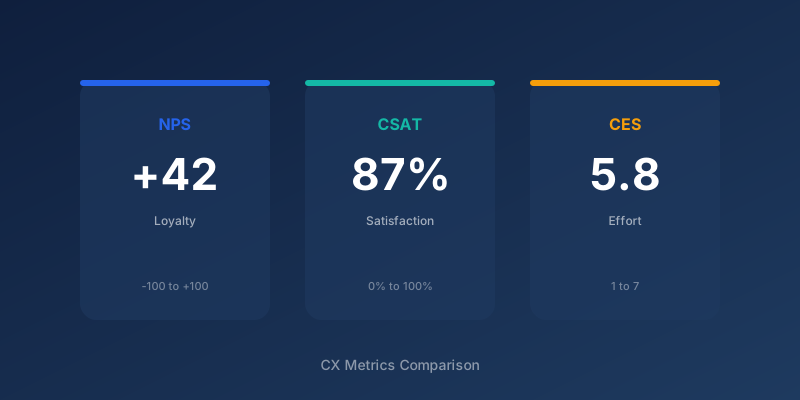
NPS, CSAT, and CES measure different things, and the real question in 2026 is not which one wins. It is when to layer a second metric on top of NPS, and when adding one just adds noise.
Getting Started with NPS: A 5-Step Implementation Guide
NPS only delivers value when it is implemented as a system, not just a metric. Therefore, here are the five steps we recommend, based on what we see working in practice.