TL;DR
- The generic NPS question is fine. But a question that references the specific interaction gets 10-20% better response rates and far more actionable open-text feedback
- Specifically, one follow-up question per segment. Promoters: what do you value? Detractors: what needs fixing? Passives: what would make us exceptional? Generic 'why' questions waste the opportunity
- Indeed, most programmes use the same question everywhere. That's lazy. A post-support NPS and a renewal NPS measure different things and should be worded differently
- A/B test quarterly. Change one variable at a time. Your first version is almost never your best
Contents15 sections
"How likely are you to recommend us?" Seems simple enough. Among the companies we work with, the pattern is clear. Specifically, those who tailor the NPS question to the specific context get dramatically better data than those using one generic question everywhere.
Moreover, the difference isn't subtle. A post-support NPS that references the support interaction gets 15-20% higher response rates and far more specific open-text feedback than a generic brand health question. In addition, the follow-up question matters even more. Asking a Detractor "why did you give that score?" wastes the chance to ask "what is the single biggest thing we should fix?"
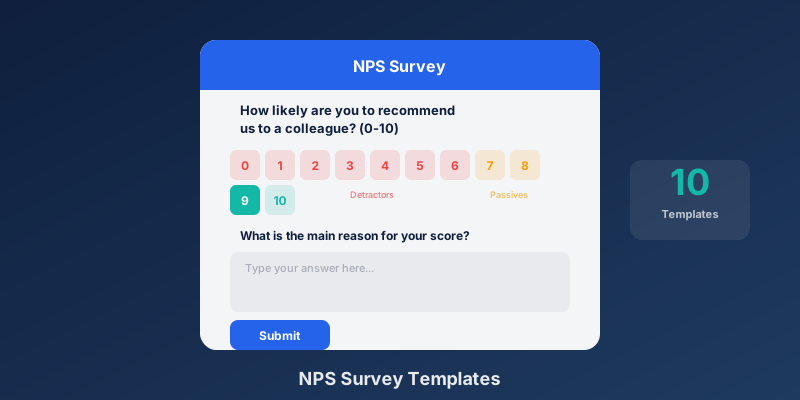
Ten templates below, each tested across our client base. Pick the ones that match your touchpoints. If you are new to NPS, start with our Getting Started with NPS guide. For the fundamentals, see What is NPS?.
1. Relationship NPS (Overall Brand Health)
The relationship NPS is the classic formulation. It measures overall loyalty independent of any specific transaction and is typically sent on a quarterly or biannual schedule.
Copy-paste question:
On a scale of 0 to 10, how likely are you to recommend [Company Name] to a friend or colleague?
Follow-up questions by segment:
- Promoters (9-10): "We're glad to hear that! What do you value most about working with us?"
- Passives (7-8): "Thank you for your feedback. What would we need to do to earn a higher score from you?"
- Detractors (0-6): "We're sorry to hear that. What is the single biggest thing we could improve?"
2. Transactional NPS (Post-Purchase)
This template captures sentiment immediately after a purchase, while the experience is still fresh. As a result, the specificity of referencing "your recent purchase" increases both relevance and response rates.
Copy-paste question:
Based on your recent purchase, how likely are you to recommend [Company Name] to a friend or colleague? (0-10)
Follow-up questions by segment:
- Promoters (9-10): "Wonderful! What made your purchase experience stand out?"
- Passives (7-8): "Thanks for your response. Was there anything about the purchase process that could have been smoother?"
- Detractors (0-6): "We appreciate your honesty. What part of the purchase experience fell short of your expectations?"
3. Post-Support NPS
Support interactions are critical moments of truth. This template ties the NPS question directly to the support experience, giving your team actionable data on service quality.
Copy-paste question:
Following your recent support experience, how likely are you to recommend [Company Name] to a friend or colleague? (0-10)
Follow-up questions by segment:
- Promoters (9-10): "Great to hear! What did our support team do particularly well?"
- Passives (7-8): "Thank you. What could our support team have done differently to make your experience even better?"
- Detractors (0-6): "We're sorry your experience wasn't up to standard. What was the main issue with the support you received?"
4. Post-Onboarding NPS
The onboarding phase sets the tone for the entire customer relationship. This template captures first impressions and identifies friction points before they become ingrained dissatisfaction.
Copy-paste question:
Now that you have completed onboarding, how likely are you to recommend [Company Name] to a friend or colleague? (0-10)
Follow-up questions by segment:
- Promoters (9-10): "Fantastic! What part of the onboarding process was most helpful for getting you started?"
- Passives (7-8): "Thanks for the feedback. What would have made your onboarding experience smoother or more complete?"
- Detractors (0-6): "We want to make this right. What was the biggest challenge you faced during onboarding?"
5. Post-Event NPS
Events, whether webinars, conferences, workshops, or training sessions, represent concentrated experiences. This template captures attendee sentiment while the event is still top of mind.
Copy-paste question:
How likely are you to recommend [Event Name] to a friend or colleague? (0-10)
Follow-up questions by segment:
- Promoters (9-10): "Glad you enjoyed it! Which session or aspect of the event was most valuable to you?"
- Passives (7-8): "Thanks for attending! What would make you more likely to recommend this event next time?"
- Detractors (0-6): "We appreciate your candid feedback. What was the main disappointment or area for improvement?"
6. Renewal NPS
The renewal moment is a natural point to gauge loyalty. Consequently, customers who are about to renew or have just renewed are actively evaluating their relationship with you, making their feedback especially meaningful.
Copy-paste question:
As you approach your renewal, how likely are you to recommend [Company Name] to a friend or colleague? (0-10)
Follow-up questions by segment:
- Promoters (9-10): "That's great to hear! What has delivered the most value for you over the past contract period?"
- Passives (7-8): "Thank you. What would increase the value you get from [Company Name] in the next period?"
- Detractors (0-6): "We want to understand your concerns. What has been the biggest gap between your expectations and your experience?"
7. B2B Account-Level NPS
B2B relationships involve multiple stakeholders with different perspectives. This template is designed for enterprise and mid-market accounts where the "recommend" concept applies to the business relationship as a whole.
Copy-paste question:
Considering your organization's overall experience, how likely are you to recommend [Company Name] to a peer in your industry? (0-10)
Follow-up questions by segment:
- Promoters (9-10): "Thank you! What aspect of our partnership has delivered the most impact for your organization?"
- Passives (7-8): "We appreciate your input. What would strengthen our partnership from your perspective?"
- Detractors (0-6): "Your feedback is important to us. What is the primary area where we are falling short of your organization's needs?"
8. Product-Specific NPS
When you offer multiple products or services, a single NPS question cannot capture the nuance. Therefore, this template isolates feedback for a specific product, making it clear what the customer is evaluating.
Copy-paste question:
How likely are you to recommend [Product Name] to a friend or colleague? (0-10)
Follow-up questions by segment:
- Promoters (9-10): "Awesome! What feature or aspect of [Product Name] do you find most valuable?"
- Passives (7-8): "Thanks for your feedback. What feature or improvement would make [Product Name] a must-have for you?"
- Detractors (0-6): "We want to improve. What is the biggest limitation or frustration you experience with [Product Name]?"
9. Employee Referral NPS (eNPS)
Employee NPS applies the same methodology internally. In particular, it measures how likely employees are to recommend your company as a place to work, serving as a powerful indicator of engagement and culture.
Copy-paste question:
How likely are you to recommend [Company Name] as a great place to work to a friend or former colleague? (0-10)
Follow-up questions by segment:
- Promoters (9-10): "That's wonderful! What do you value most about working here?"
- Passives (7-8): "Thanks for your honest response. What one change would make your work experience significantly better?"
- Detractors (0-6): "We take this seriously. What is the primary reason you would hesitate to recommend us as an employer?"
10. Competitive Benchmark NPS
This template adds a competitive dimension by asking customers to evaluate you relative to alternatives. Additionally, it surfaces differentiation strengths and competitive vulnerabilities that a standard NPS question might miss.
Copy-paste question:
Compared to other solutions you have used, how likely are you to recommend [Company Name] to a friend or colleague? (0-10)
Follow-up questions by segment:
- Promoters (9-10): "Great! What sets [Company Name] apart from other options you have considered or used?"
- Passives (7-8): "Thank you. In which areas do you feel competing solutions outperform us?"
- Detractors (0-6): "We appreciate your honesty. What does a competitor do better that you wish we would match or exceed?"
A/B Testing Your NPS Questions: A Practical Framework
Choosing the right template is only the beginning. Furthermore, continuous optimization through A/B testing ensures your NPS program improves over time. Here is a framework you can apply to any template in this guide.
What to Test
- Question framing: Change the introductory context (e.g., "Based on your recent experience" vs. "Thinking about the past 3 months")
- Recommendation target: "Friend or colleague" vs. "someone in your network" vs. "a peer"
- Follow-up wording: Open-ended ("Why did you give that score?") vs. directed ("What is the single biggest thing we could improve?")
- Survey timing: Hours vs. days after the trigger event
- Personalization level: Generic vs. including customer name, product name, or agent name
How to Run a Valid Test
- Randomize: Split your audience randomly, not by segment or geography
- Equal groups: Ensure both variants reach a statistically comparable audience
- Sufficient volume: Aim for at least 100 responses per variant before drawing conclusions
- Single variable: Change only one element at a time
- Full cycle: Run the test for at least one complete survey cycle to account for timing effects
What to Measure
- Response rate: Did more people complete the survey?
- Score distribution: Did the mean or distribution shift significantly?
- Open-text quality: Did you receive more specific, actionable feedback?
- Completion rate: Did fewer people abandon the survey midway?
For more strategies on boosting participation, see our guide on how to improve survey response rates.
Template Comparison Table
| # | Template | Trigger/Timing | Best For | Key Differentiator |
|---|---|---|---|---|
| 1 | Relationship NPS | Quarterly/biannual schedule | Brand health tracking | Broad, trend-oriented |
| 2 | Post-Purchase NPS | 24-48h after purchase | E-commerce, retail | Transaction-specific |
| 3 | Post-Support NPS | 1-2h after ticket resolution | Service quality | Immediate feedback loop |
| 4 | Post-Onboarding NPS | 1-3 days after onboarding | SaaS, services | First impression capture |
| 5 | Post-Event NPS | Within 24h of event | Events, webinars | Experience-specific |
| 6 | Renewal NPS | 30-60 days before renewal | Subscription businesses | Retention-focused |
| 7 | B2B Account NPS | Quarterly for key accounts | Enterprise, mid-market | Multi-stakeholder view |
| 8 | Product-Specific NPS | After 30 days of usage | Multi-product companies | Product-level granularity |
| 9 | Employee NPS (eNPS) | Monthly/quarterly pulse | HR, culture teams | Internal engagement |
| 10 | Competitive Benchmark NPS | Annually | Competitive markets | Differentiation insight |
How to Choose the Right Template
Selecting the right template comes down to three questions:
-
What is the goal? If you want to track overall loyalty, use the Relationship NPS (#1). If you want to optimize a specific touchpoint, use the corresponding transactional template (#2-6).
-
Who is the audience? B2B accounts with multiple stakeholders need the Account-Level template (#7). Employees need the eNPS template (#9). End consumers respond best to simpler, transaction-linked questions.
-
What will you do with the data? If product teams need to act on the feedback, use the Product-Specific template (#8). If you need competitive intelligence, the Benchmark template (#10) surfaces that directly.
Most mature NPS programs use 2 to 4 templates simultaneously: one relationship NPS for overall tracking, plus 1 to 3 transactional variants for key touchpoints.
Common Mistakes to Avoid
Mistake 1: Using the same generic question everywhere. A customer who just had a support interaction and receives a generic "How likely are you to recommend us?" question does not know what they are evaluating. Specificity drives quality.
Mistake 2: Asking too many follow-up questions. The NPS survey should take under 60 seconds. One score, one follow-up. Anything more and your completion rates will suffer. If you need more data, use a separate, longer survey for a subset of respondents.
Mistake 3: Ignoring the follow-up question design. The open-text follow-up is where the real insight lives. A generic "Why?" is less effective than a segment-tailored question that guides the respondent toward actionable feedback.
Mistake 4: Never testing your question wording. The first version you deploy is almost never the best. Commit to testing at least one element per quarter.
Mistake 5: Forgetting to close the loop. No template in the world matters if you do not act on the feedback. Every Detractor response should trigger a follow-up workflow. Learn more about building a complete NPS program in our Getting Started with NPS guide.
Next Steps
You now have 10 proven NPS question templates ready to deploy. Here is how to move forward:
-
Pick your starting template. If you do not have an NPS program yet, start with the Relationship NPS (#1) and one transactional variant that matches your most important customer touchpoint.
-
Set up your survey tool. Configure the question, follow-up logic, and distribution triggers.
-
Plan your A/B test. Choose one element to test in your first cycle.
-
Build your close-the-loop workflow. Define who follows up with Detractors, within what timeframe, and with what authority to resolve issues.
-
Review and iterate. After your first full cycle, review response rates, score distribution, and feedback quality. Adjust your template choice and wording based on what you learn.
Ready to launch your NPS program with these templates? Explore our pricing plans or get in touch with our team to discuss which setup fits your organization best.
Frequently asked questions
Can I change the NPS question wording without breaking the methodology?
Yes - and you should. Keep the 0-10 scale and the core 'likelihood to recommend' concept. Everything else is fair game: what you ask them to recommend, the context you add, the framing. Furthermore, in our experience, contextualised questions outperform generic ones consistently.
Should I use the same NPS question for all touchpoints?
No. That's one of the most common mistakes we see. A customer who just had a support interaction needs context. For example, a generic 'how likely are you to recommend us' leaves them unsure what they're evaluating. Instead, reference the specific experience. It makes the data actionable and shows customers you care about their particular situation.
How many follow-up questions should I include after the NPS score?
One open-ended follow-up question is the sweet spot. Two is acceptable if the second is a quick multiple-choice. Going beyond two follow-ups significantly increases survey abandonment. The single most important follow-up is asking 'why' they gave that score. Ideally, tailor the wording to their segment (Promoter, Passive, or Detractor).
What is the difference between relationship NPS and transactional NPS?
Relationship NPS measures overall loyalty and is sent on a regular schedule (quarterly or biannually) independent of any specific interaction. Transactional NPS is triggered by a specific event like a purchase, support call, or onboarding session. Most mature programs use both: transactional to optimize individual touchpoints, and relationship to track overall brand health.
How do I A/B test NPS questions without skewing my trend data?
Split your audience randomly into equal groups and run both variants simultaneously for at least one full survey cycle. Compare response rates, score distributions, and the quality of open-text feedback. Once you pick a winner, switch fully to that variant. Keep a log of when you changed wording so you can account for it in trend analysis.
Should the follow-up question be different for Promoters, Passives, and Detractors?
Absolutely. Promoters should be asked what they value most (so you can reinforce it). Detractors should be asked what needs to improve (so you can fix it). Passives should be asked what would make their experience exceptional (so you can convert them). Generic follow-ups miss the opportunity to gather segment-specific insights.
Is it okay to add demographic or firmographic questions to an NPS survey?
Keep the NPS survey itself short: the score question plus one follow-up. If you need demographic data, pull it from your CRM or customer database rather than adding questions. Every additional question reduces completion rates by roughly 5-10%. If you absolutely must ask, place extra questions after the NPS follow-up and make them optional.

Written by
SurveyGauge Team
The advisors and developers behind SurveyGauge. We run customer satisfaction programmes for B2B companies, from 20 key accounts to global banks.