
CX in Financial Services: Banking, Empathy, and Personalization
Banking ranks 4th globally in KPMG's benchmark, but that ranking is built on retail interactions. CustomerGauge's 2026 NPS data tells a different story for B2B: banking specifically sits at 30, well below the sector average of 44, and relationship-driven sub-sectors consistently outperform it.
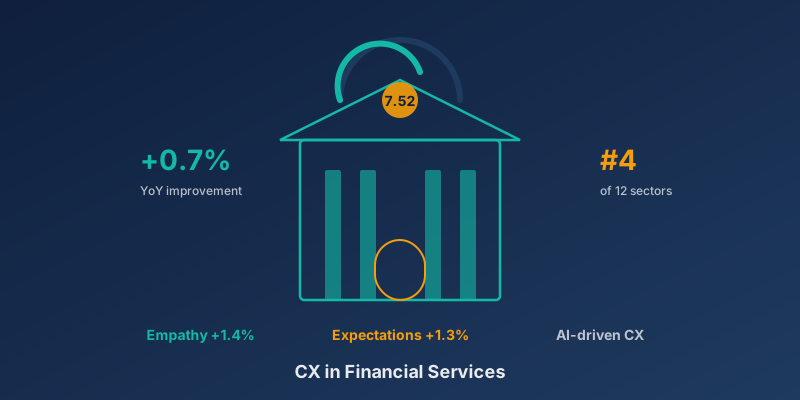
- Banking scores 7.52 in KPMG's global CEE benchmark, ranking 4th out of 12 sectors - but that score is built mostly on retail and consumer interactions.
- The sector improved 0.7% year-over-year, primarily driven by Empathy (+1.4%) and Expectations (+1.3%), not technology.
- CustomerGauge's 2026 NPS benchmark tells a more specific story for B2B: banking's NPS sits at just 30 (down from 37), well below the financial services average of 44 - while relationship-driven sub-sectors like private banking and wealth management consistently outperform retail.
- For B2B financial services, the deciding loyalty driver is not the app. It is whether the same relationship manager who onboarded the account is still the one picking up the phone two years later.
Contents9 sections
Financial institutions operate in one of the most regulated and competitive markets. Customers expect more than correct transaction handling: they expect trust, relevance, and an experience that feels personal. KPMG's Global Customer Experience Excellence 2025-2026 report gives us precise data on where the sector stands, and CustomerGauge's 2026 financial services NPS benchmarks add a second, more specific data point for B2B financial services providers.
Banking: The 4th Best Sector Globally
With a CEE score of 7.52, banking ranks as the 4th best sector in KPMG's global benchmark, surpassed only by Healthcare (7.90), Non-Grocery Retail (7.65), and Grocery Retail (7.54). The score is built from the same six dimensions the whole benchmark rests on, which we walk through in the six pillars of customer experience.
It's a strong position. But the interesting part is what drives the improvement, and, as the next section shows, what the ranking does not tell you if you sell to businesses rather than consumers.
- Healthcare7.9
- Non-Grocery Retail7.65
- Grocery Retail7.54
- Banking4th globally, +0.7% YoY7.52
Empathy and Expectations: The Surprising Drivers
Banking improved 0.7% year-over-year. The two primary drivers were:
- Empathy: +1.4% - the largest improvement across all pillars
- Expectations: +1.3% - the second-largest improvement
In a sector often associated with digital transformation and technological innovation, it's the human dimensions that drive the greatest progress.
What Does Empathy Mean in Banking?
Empathy in banking means:
- Understanding the customer's financial situation and concerns
- Communicating with respect and understanding, especially in vulnerable situations (debt, loss, complex decisions)
- Proactively offering solutions that match the customer's life situation, not just the bank's product catalogue
- Demonstrating that the bank acts in the customer's interest, not just its own
What Does Expectations Management Mean?
Expectations is about:
- Clear communication about what the customer can expect (response times, processes, terms)
- Proactive information when something changes
- Consistent delivery across digital and physical channels
- Exceeding expectations in the moments that matter
What We See in Practice
Among the financial institutions we work with across the Nordics, three patterns show up consistently.
The best combine digital efficiency with personal engagement. They use technology to remove friction, and reinvest the time it frees up in deeper customer relationships.
The middle group has invested in technology but is missing the human dimension. They have good apps and fast processes, but customers don't feel understood.
The weakest do neither. No digital efficiency, no personal empathy - and, predictably, no loyalty.
Banking as an Early AI Adopter
Financial institutions are among the first to adopt AI at scale. The report highlights:
- Fraud detection: AI-driven real-time fraud prevention
- Hyper-personalization: AI-based product recommendations and offers
- Risk management: Advanced models for credit scoring and customer segmentation
For example, an Australian bank reported a 40% jump in engagement after deploying an AI-powered "customer brain" across 75% of all interactions.
But Infrastructure Lags Behind
KPMG notes that only 25% of banks have enterprise-wide cloud or hybrid-cloud platforms strategically supporting data-driven services. The majority still struggles with data silos, legacy systems, and fragmented customer views. AI cannot compensate for weak infrastructure, and it cannot replace empathy.
Common Mistakes in Financial Services CX
- Focusing on digitalization without a human anchor. The app is excellent, but when a customer calls with a real problem, the experience is mediocre.
- Treating NPS as the only metric. NPS tells you that something is wrong. It doesn't tell you what. Measure the underlying dimensions too: trust, empathy, expectations. Key driver analysis is the method for this.
- Collecting feedback without follow-up. Data gets collected, dashboards get built, but nobody contacts the dissatisfied customer. See close the loop and why it's the discipline that actually moves the score.
- Giving frontline employees no mandate. Employees without the authority to solve problems can't deliver empathy. They can only follow the script.
Why the KPMG Ranking Doesn't Tell the Whole Story for B2B Financial Services
Here's the counterintuitive part. KPMG's CEE benchmark measures experience quality across six dimensions, largely from consumer and retail interactions: someone opening a savings account, disputing a card charge, or applying for a mortgage online. That's a real and useful measurement. It's also close to irrelevant if your financial services business sells to other businesses.
CustomerGauge's 2026 financial services NPS benchmarks tell a more specific story. The average NPS across financial services is 44. Banking specifically sits at just 30, down from 37 the year before, well below that sector average, while the sector's top performer, USAA, reaches 75. Meanwhile, according to CustomerGauge's own analysis, benchmarks vary significantly by sub-sector: retail banking typically runs lower than private banking or wealth management, where relationship quality is a primary driver of loyalty, not app design.
These two data points measure different things (KPMG measures experience quality, CustomerGauge measures loyalty outcomes), so treat them as complementary, not identical. But they point in the same direction: the closer a financial services relationship is to B2B and account-based, the less a generic "banking" ranking tells you, and the more the actual driver is relationship continuity at the account level, not the mobile app.
If you run CX for a commercial bank, a corporate leasing or factoring business, or a B2B wealth management arm, don't benchmark against banking's overall 30. Benchmark against the sub-sector where relationship depth is the norm, and treat the retail average as a floor, not a target. Also see NPS benchmarks by industry for how this plays out across other B2B sectors.
- BankingDown from 37 the year before30
- Financial services average44
- USAA (top performer)75
What the Best Financial Institutions Do Differently
Based on the report's findings, we can identify five characteristics of CX-leading banks:
1. They Combine Digital Efficiency with Personal Engagement
Technology removes friction, but it doesn't replace human connection. The best banks use AI to free up time, which employees invest in deeper customer relationships.
2. They Measure Broader Than NPS
NPS is important, but it's not enough. CX leaders measure the underlying dimensions (trust, empathy, expectations) to understand what drives the score.
3. They Act Systematically on Feedback
Collecting data isn't enough. The best companies have designed processes for Close the Loop: systematic follow-up that ensures feedback leads to concrete improvements.
4. They Invest in Employee Empowerment
Total Experience is about connecting customer and employee experience. Banks that give frontline employees autonomy, tools, and insight perform better on empathy and resolution.
5. They See CX as a Growth Discipline, Not a Support Function
CX leaders in banking have elevated customer satisfaction from a support metric to a strategic KPI with direct connection to revenue and growth. For a broader view of how AI is reshaping that connection across sectors in 2026, see AI and Customer Experience in 2026.
What This Means for Financial Institutions
SurveyGauge works with financial institutions across the Nordics on exactly this kind of programme. Based on KPMG's and CustomerGauge's findings, we recommend:
Prioritize Empathy in Your CX Programme
Empathy is the pillar driving the largest improvement in banking globally. Measure it explicitly, and use insights to train and equip your customer-facing teams.
Build a Coherent Customer View
Personalization requires data flowing across systems. SurveyGauge's CRM/ERP integrations and open API create the foundation for a unified customer view.
Benchmark Against Your Sub-Sector, Not the Retail Average
If your financial services business is B2B or relationship-driven, don't measure yourself against banking's blended average. Measure against the sub-sector where relationship depth is the norm.
Make Close the Loop a Core Discipline
Resolution is a strong NPS driver. Automate follow-up with dissatisfied customers, and ensure feedback always leads to action.
How SurveyGauge Helps Financial Institutions
Our model of Platform + Administration + Advisory is built for complex, regulated enterprises:
- Compliance-ready: Full GDPR compliance, secure data processing, audit trails
- Multi-entity support: Measure across business units, markets, and legal entities
- AI-powered analysis: Sentiment analysis and pattern recognition in open-ended responses
- Dedicated advisory: CX experts with financial sector experience
- Minimal internal burden: We handle the entire operational process
Sources: KPMG Global Customer Experience Excellence 2025-2026, "Total Experience: Redefining excellence in the age of agentic AI"; CustomerGauge, "Financial Services NPS Benchmarks: 27 Bank Scores (2026)" and "NPS Use Case for Financial Services Companies" (2026).
Frequently Asked Questions
Ready to know what your customers actually think?
SurveyGauge helps Nordic B2B companies move from gut feeling to data-driven CX decisions.
SurveyGauge Team
Customer Experience Experts
SurveyGauge-teamet hjælper virksomheder med at måle og forbedre kundetilfredshed via professionelle surveys, analyser og rådgivning.
You might also be interested in
View all articles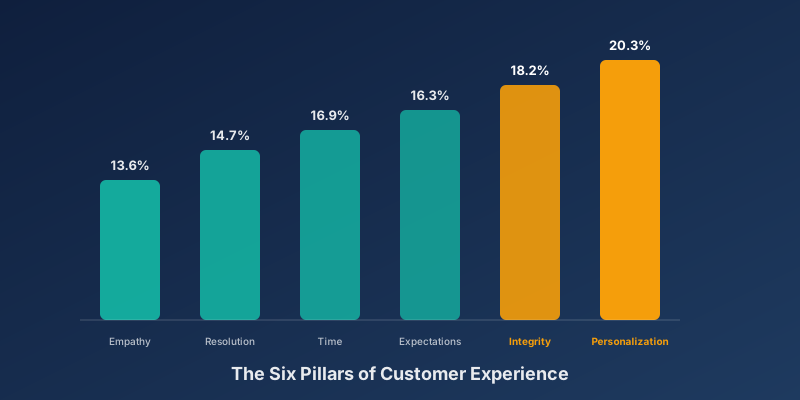
The 6 Pillars of Customer Experience: What Drives Loyalty and NPS
KPMG's Customer Experience Excellence report identifies six universal drivers behind NPS and loyalty, weighted from 80,594 interviews. Integrity and Personalization combined drive 39% of loyalty, and B2B buying committees make Personalization structurally harder than in B2C.
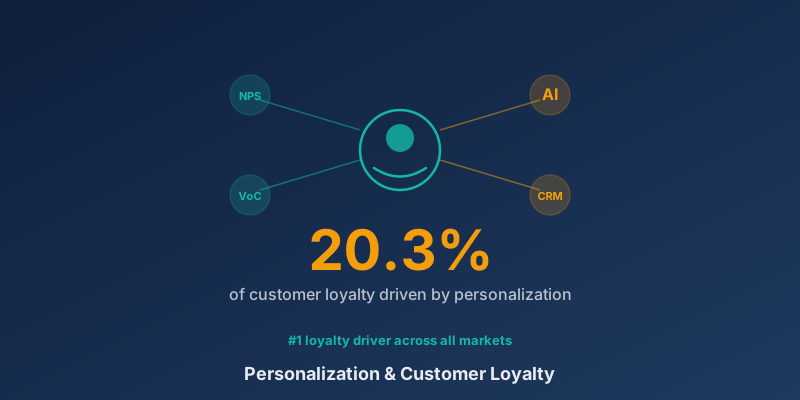
Personalization Drives 20% of Customer Loyalty: What It Means for Your CX Strategy
Personalization drives the single largest share of customer loyalty in KPMG's global CX benchmark. But Gartner's 2025 data shows it backfires for over half of customers when it feels like surveillance rather than help. Here is how to get it right in B2B.
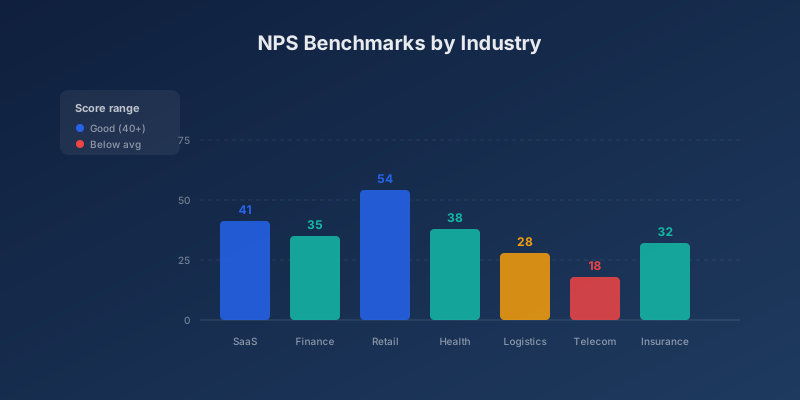
NPS Benchmarks 2026: What Is a Good NPS Score by Industry?
An NPS of 30 is excellent in telecoms but mediocre in SaaS. See good NPS scores by industry, region and business model for 2026 - and how to read them.
Account-Based CX: Run Your Feedback Programme on the Accounts That Pay the Bills
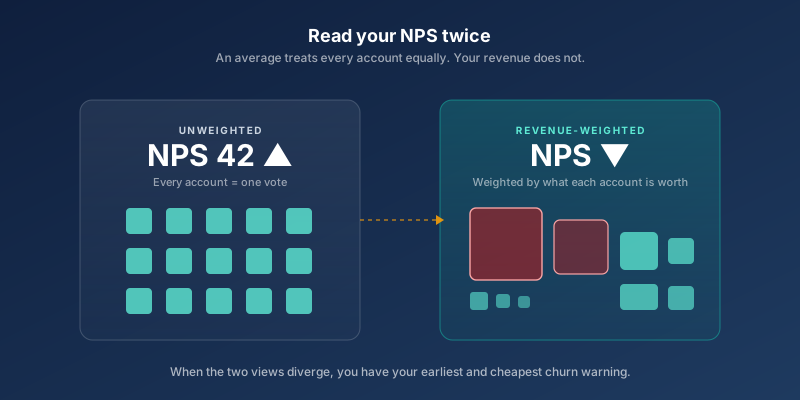
In most B2B companies a small share of accounts carries most of the revenue, yet every account gets the same survey and the same weight in the score. Account-based CX fixes that mismatch: weight feedback by account value, survey the whole buying group, and tier your follow-up.